
In a striking opinion piece published Wednesday, The Federalist’s editors argue that American society has reached a dark inversion of moral priorities: we increasingly treat animals like children and children like animals. The piece, titled “In Our Modern Dystopia, We Treat Animals Like Children and Children Like Animals,” points to recent news events and cultural trends to make its case, drawing on the Baby Gabriel surrogacy dispute, Massachusetts’ new unlimited abortion law, and a surge in pet spending.
The article opens with the saga of McKenna West, a surrogate mother who refused a biological parents’ demand to abort the baby she was carrying after prenatal tests revealed a heart condition. The parents, Nausheen Gilkar and Omar Ahmed, reportedly tried to force the abortion, but West refused and eventually won a court order requiring them to provide life-saving heart surgery for the child, now named Rumi. The baby “is now recuperating under the loving care of his parents and his heroic team of doctors, nurses, and medical staff,” according to the parents’ attorney, though The Federalist notes the definition of “loving” is complicated given the parents’ earlier actions.

The piece argues that Gilkar and Ahmed treated their son “as something less than human once they found out he was less healthy than they expected,” comparing the baby-acquisition process to “shopping for a goldendoodle” — the consumer simply moves on (or, in this case, demands a refund) when the product doesn’t meet expectations.
A Broader Pattern: Abortion Until Birth
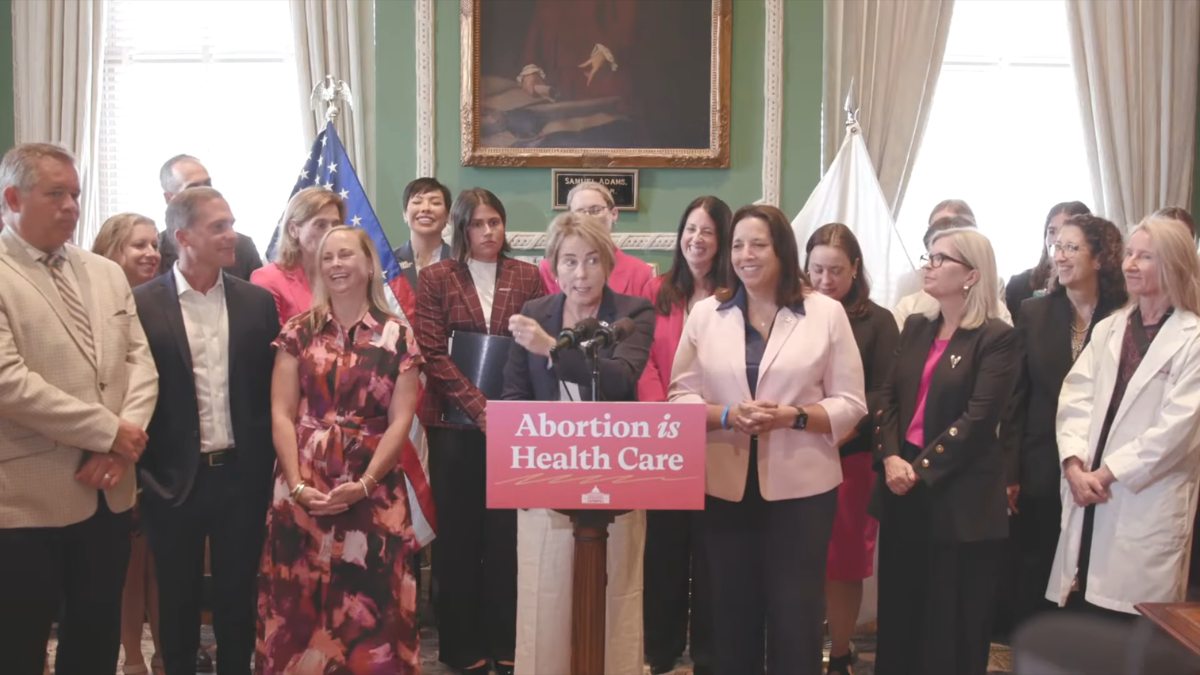
The article extends the comparison to Massachusetts’ new law allowing abortion through all nine months of pregnancy, a measure signed by Governor Maura Healey in August. It highlights the case of Kate Dineen and Alex Lawton, described as “poster parents” for the law, who traveled to Maryland to end their unborn son’s life after he suffered a stroke, because the state’s previous 24-week ban made it impossible to abort closer to home. The couple argued the baby would face “years of pain and suffering” if born, a rationale The Federalist says treats children like pets that aren’t supposed to be unhealthy.
The Boston Globe, in covering Dineen and Lawton’s story, sympathized with their ordeal, calling it something “no one should ever have to go through” — referring to the travel, not the abortion itself, The Federalist notes. The piece also points out the irony that many of the same Democrats who backed the abortion bill also eagerly passed animal protections in prior years, a contradiction highlighted by writer Hannah Bates in these pages.
The Commodification of Children
The article widens its lens to the near-billion-dollar fertility industry, which it says “sifts through tiny humans to find those ‘worth having.'” It cites Paris Hilton’s reported creation of 20 embryos — all male — and her decision to “sideline” or destroy them in her quest for a daughter. It also quotes Barrie Drewitt-Barlow, one of the UK’s “first gay fathers,” who encapsulated the consumerist mindset: “Nobody wants an ugly kid.” Drewitt-Barlow was charged with multiple sex crimes earlier this year, the piece notes.
Prospective pet owners, The Federalist points out, are notorious for seeking out preferred breed, size, sex, color, ancestry, and picture-perfect health — and now would-be parents are doing the same. Having children, the article argues, is increasingly seen as optional, to be had only if a “stars-align gamut of criteria are met.” It cites survey data showing Gen Z men and women rank having children far behind other priorities like a “fulfilling” job or having enough money, and that about half of under-50 U.S. adults without kids say they don’t want them, with most saying “they just don’t want to.”
Pet Spending Soars as Birth Rates Plummet
The article highlights a stark statistical contrast: as the birth rate plummets, pet spending is exploding and is expected to exceed $160 billion this year — nearly triple what was spent in 2013. Costs include luxury items, a growing pet insurance market, and a willingness by pet owners to sacrifice their own finances for their animals. Nearly two-thirds of pet owners say they would quit their job if it interfered with pet care, and more than 75 percent say they would go into debt for critical care for their animal. According to 2024 survey data, two-thirds of households have a pet, and more than half consider the pet “as much a part of their family as a human family member.” The piece mentions over-the-top doggy birthday “pawties,” “gentle parenting” for canines, and pet “parents” admitting they’re “‘very guilty’ of treating their pups as babies.”
A Peter Singer World
The Federalist attributes this inversion to the decline of a religious worldview, specifically the concept of Imago Dei — the belief that humans are made in God’s image. With that foundation kicked to the curb, the piece argues, we live in “a Peter Singer world” where babies are less than human and animals get promoted to take their place. Singer, a Princeton ethicist, wrote nearly 50 years ago: “Human babies are not born self-aware, or capable of grasping that they exist over time. They are not persons,” and “the life of a newborn is of less value than the life of a pig, a dog, or a chimpanzee.”
The article’s central thesis is that large segments of society now view pets and children as different versions of the same product: “an adult accessory that exists to improve the life of its ‘owner’ without causing too much inconvenience or making too many demands.” It decries this as “grossly dark and sinister,” a reflection of both a “Bambi-fied anthropology” that humanizes animals and a manifestation of Singer’s utilitarian ethics.
The piece concludes with a stark warning: “With God and the reality that humans are made in his image kicked to the curb, it’s a Peter Singer world where babies are less than human and animals get promoted to take their place, but what’s truly important is adults getting whatever adults want, regardless of the body count.”
Source: thefederalist.com — https://thefederalist.com/2026/08/19/in-our-modern-dystopia-we-treat-animals-like-children-and-children-like-animals/