
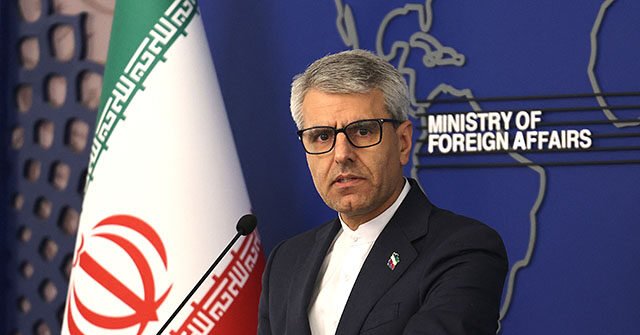
Iran’s Foreign Ministry announced Tuesday that negotiations with Oman regarding control over the Strait of Hormuz are progressing positively, even as the Islamic Republic pursues closer economic partnerships with Pakistan, which had recently presented itself as an impartial mediator in U.S.-Iran tensions.
Foreign Ministry spokesman Esmail Baqaei characterized discussions with Oman as focused on “establishing safe shipping routes while safeguarding the sovereign rights and security interests of Iran and Oman alike.” Iranian officials have consistently maintained these are strictly bilateral conversations between Tehran and Muscat, with no American involvement.
The talks center on establishing permanent control mechanisms over the strategically vital waterway, with Iran seeking authority to collect fees from international shipping passing through the strait. Baqaei and other Iranian officials have emphasized the bilateral nature of these discussions, explicitly excluding any U.S. participation.
Competing Narratives on Strait Access
The Iranian position stands in sharp contrast to recent statements from top U.S. officials. President Donald Trump said Saturday he had called off what he described as potentially the heaviest bombardment “seen since World War II” against Iran after Tehran and “other Middle Eastern countries” requested another opportunity for diplomatic resolution.
Trump indicated a “deal on Hormuz” was under consideration that “would include the immediate, complete, and total opening of the Hormuz Strait,” with the president adding Monday that discussions involved “the opening of the Strait, having it open literally by tomorrow, completely open.”
Secretary of State Marco Rubio stated Tuesday that the Strait of Hormuz is currently functioning, with ships and oil moving through the waterway. According to Rubio, the United States is engaged in three-way negotiations with Oman and Iran to maintain access.
“There are ships moving through the Straits. There’s oil moving right now through the Straits. The Straits are open,” Rubio said, adding that talks focus on ensuring more vessels can pass safely in the short term while pursuing longer-term denuclearization discussions.
Treasury Secretary Scott Bessent similarly confirmed the U.S. was “in talks with the Iranians” to “open the Strait and move towards a more normalized position in this conflict.”
Iran’s Control Scheme
Despite U.S. officials describing trilateral negotiations, Iranian authorities insist their only agreement is with Oman, with both nations reportedly nearing an arrangement that would grant Tehran perpetual control over the strait, with Oman serving as a junior partner.
According to reports, Iran rejected an Omani proposal for joint management of strait traffic, with both countries collecting fees, because the plan would have given Oman excessive control over its own territorial waters. Tehran wants the ability to shut down the entire strait when desired and seeks to prevent ships from using Omani coastal waters to avoid Iranian-imposed fees.
Iran’s preferred arrangement, revealed to foreign journalists Monday, would have ships departing the Persian Gulf use Oman’s side of the strait, while Iran controls all inbound traffic. This configuration would prevent Oman from allowing bidirectional traffic through its waters, effectively ensuring all shipping must pass through Iranian-controlled zones.
Pakistan’s Evolving Role
A Pakistani source told The National Wednesday that Pakistan and other intermediaries are working on drafting an updated Memorandum of Understanding focused on “opening the Strait of Hormuz and keeping it open,” with the source adding that “messages are being passed” and “indirect talks are in an advanced stage.”
Regional sources and a U.S. official indicated the revised MOU would mirror certain aspects of an original June agreement, including a 60-day toll-free reopening of the strait. Iran violated that previous agreement by launching what were described as terror attacks on civilian vessels in the waterway.
The proposed arrangement would reportedly accept Iran’s traffic flow scheme, with inbound vessels using Iranian waters and outbound ships from the Persian Gulf traveling through Omani waters. Only the initial 60-day period would explicitly prohibit tolls and fees.
Persian Gulf states, collectively known as the Gulf Cooperation Council, “would prefer everything to be explicit in any agreement,” according to the Pakistani official. While U.S. negotiators seek guarantees of continued strait access, Iranian officials have reportedly stated that pre-conflict conditions of free, safe passage will not return.
Iran-Pakistan Economic Deepening
On Wednesday, Iranian trade minister Mohammad Atabak met with six Pakistani cabinet members in Islamabad, including commerce minister Jam Kamal Khan. The gathering was promoted as an effort to strengthen economic relations between the nations, including discussion of a free trade agreement and simplified shipping arrangements for Iranian products to Pakistan.
“The Islamic Republic of Iran, with a view to long-term horizons, welcomes all the proposals put forward by the esteemed Pakistani ministers and announces its readiness to draw up an executive roadmap in the shortest possible time,” Atabak declared — a statement that appears to conflict with Pakistan’s claims of neutral mediation.
Iranian Foreign Minister Abbas Araghchi has reportedly accepted an invitation to visit Pakistan Friday, where he is scheduled to meet with Prime Minister Shehbaz Sharif and defense chief Asim Munir. Munir is the Pakistani official reportedly most admired and trusted by President Trump.
The apparent contradiction between Pakistan’s role as a mediator and its simultaneous pursuit of closer economic integration with Iran raises questions about Islamabad’s ability to serve as an impartial broker in negotiations involving American interests in the region.
Source: www.breitbart.com — https://www.breitbart.com/middle-east/2026/08/05/iran-says-talks-with-oman-progressing-meetings-with-pakistan-ongoing/