
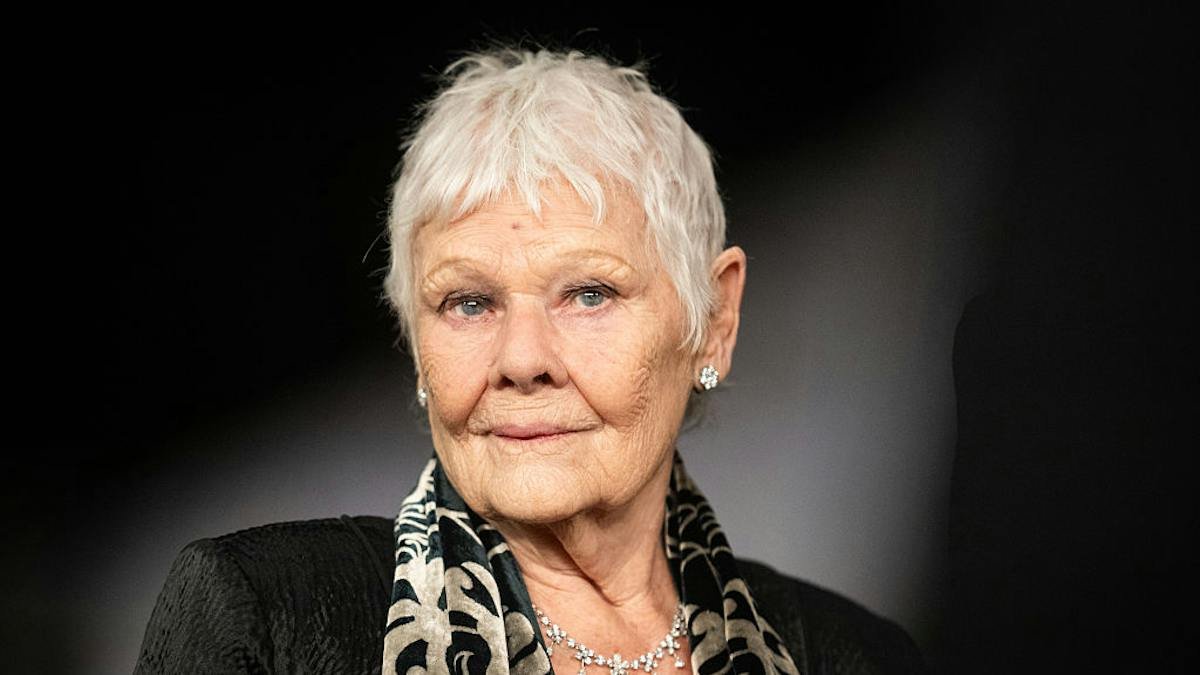
Dame Judi Dench is done tiptoeing around the subject of trigger warnings. The 91-year-old actress, best known to a generation of moviegoers as MI6 chief “M” in eight consecutive James Bond films, told her friend and writing partner Brendan O’Hea that the practice of flagging potentially distressing content before a film or stage production has overstepped its bounds, according to an interview conducted for her forthcoming memoir.
Her verdict, as reported by The Daily Wire, was blunt: “I think they have gone too far. It’s mollycoddling. If you’re that sensitive, don’t go to the theatre.”
The remarks come at a moment when trigger warnings have become a running cultural argument on both sides of the Atlantic, with theaters, universities, museums and streaming platforms increasingly attaching advisories to works that contain violence, sexual content, or difficult historical material. Supporters frame the practice as basic courtesy for audiences who may have lived through trauma. Critics — Dench now among the most prominent — see it as a form of preemptive censorship that flattens the emotional risk that makes live performance worth attending.

Where she draws the line
Dench was careful not to reject every advisory outright. She said practical safety warnings about strobe lighting and gunshots should stay, and that age limits for children are a given. Beyond that, she suggested the list of caveats has become self-defeating.
“Otherwise, where will it end?” she asked. “The trigger warnings before ‘Titus Andronicus’ would be longer than the play.”
The Shakespeare reference is pointed — that early tragedy is famously among the bloodiest works in the canon, involving mutilation, rape and a climax in which a character serves two of the title character’s sons to him in a pie. If any production were to require a comprehensive advance briefing, it would be that one, and Dench seems to be saying the absurdity of the exercise reveals itself in the attempt.

She also argued that warnings carry a narrative cost beyond mere caution. “And if you overdo the warnings, doesn’t it take away from the audience’s enjoyment of the story?” she asked. “Do you tell them that the butler did it in an Agatha Christie play so as not to shock them?”
Her broader case rests on the idea that discomfort is the point. “Besides, in the safety of a theatre or cinema, I want to be triggered, excited, stimulated, provoked and disturbed, to be taken out of my comfort zone,” she said. “Isn’t that what makes theatre and films so thrilling?”
The bananas problem
Dench closed her argument by asking who, exactly, would be tasked with deciding what counts as triggering — and where the cataloging would stop.

“And who knows what might trigger people? Balloons, clowns, buttons … I have a friend who doesn’t like bananas,” she said, recounting that the friend feels physically ill at the sight of one. “Should supermarkets put up warning signs in the fruit and veg aisle? It drives me wild.”
The anecdote is funny, but it’s also doing structural work for her position: if aversions are idiosyncratic and effectively limitless, any institution that tries to anticipate them will either produce unusable amounts of signage or an arbitrary, and possibly ideological, subset of warnings. That last concern is where the debate tends to get sharpest, with skeptics arguing that advisory lists reflect the sensitivities of whoever writes them rather than any objective measure of harm.
Dench’s comments arrive amid a broader re-litigation of trigger warnings in cultural institutions. Universities have been at the center of the argument for years, but theaters and film distributors have increasingly found themselves in the same conversation, weighing accessibility concerns against complaints that audiences are being treated as fragile.
A career built on discomfort
Dench’s authority to weigh in on this is considerable. Across a stage and screen career spanning more than six decades, she has worked in tragedy, comedy, and the prestige dramas that tend to put audiences through the wringer — including her Oscar-winning turn as Queen Elizabeth I in “Shakespeare in Love” and her Oscar-nominated performance as the embittered novelist Iris Murdoch in “Iris.” Her seven-film run as M in the Bond franchise, beginning with 1995’s “GoldenEye,” made her one of the most recognizable authority figures in modern cinema.
The interview was conducted for “Is It Too Late to Make a Run for It?”, her memoir, which is scheduled for release in late October in the United Kingdom and will be available in the United States on November 3. The book’s title, with its note of comic panic, suits the tone of her remarks — an entertainer of a certain age looking at institutional habits she finds puzzling and saying so without much hedging.
Whether the memoir expands on the trigger-warning argument or treats it as one thread among many remains to be seen when the book lands. For now, the excerpted comments have already pushed Dench into the middle of a fight she had no obvious obligation to join — and given the reaction such interventions tend to generate, it’s unlikely to be the last word on the subject from her or anyone else.
Source: www.dailywire.com — https://www.dailywire.com/news/james-bond-actress-delivers-ultimatum-over-trigger-warnings-in-movies