
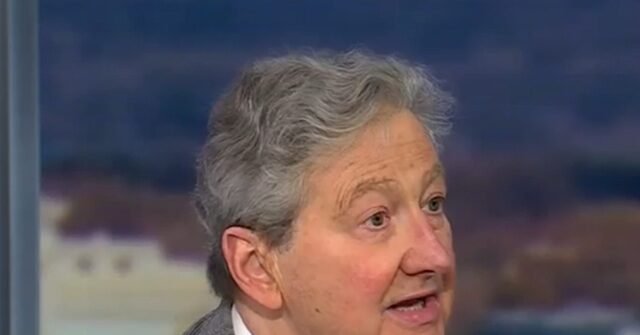
Sen. John Kennedy (R-LA) said China has the power to reopen the Strait of Hormuz immediately but is deliberately refusing to act, and that at some point the United States will have to weigh whether to step back and let other nations bear the consequences of a shutdown they have declined to help resolve.
Kennedy made the remarks Wednesday during an appearance on Fox News Channel’s “Will Cain Show,” according to a clip reported by Breitbart News.
In his comments, Kennedy argued that U.S. military objectives in the region have been met, pointing to the destruction of Iranian air defenses and asserting that Iran currently has no nuclear weapons program. The remaining unresolved issue, he said, is the Strait of Hormuz.
“The only problem in all of this is the Strait of Hormuz,” Kennedy said. “China could open it tomorrow if it told Iran to. China is choosing not to.”
A decision the president will have to make
Kennedy framed the question as one that ultimately lands with the president: whether to remain engaged, or to let other countries that have refused to contribute take on the challenge.
“At some point, the president’s going to have to decide whether, having achieved all of our objectives, it’s time to come home and let China and Russia and North Korea and Europe and all of the other countries that refuse to help take a crack at it,” Kennedy said, “because they’re going to pay the price of a closed strait even more than America.”
The Louisiana Republican’s argument rests on the idea that the economic damage from a closed strait falls disproportionately on other major economies — meaning the U.S. could afford to hand off the problem to nations he says have so far declined to assist.
‘The chief reptile, the quarterback, is President Xi’
Kennedy did not limit his criticism to Iran. He lumped Iran together with China, Russia and North Korea, describing them as a bloc of adversarial states whose leaders he said cannot be trusted.
“I think that the people running Iran are reptiles, and they’re part of a colony of reptiles, China, North Korea, Russia, and — as I said — Iran,” Kennedy said. “The chief reptile, the quarterback, is President Xi in China. You can’t trust any of them. All four of them are the same.”
The senator’s characterization reflects a hawkish view of U.S. adversaries that has been a consistent feature of his public commentary. By naming China as the “quarterback” of the group, he placed primary responsibility for Iran’s posture on Beijing — an argument that aligns with his assertion that China, not the U.S., holds the leverage to reopen the strait.
Intelligence and the nuclear question
Kennedy also contended that the U.S. has achieved its objectives and retains the ability to detect and respond to any renewed Iranian nuclear activity.
“We’ve also knocked out their air defenses,” he said. “And our intelligence is so good that we will know, within minutes, if Iran starts its nuclear program again, and we can bomb it again. They have no nuclear weapons program.”
That claim — that Iran has no active nuclear weapons program and that U.S. intelligence could detect a restart within minutes — is Kennedy’s own assessment, offered during the television interview. He presented it as grounds for concluding that the nuclear file is, for now, closed, leaving the strait as the central outstanding concern.
Why the strait matters
The Strait of Hormuz is a narrow chokepoint at the mouth of the Persian Gulf through which a substantial share of the world’s seaborne oil passes. A closure — whether through military action, mining, or political pressure on shipping — would disrupt global energy markets and hit importers across Asia and Europe particularly hard.
That dynamic is central to Kennedy’s reasoning. If the countries most exposed to a closure are also the ones refusing to help keep the waterway open, he suggested, then the burden of maintaining it should not fall on the U.S. alone.
His remarks come amid a broader debate in Washington over the scope of U.S. military involvement in the region and whether allied nations are contributing their fair share to security arrangements that benefit the global economy. Kennedy, a frequent critic of what he casts as free-riding by allies, used the interview to press that theme — naming Europe alongside China, Russia and North Korea as beneficiaries of a system they are not paying to sustain.
Whether the president ultimately adopts the course Kennedy outlined — declaring objectives met, pulling back, and leaving the strait to others — remains an open question. But the senator’s comments put a specific proposal on the table: that the U.S. could plausibly walk away and let the countries he says refuse to help deal with the fallout of a waterway they depend on more than America does.
Kennedy’s interview was reported by Breitbart News, which published a clip of the segment. The remarks on the “Will Cain Show” add to a growing body of commentary from Republican senators pressing for a narrower, more burden-shared approach to overseas commitments — an argument that has gained traction within parts of the party as the costs and risks of extended deployments draw renewed scrutiny.
Source: www.breitbart.com — https://www.breitbart.com/clips/2026/09/23/gop-sen-kennedy-china-could-open-strait-of-hormuz-now-well-have-to-decide-if-we-leave-strait-to-them-and-others/