
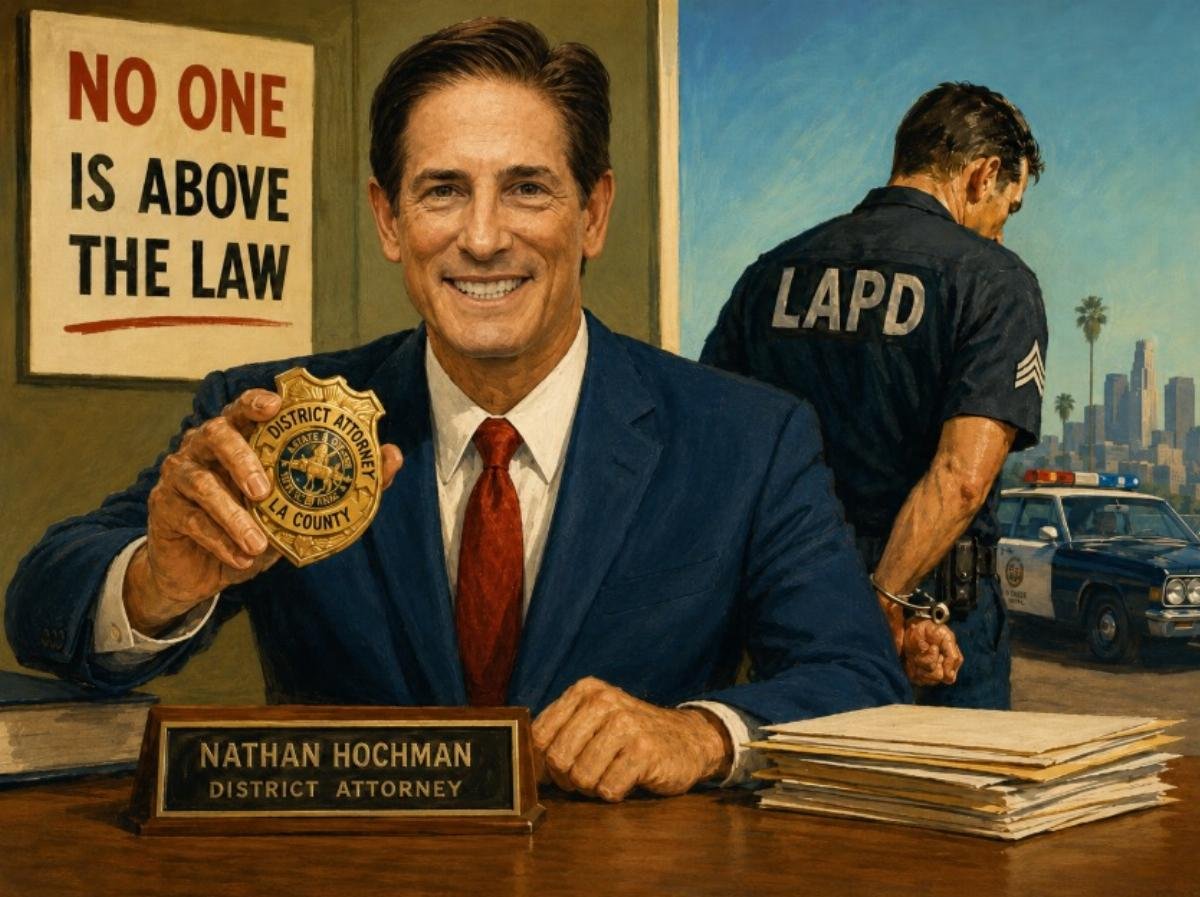
Los Angeles County District Attorney Nathan Hochman has spent his tenure rolling back the progressive criminal justice policies of his predecessor, George Gascón. He has dropped charges against police officers, restored the death penalty as an option, and pushed for more funding to implement Proposition 36. But his latest decision—charging LAPD Officer Daniel Flores with 16 felony counts of eavesdropping—has sparked a firestorm of criticism from both sides of the political spectrum.
According to a report from the SoCal News Group, Flores, 43, secretly recorded colleagues in the LAPD’s Training Division in 2024. In those recordings, fellow officers were heard using slurs and making derogatory remarks about Mexican, Asian, and Black people, as well as women. The recordings were deemed illegal by the District Attorney’s Office, and Flores now faces up to 13 years in state prison if convicted.
Mayor Karen Bass has publicly criticized Hochman’s decision, arguing that Flores deserves whistleblower protection. Pro-police advocates, meanwhile, worry that the prosecution signals a return to the anti-cop agenda that defined Gascón’s tenure. Hochman’s office has defended the charges, pointing to California’s strict all-party consent law, which makes it a crime to record private conversations without everyone’s permission.
Hochman’s Balancing Act
Hochman, a former Republican who ran for state Attorney General in 2022, has walked a careful line since taking office. He has courted both moderate Democrats and law enforcement groups, attending town halls with Sheriff Robert Luna and publicly disagreeing with certain Trump administration policies. His supporters, including American Thinker columnist Arthur Schaper, argue that the Flores case is proof of Hochman’s integrity rather than a betrayal of police.
“A pro-law-enforcement district attorney ought to enforce the law even when the defendant is a police officer,” Schaper wrote, emphasizing that no one is above the law. He also noted that Hochman has, to his credit, dismissed charges against two Torrance police officers who fired on a suspect—a case Gascón had reopened.
But the Flores case is different. Schaper argues that the recordings, which captured offensive language, do not constitute a crime in themselves. “It’s not a crime to say mean things about people,” he wrote, while adding that the manner in which the recordings were obtained violated state law.
California’s Consent Law Under Scrutiny
The case has reignited debate over California’s wiretapping laws, which are among the strictest in the nation. Unlike many states, California requires all parties to consent to any recording of a private conversation. Critics argue this makes it difficult for employees to expose misconduct, especially in the workplace.
Schaper suggests that while Flores should face consequences for violating the law, California’s consent-to-record statutes need to be amended. “Now more than ever, the ability to speak our minds is crucial to the republic we cherish,” he wrote, calling on Hochman to urge the state legislature to reform the law.
Hochman has acknowledged the unprofessionalism of the officers heard in the recordings, but he has maintained that the charges against Flores are about the illegal act, not the content of the conversations.
Whistleblower Protection vs. Departmental Trust
The case raises a fundamental question: can a police officer be a whistleblower if they break the law to expose wrongdoing? Mayor Bass says yes, pointing to the derogatory remarks as evidence of a toxic culture within the LAPD’s Training Division. But Hochman’s office argues that Flores’s actions undermine the trust and integrity of the department.
“Cops NEED to be able to discuss confidential matters without the risk that someone will release the information,” Schaper wrote, acknowledging that police officers are held to a higher standard but that private conversations should not be used against them.
The criticism of Hochman comes from both pro-police and progressive quarters. Some law enforcement advocates fear that charging Flores will embolden those who want to defund the police or paint the entire department as racist. Others, including civil liberties groups, argue that the recordings exposed legitimate discrimination that should be addressed.
A Delicate Precedent
Hochman’s decision to prosecute Flores sets a precedent that could have far-reaching implications for whistleblowers across California. If the case goes to trial, it will test the limits of the state’s consent law and the definition of whistleblower protection.
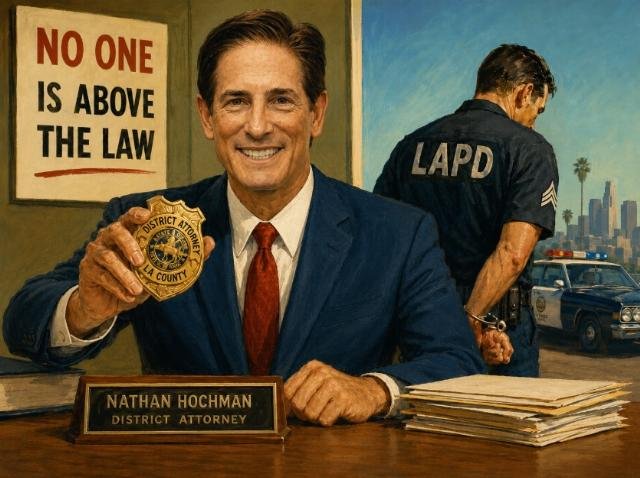
Schaper believes Hochman should push for a plea deal, but also ensure that Flores faces “hard time.” He stresses that the DA’s actions should not be seen as a betrayal of police, but rather as an example of a prosecutor who enforces the law impartially.
“Hochman is showing his true colors and character by taking on this case,” Schaper wrote. “No one is above the law, and when a rogue cop records other cops to implicate them in something, that lowers morale in the worst way.”
For now, the case remains a flashpoint in Los Angeles County, where the legacy of Gascón’s tenure still looms large. Hochman has managed to rebuild trust with law enforcement, but the Flores case could strain that relationship if not handled carefully.
The broader question—whether California’s consent law should be reformed—is likely to be a topic of legislative debate in the coming months. Hochman, who has already called for more funding to implement Prop 36, may need to add wiretap reform to his agenda if he wants to navigate this controversy successfully.
As Schaper put it, “I respect all this. He’s getting the job done.” But whether that job includes protecting police officers’ privacy or exposing their wrongdoing is a line that Hochman is now walking.
Source: www.americanthinker.com — https://www.americanthinker.com/articles/2026/08/los-angeles-county-da-hochman-is-doing-the-right-thing/