
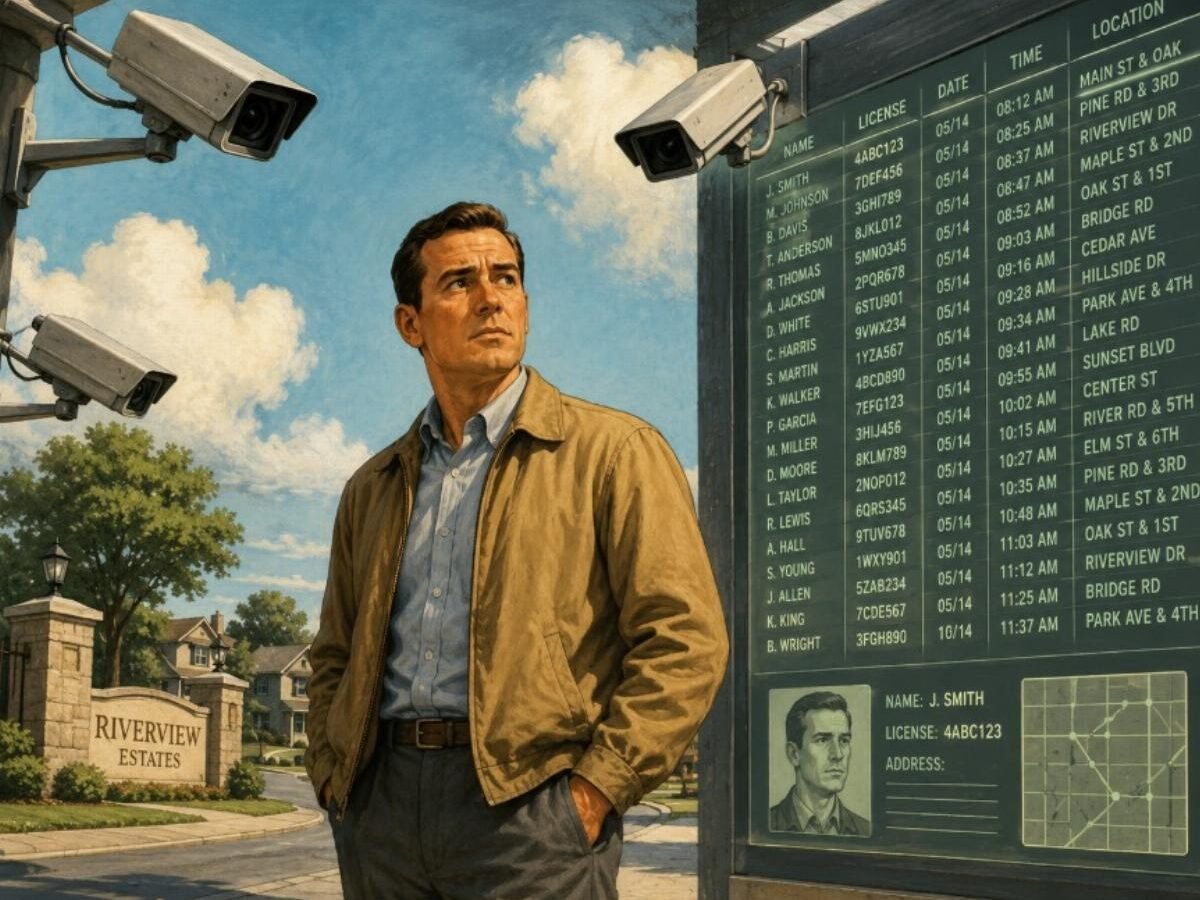
When a notice went up on a community Facebook page announcing that the neighborhood entrance now had two Flock cameras, the reactions split down familiar lines. “Good, that’ll keep out criminals,” said some. “This is a 1984 escalation,” said others. According to American Thinker columnist Andrea Widburg, both reactions are correct.
That tension—between the promise of public safety and the threat of pervasive surveillance—has found a concrete test case in Stow, Massachusetts, a small town of about 7,174 people. There, police are pursuing termination proceedings against Officer Jason Rogers, who is alleged to have misused Flock cameras and conducted unauthorized searches in other law enforcement databases. The town has also cut ties with Flock entirely, removing its automatic license plate reader.
Police Chief Michael Sallese and Town Administrator Denise M. Dembkoski announced the move in a press release, according to American Thinker. The alleged misconduct came to light on June 18, when a person Rogers had reportedly searched for filed a complaint with the department. Police said Rogers and the complainant knew each other.
A four-week internal affairs investigation determined that Rogers unlawfully accessed Criminal Offender Record Information through the Massachusetts Criminal Justice Information Services system on at least five occasions, police said. Rogers also allegedly ran vehicle information through both Flock Safety and CJIS on multiple dates without a legitimate law enforcement reason.

The case is a small-town echo of a much broader pattern. American Thinker notes that The New York Times recently reported on numerous instances of police overstepping with Flock cameras—including a Texas officer who used the cameras to track a woman across state lines after she was suspected of self-administering an abortion. Officers in other parts of the country have tracked romantic partners. Los Angeles and Dayton, Ohio, are among the cities that suspended their Flock contracts to prevent immigration authorities from accessing camera data. Dayton resorted to covering the cameras with trash bags.
Residents in Houston, Oakland, and Grand Junction, Colorado, have taken matters into their own hands, with police reports and surveillance footage documenting Flock cameras being cut down, splattered with paint, and even shot.
The Stow case is notable because the alleged misuse seems more personal than political. Rogers is accused of running plate and criminal history searches on someone he knew, without a legitimate law enforcement reason. If the allegations hold, it would be a textbook example of how a tool designed to catch criminals can be turned on a private citizen for reasons entirely outside the public interest.
Widburg draws a historical parallel, recalling London’s early embrace of closed-circuit television cameras in the 1990s and early 2000s. The Brits were assured the cameras were for post-hoc crime solving, not proactive spying. “Now, of course, all of Britain has become one of the most totalitarian places in the Western world,” she writes, pointing to policing of speech and behavior that would have been unthinkable when the cameras were sold as a safety measure.
Her point is that the surveillance infrastructure never stays limited to its original, benign purpose. Once the databases exist, the temptation to misuse them is constant—and, as the Stow case suggests, not always limited to a few big-city bad apples.
The Town of Stow’s decision to terminate its Flock contract is a sharp rebuke. It suggests that even in a small, relatively quiet community, the risk of abuse outweighed the benefits of the cameras. For residents, the message is that the town’s leaders are listening to concerns about overreach, not just the promise of deterrence.
At the same time, Widburg acknowledges that Flock cameras and similar systems aren’t going away. They can serve useful purposes, and information can be both used and abused. The challenge for law-abiding citizens, she argues, is to protect themselves—both by pushing back on surveillance expansion and by being aware of what data brokers and people-search sites already collect and sell about them, often legally.
The Stow case is a reminder that the debate over Flock cameras isn’t abstract. It’s about whether a police officer with access to your license plate number, your driving history, and your criminal record—if any—can use that information to settle a personal score. When that happens, the community pays the price, not just in privacy but in trust.
The town’s response—firing the officer and dropping the cameras—may signal a growing intolerance for the sort of discretion that surveillance systems grant to individual officers. Whether other towns follow suit remains to be seen. But the Stow story is a cautionary tale for any community considering whether to install Flock cameras: the same system that can help catch a criminal can also be turned against a neighbor.
Source: www.americanthinker.com — https://www.americanthinker.com/blog/2026/09/a-massachusetts-police-officer-faces-firing-for-misusing-flock/