
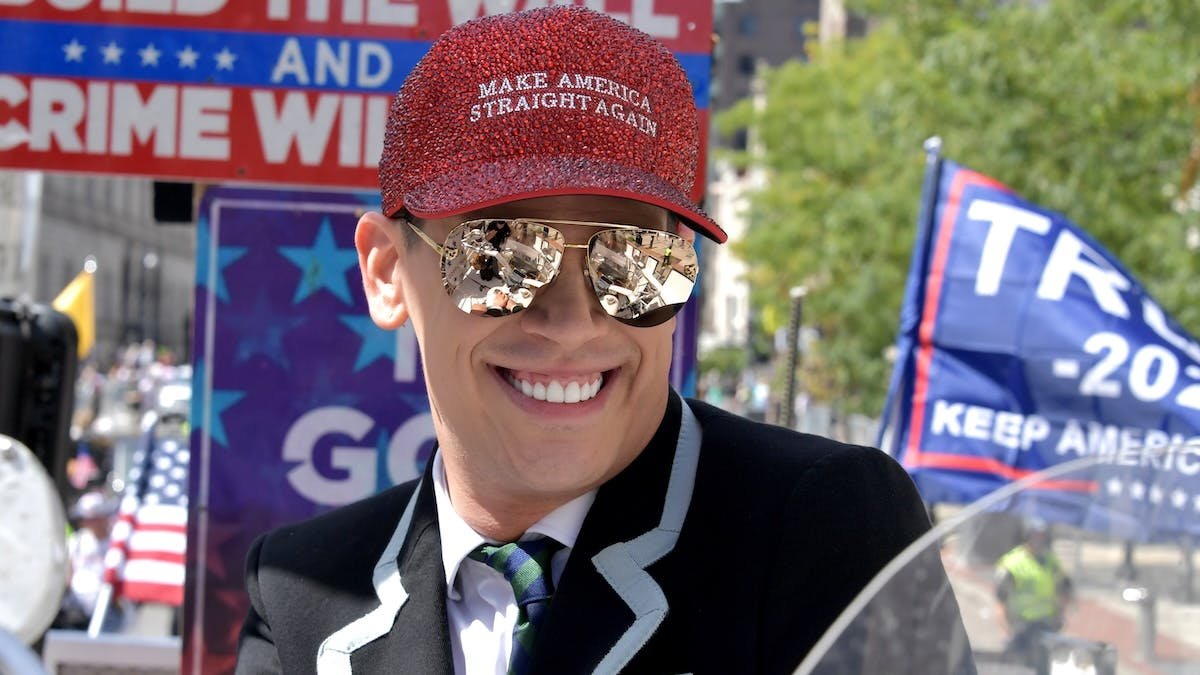
Milo Yiannopoulos got what many of his critics might call the perfect ending to his American career — a quiet, unceremonious deportation. Last week, immigration officials arrested the provocateur at the New Orleans airport and put him on a plane back to the United Kingdom, according to a report from The Daily Wire. No crowd, no camera crews, no golden throne. Just a flight.
The arrest capped a dramatic arc for a man who, a decade ago, could spark violent campus riots just by being booked to speak. Yiannopoulos described the experience to Piers Morgan in an interview that aired after his deportation, saying, “It was physically degrading. It was frightening. I don’t think I’ve ever been frightened like that before.” In a piece for The Spectator, he claimed the ICE facility he passed through was empty and compared the Trump administration’s deportation policy to a chess board missing its pieces. He also said the experience changed his perspective, admitting, “In the past, I think I’ve been a little blasé when people talked about their trauma.”
The Daily Wire’s profile of Yiannopoulos — written by Neal Pollack — makes the case that his downfall was as inevitable as his rise was improbable, and that the internet and political culture we live in today bear the unmistakable fingerprints of his methods.
From Tech Blogger to Professional Provocateur
Yiannopoulos’ path to infamy began far from the American culture war. After dropping out of university, he worked for the Catholic Herald before pivoting into tech journalism around 2009, writing for the Daily Telegraph and contributing to TechCrunch. He built a reputation as a theatrical gadfly in London’s startup scene — so much so that by 2012, Wired UK was describing him as a “provocateur” who liked to “provoke and irritate, often for its own sake.”
In late 2011, he co-founded The Kernel, a publication explicitly designed to break what he saw as the timid, insular conventions of British tech media. The outlet specialized in picking fights with the establishment, and the persona landed. The Observer called him the “pit bull of tech media.” Forbes, with characteristic grandiosity, dubbed him “Digital Media’s Citizen Kane.” He told Forbes he enjoyed “seeing the wicked suffer.”
But it was Gamergate that showed him where the real money and influence were. The internet movement, which targeted perceived leftism and, frequently, women in the video game industry, gave Yiannopoulos a template for weaponizing provocation against feminism, political correctness, and the American culture war. He admitted as much in a 2015 interview, saying, “I’d be lying if I said I didn’t recognize the potential of GamerGate to give the left a bloody nose.”
His September 2015 Breitbart column, “Feminist Bullies Tearing the Video Game Industry Apart,” was a signal of what was to come, written in the mocking register that would become his signature. He told the L.A. Times that year, “I enjoy upsetting the right people.”
Trump, Campuses, and the “Dangerous Faggot” Tour
By 2016, Yiannopoulos had evolved from Gamergate provocateur into a de facto Trump surrogate — not officially, but culturally. He called Trump “Daddy” and styled himself a “Trump-sexual.” He later explained that his attachment to the nickname was purely tactical. “I wasn’t particularly attached to it until I saw how much it wound up liberals,” he said, adding, “and now I do it all the time.”
The Washington Post noted in July 2016 that his career had “taken off exponentially” and observed that Breitbart Tech had become as much a publicity machine for Yiannopoulos himself as it was a news operation. He called Trump “a perfect storm of everything I love in life.”
His college tour, branded the “Dangerous Faggot” tour, was theatrical by design. At UC Santa Barbara in May 2016, he entered a packed hall on a golden throne, wearing pearls, with a life-size Trump cutout waiting on stage. But beneath the spectacle, there was a real constituency. One student at the event told the campus newspaper, “I stopped being ashamed of my opinions and conservative values, so thank you.”

The appearances became a recurring flashpoint for campus unrest, culminating in a February 2017 riot at UC Berkeley. Roughly 150 masked agitators set fires, lit fireworks, broke windows, and attacked police. The university evacuated Yiannopoulos and canceled the event. Then-President Trump threatened Berkeley’s federal funding, and Bill Maher observed that “liberals always take the bait.”
Ban, Book Deal, and a Swift Collapse
Twitter permanently banned Yiannopoulos in 2016 after he mocked actress Leslie Jones’ reaction to negative reviews of the all-female “Ghostbusters” reboot. His followers then unleashed a torrent of abuse that drove Jones off the platform; she wrote, “I have been called Apes.” For Yiannopoulos, the ban was a publicity windfall. At an RNC party he hosted in Cleveland, he told a roaring crowd, “I just got banned from Twitter.”
By December, Simon & Schuster had offered him a reported $250,000 book deal. He described the meeting in terms that were almost embarrassingly on-brand: “I thought they were going to have me escorted from the building.” Instead, he said, they offered him “a wheelbarrow full of money.” He also revealed his priorities plainly: “I don’t care about politics. I only talk about politics because of Trump.”
His downfall was swift and, in retrospect, predictable. In 2016, Yiannopoulos appeared on the Drunken Peasants podcast, discussing relationships between adult men and teenage boys, attacking age-of-consent laws, and detailing his own sexual experiences with an older Catholic priest. The conservative anti-Trump account The Reagan Battalion resurfaced the footage on February 19, 2017 — just as Yiannopoulos was about to appear at CPAC.
The backlash was immediate. CPAC rescinded his invitation the next day, with chairman Matt Schlapp stating, “There is no disagreement among our attendees on the evils of sexual abuse of children.” The day after that, he lost his book deal. Then, on February 21, he resigned as Breitbart’s senior editor. He insisted, “This decision is mine alone,” though the Washington Post reported that Breitbart staffers had been discussing leaving if he stayed. His public explanation was that his “poor choice of words” was distracting from his colleagues’ work.

Aftermath: Debt, Desperation, and the Politics of Attention
Yiannopoulos still had an audience after the crash. He self-published “Dangerous” in July 2017 and sued Simon & Schuster for $10 million for breach of contract. The litigation turned embarrassing when the publisher’s editorial notes on his manuscript entered the record. By February 2018, he abandoned the lawsuit, saying he didn’t want to spend his book profits and another two years litigating.
By late 2018, documents assembled by former Australian tour promoters indicated Yiannopoulos was more than $2 million in debt. Alleged creditors included the Mercer family ($400,000), former lawyers ($153,215), and longtime ghostwriter Allum Bokhari ($76,574) — plus $20,000 to Cartier. Yiannopoulos disputed the characterization, saying these were “company debts, not personal,” and claimed he was earning $40,000 a month.
He made public pleas for money on Patreon, saying, “I’ve had a miserable year or two, banned and de-platformed and censored and blacklisted.” In 2022, he announced he was “ex-gay” after undergoing Catholic conversion therapy. He worked as an unpaid intern for Rep. Marjorie Taylor Greene. That same year, he entered Kanye West’s chaotic political orbit, working with Nick Fuentes on Ye’s prospective 2024 presidential campaign. He was fired, rehired in 2023 as Ye’s director of political operations, and eventually became the chief of staff at Yeezy.
And now, he’s a deportee.
The Daily Wire’s profile argues that Yiannopoulos’ legacy isn’t just a series of scandals — it’s the modern political influencer playbook itself. The willingness to change positions without integrity, to manufacture feuds for attention, to treat ideological capital as a currency, to convert cancellation into marketing, and to make personality more important than ideas — all of that is utterly normal now. Yiannopoulos looks dated and pathetic in 2026 partly because the culture has thoroughly absorbed the techniques that made him freakishly novel in 2015.
In the end, ICE gave the original proto-troll what no protester, rival, or platform ever managed to deliver. It didn’t argue with him, quote-tweet him, protest him, interview him, or buy tickets to hate-watch him. It just put him on a plane. No one waved goodbye.
Source: www.dailywire.com — https://www.dailywire.com/news/the-rise-fall-and-deportation-of-the-original-political-troll