
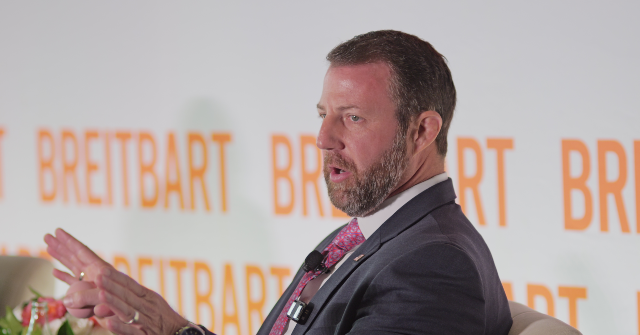
Homeland Security Secretary Markwayne Mullin said this week that his department is fielding equipment along the southern border that he is not permitted to describe in detail, offering a rare public hint about capabilities he characterized as non-lethal.
Speaking Tuesday at an event with Breitbart News, Mullin told the outlet’s Washington Bureau Chief Matthew Boyle that the technology sits within what he called the “primary” border wall system, which he said runs from the Pacific Ocean to the Gulf of America and includes a mix of physical barriers, water barriers and sensor-equipped “smart” sections.
“In some of the higher sectors that may funnel them to it, we actually have some equipment that I can’t talk about, but it’s non-lethal. Not less lethal; it’s non-lethal, but it’s enough to get their attention,” Mullin said, according to Breitbart’s account of the interview.
The secretary did not name the equipment, its manufacturer, where it is deployed or how it is meant to be used. The remark came during a broader discussion contrasting the current administration’s border posture with that of former President Joe Biden, which Mullin framed as a two-part effort aimed at the border itself and at interior enforcement.
A wall built in two layers
Much of Mullin’s remarks focused on the physical barrier and the layered approach he said officials are now taking. He described the primary wall as the first line, combining land, water and technology-assisted segments. According to Breitbart, Mullin said the sensor systems can distinguish whether a person crossing is a man or a woman based on gait and weight, and can indicate how many people are present. Drones, he added, are also used to track crossings.
The secondary wall, Mullin said, is designed to sit roughly 120 feet behind the primary barrier where land allows. In practice, he said, that distance is often halved to about 60 feet because of the Roosevelt Reservation, a federal easement that applies everywhere except Texas.
The gap matters because it buys time for agents to respond, Mullin argued. He said cartels adapted quickly to the first wall, deploying plasma cutters to breach it and move people through before authorities could arrive.
“What we saw with the primary wall, the first wall we put up, is the cartels got really quick at getting plasma cutters there, being able to cut the wall, get people in, and rush them through,” he said. The second wall, he added, is “much more difficult to get through.”
A road built between the two barriers is intended to speed up agent response, according to Mullin’s remarks. He also said wall heights have been increased from about 18 feet in some places to 30 feet, making ladder crossings both harder to attempt and riskier to complete.
“People will probably jump at 18 feet… most people aren’t willing to let go at 30 feet. That’s a much different drop,” he said.
Construction pace and legal fights
Mullin said the administration is now building at a record pace, but acknowledged a slow start that he attributed to logistics and litigation. He cited sold-off material, a contractor cancellation and a dispute with California, which he said had threatened companies working on the wall with exclusion from state contracts.
“We had to get courts involved in it,” Mullin said, noting that some issues remain unresolved. Once land acquisition was settled, he said, work accelerated.
He closed that portion of the conversation by asserting that the border is already “highly” secured, a claim likely to draw scrutiny from critics who argue that crossings, while down from earlier highs, have not been eliminated and that enforcement gaps remain.
The interview did not include an on-the-record demonstration of the undisclosed equipment, and DHS has not publicly released specifications for it. Breitbart published its account of the exchange on Tuesday.
The comments add to a running public debate over how the government describes its border technology — particularly tools designed to deter or redirect people without causing lasting harm. Non-lethal systems can range from acoustic devices and directed-energy platforms to chemical irritants, and the category has historically attracted oversight questions from lawmakers and watchdogs when deployments are disclosed only in general terms.
For now, Mullin’s description leaves the specifics to the department. What he offered was a broad claim about capability, a firm insistence that the equipment is not designed to kill, and a clear signal that the administration intends to keep the details to itself.
Source: www.breitbart.com — https://www.breitbart.com/national-security/2026/10/06/exclusive-sec-markwayne-mullin-dhs-employing-equipment-that-i-cant-talk-about-at-border/