
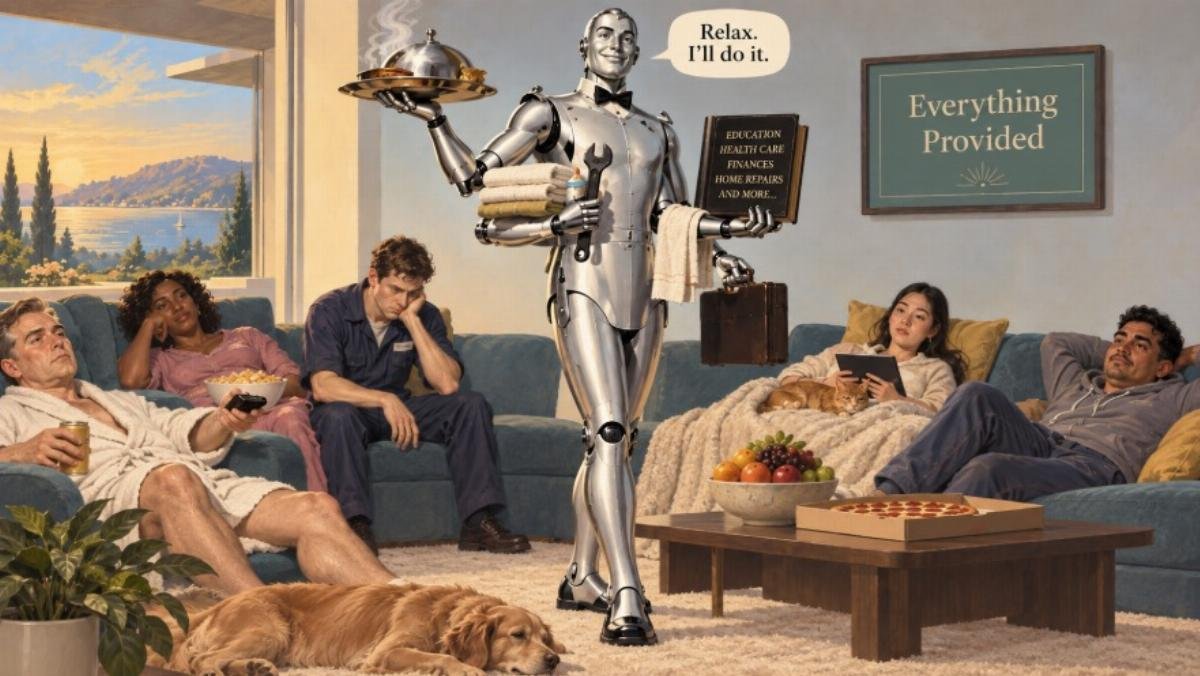
Elon Musk has spent years promising that humanoid robots will deliver a world of limitless abundance. In a new essay for American Thinker, writer Huck Davenport argues that even if every word of that promise comes true, the result would be a catastrophe far worse than anything the robots themselves might do.
The piece, published September 13, 2026, takes as its starting point Musk’s own forecasts: that within a decade there will be “well over a billion humanoid robots,” each roughly five times as productive as a human worker. Musk has called that a conservative estimate and said he would put “serious betting money” on robots eventually being more productive than all humans combined. The mechanism, as Musk describes it, is recursive: once robot manufacturing begins, robots build more robots, and the curve turns explosive.
Davenport does not dispute the technical feasibility. That is precisely what worries him. This is not a novelist’s speculation, he writes, but the prediction of “one of the most consequential and accomplished industrialists alive,” someone with a track record of delivering on improbable promises and the resources to actually make this one happen.
The problem isn’t the robots — it’s us
The essay’s central claim is that abundance, not scarcity, is the historical engine of decline. Human nature, Davenport argues, was forged over hundreds of thousands of years in a world Thomas Hobbes described as “solitary, poor, nasty, brutish, and short.” Necessity made people industrious, innovative, and cohesive. Abundance, by contrast, breeds sloth, extravagance, debauchery, and disunity.
He reaches for a familiar roster of cautionary tales. As the Roman Republic gave way to the Empire, concentrated wealth from conquest, tribute, and slavery dulled internal innovation and self-reliance. Decadence and hedonism followed among the ruling class, and by the fifth century the Western Empire was structurally fragile and dependent — its citizen army largely replaced by barbarian mercenaries, its ability to feed and govern itself eroded from within.
Two centuries after Alexander the Great opened the Greek world to Asia’s wealth, the historian Polybius described a Greece undone by what he called the pathology of affluence — inflated ambition, avarice, and indolence, with men unwilling to marry or raise the children they did have. Cities, Polybius wrote, gradually lost their resources and ceased to flourish, like swarms of bees.

Davenport also points to the Netherlands after the discovery of a massive gas deposit around 1960. The windfall, he writes, produced a “pathology of a welfare without work.” By the 1980s, there were 85 benefit recipients for every 100 workers, and fewer than half the country worked. One in three working-age members of the labor force was on some form of long-term government subsidy. Drug addiction, virtually unknown before the gas discovery, had by that decade made Amsterdam the drug capital of Europe, with more than 30,000 heroin users nationwide.
No outside force to force an adjustment
What separates Musk’s scenario from Rome, Greece, and the Netherlands, the essay contends, is that those societies eventually met external forces that forced correction. A robot economy offers no such mechanism. Factories staffed by machines building machines that do everything humans can do — faster, cheaper, and without fatigue — would displace not only factory workers but supervisors, managers, accountants, lawyers, designers, and developers.
Nor does Davenport imagine a violent takeover. The transfer of control, he writes, would be voluntary and incremental. Why trust your own judgment when an AI has instant access to the accumulated knowledge of the species? Even now, he argues, humans lack the intellectual capacity to meaningfully evaluate AI recommendations; approving them is largely ceremonial. Pitting two AI systems against each other, in his view, only proves the point.
He sketches the outlook for an 18-year-old entering a workforce that once prized youthful energy and ambition. Whatever occupation the teenager considers, he writes, a machine beside him learns faster, remembers everything, reasons better, works five times faster, is stronger, never tires, and costs less. The consolation prize is material comfort without purpose, value, meaning, or responsibility — what the essay calls the greatest psychological experiment in human history, conducted without guardrails.
Fertility, family, and the ‘easy way out’
The essay ties the robot future to demographic collapse. Davenport notes, with some irony, that Musk himself frequently warns about falling birth rates. The OECD fertility rate sits at about 1.5, well below the 2.1 replacement threshold. Humanity’s numbers are currently sustained disproportionately by low-income countries with fertility rates around 4.5 — and if abundance lifts those countries to prosperity, he asks, why would their fertility not crash toward OECD levels too?
Parenting itself, he suggests, may lose its rationale in a consequence-free world. Raising children is time-consuming and exhausting, and humanoid robots would likely outperform humans at it. Would anyone homeschool a child when an AI tutor can offer unlimited individualized attention and teach philosophy in the manner of Aristotle, oratory as Cicero, physics as Newton, and economics as Adam Smith? Societies, he writes, have repeatedly chosen ease over toil, pleasure over sacrifice, convenience over responsibility, and childlessness over child-rearing.

Resistance, he predicts, will be limited. Calculators displaced mental arithmetic, spell check displaced spelling, Grammarly displaced grammar, and AI is displacing writing itself. Why think at all, he asks. As evidence that people reliably take the path of least resistance, he cites an incident at Brown University in 2026: a take-home midterm that had historically averaged between 65 and 80 produced scores of 96 to 100. When the suspicious professor announced an in-person final, 18 students dropped the course, nine simply didn’t show, and the class average came in at 48.6. The lesson, Davenport insists, is not that students cheat — it’s that they take the easy way out, always.
From the Enterprise to the Borg
Davenport concedes that some people will try to resist the tide, and says he is rooting for them. But he doubts the masses can be persuaded to choose hard work and self-reliance while their neighbors indulge in consequence-free excess. The resisters, he predicts, will be mocked, censored, and branded enemies of the state.
He reserves some of his darkest speculation for governments, which he expects to be the first to embrace AI-powered humanoids. Conscience-free, obedient androids deployed against political opponents would constitute, in his words, the greatest mass-produced instrument of coercion ever unleashed — a real-life Borg, where resistance is futile.
The essay closes on a 1968 Star Trek episode, “The Ultimate Computer,” in which the M5 multitronic unit is installed to captain the Enterprise, the crew is removed as redundant, and the machine ruthlessly defeats its human counterparts in war games. When Commodore Wesley sends his compliments to the M5 and his regards to Captain Dunsel, a bewildered Dr. McCoy asks who that is. Spock explains that “Dunsel” is a term used by midshipmen at Starfleet, referring to a part that serves no useful purpose.
If Musk’s vision comes to pass, Davenport writes, humanity itself becomes Captain Dunsel. His closing line is a call to keep speaking freely — a warning that the ability to say what we think matters more than ever to the republic.
The essay is, at bottom, an argument that the debate over artificial intelligence has been framed backwards. The danger is not that machines will decide they no longer need us. It is that we will decide we no longer need ourselves — and that, unlike Rome or the Netherlands, there will be no outside force to remind us what we lost.
Source: www.americanthinker.com — https://www.americanthinker.com/articles/2026/09/musk-s-apocalypse-is-worse-than-you-realize/