
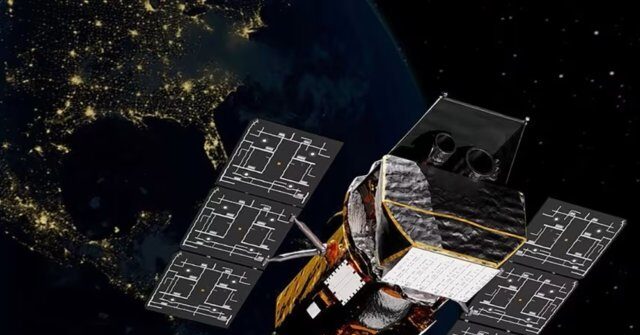
After more than two decades of service, NASA’s Swift Observatory has made its uncontrolled descent back to Earth, marking the end of a groundbreaking mission that far outlasted its original two-year timeline. The 3,200-pound spacecraft, which hunted gamma-ray bursts and cosmic explosions, re-entered the atmosphere mid-morning today, according to NASA tracking data.
Projections indicated that surviving fragments would scatter across a broad equatorial band spanning Central and South America, Africa, parts of Asia, and northern Australia. The agency confirmed this pattern with a statement noting that “re-entry locations of any surviving components can vary from hemisphere to hemisphere.”
The Mission That Wouldn’t Quit
Launched in 2004, Swift’s primary mission was intended to last just two years. Instead, the observatory operated for 21 years—detecting more than 2,000 gamma-ray bursts, 1,400 exploding stars, and monitoring black holes tearing apart neighboring stars. Its unique ability to pivot rapidly toward sudden cosmic events made it an indispensable “first responder” in space astronomy.
A Failed Rescue Attempt
NASA made a last-ditch effort in August to extend Swift’s operational life by launching a $30 million rescue mission called Link. The spacecraft encountered catastrophic issues, however, spiraling into an uncontrollable spin that ultimately forced NASA to abandon the plans. “This is not the outcome we were working toward,” NASA Administrator Jared Isaacman said at the time.
The Sun Sealed Its Fate
Swift’s demise was hastened by increased solar activity, which dragged its low Earth orbit down faster than anticipated. After months of gradual orbital decay, the observatory’s systems were finally shut down in late October. By then, its orbit had degraded to the point where stable scientific observations were no longer possible.
Astronomers are now grappling with the void left by Swift’s absence, particularly its early-warning capabilities for other large-scale telescopes. “Our fervent hope is that the lessons learned by the successes of Swift can be applied to new generations of space missions,” said John Nousek, a key scientist on the mission.
Source: www.breitbart.com — https://www.breitbart.com/tech/2026/11/04/nasas-swift-observatory-is-crashing-back-to-earth-today-after-21-years-in-orbit/