
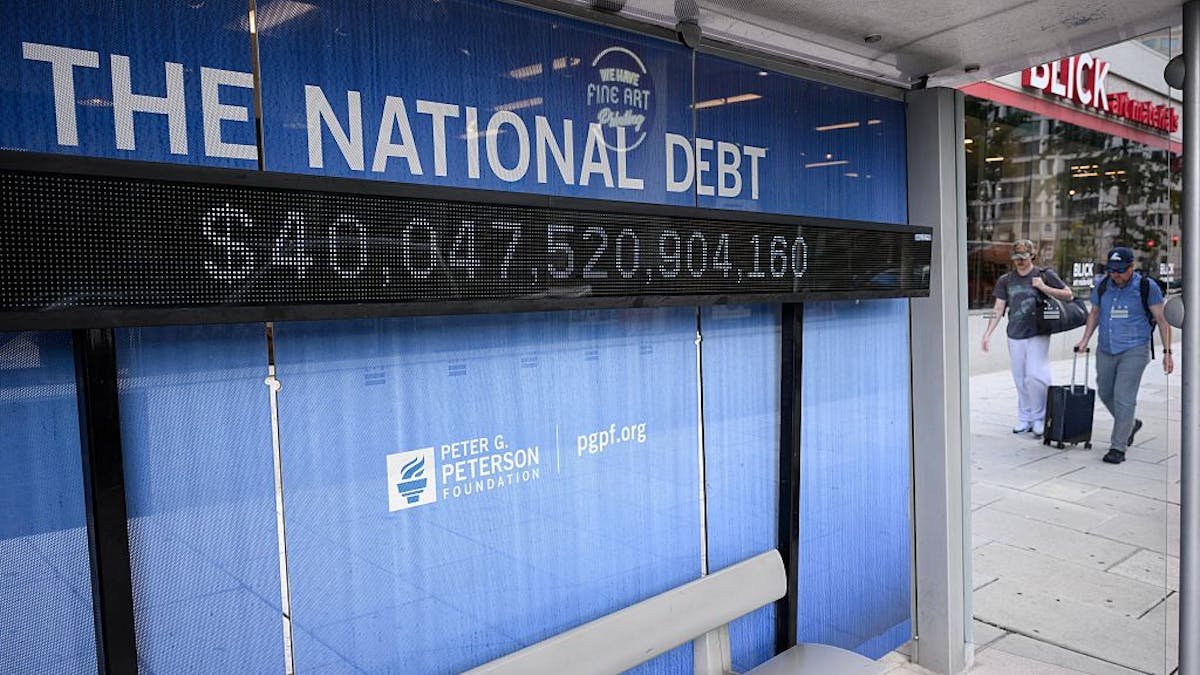
The United States national debt topped $40 trillion for the first time this week, a new milestone that underscores how far federal borrowing has spiraled since President Ronald Reagan sounded the alarm when the debt first reached $1 trillion more than four decades ago.
The crossing, reported Tuesday, came just four years after the debt first surpassed $30 trillion, according to Treasury data cited by financial firm River. The rapid acceleration has renewed scrutiny on federal spending as lawmakers face another government funding deadline at the end of September.
Reagan, in a televised address after the $1 trillion mark was hit in the early 1980s, framed the moment as a warning about the trajectory of federal fiscal policy. “If we as a nation needed a warning, let that be it,” he said.

Since then, the debt has climbed under successive administrations from both parties, with spending consistently outpacing revenue. A chart from River, based on Treasury data, shows that federal spending and the national debt have increased in virtually every presidency since Richard Nixon’s administration.
The $40 trillion milestone arrives as the issue of fiscal responsibility has become a central political flashpoint. President Donald Trump made reducing the national debt a pillar of his 2024 campaign. His administration has pursued a two-pronged approach: Commerce Secretary Howard Lutnick said his job was to raise $1 trillion in revenue, while Elon Musk, who led the Department of Government Efficiency (DOGE) initiative, was tasked with cutting $1 trillion in spending.
Trump himself warned about the dangers of unsustainable borrowing more than a decade ago. In 2012, he described a $17 trillion national debt and a $1 trillion budget deficit as a “national security risk of the highest order.”
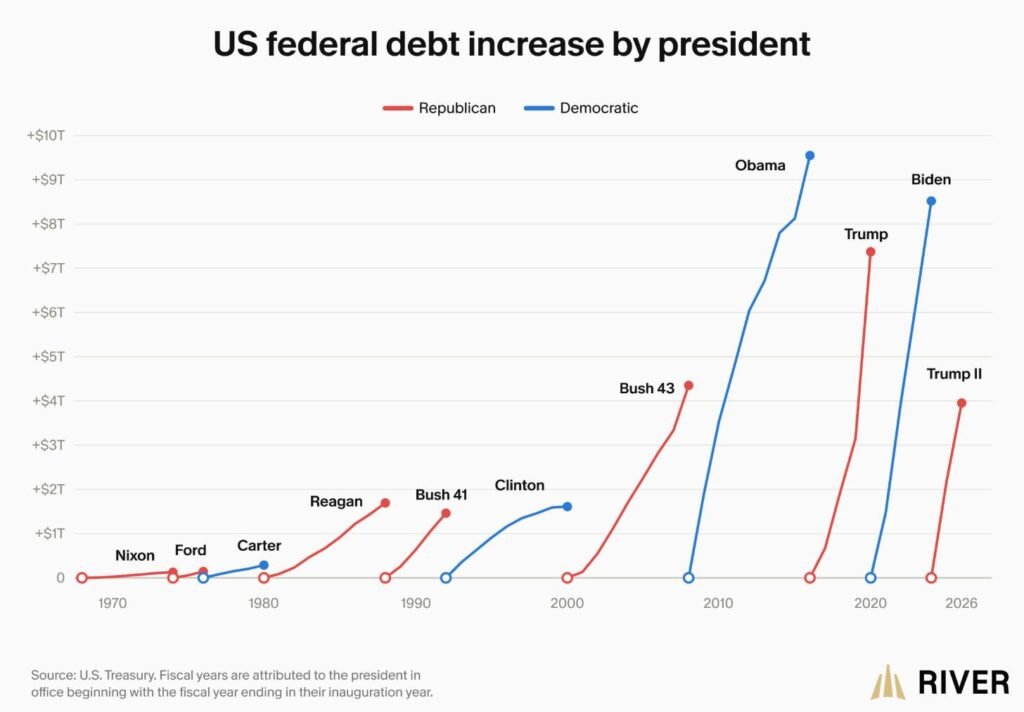
The federal government continues to spend substantially more than it collects, adding billions to the debt each month. The Treasury Department reported a $432.3 billion deficit in July, the largest monthly shortfall since March 2021, when President Joe Biden signed a COVID-19 stimulus package.
Sen. Ron Johnson (R-WI), a longtime advocate of reining in federal spending, has repeatedly called for a return to pre-pandemic expenditure levels. In a recent interview, he argued that the current trajectory is harming future generations. “What we are doing to our children, how we are robbing them of the opportunities and diminishing their prospects, that’s truly immoral,” Johnson said. “And we need to recognize that fact and we need to stop it.”
A Milestone Decades in the Making
The jump from $30 trillion to $40 trillion took just four years, a dramatic acceleration compared to previous trillion-dollar increments. The debt first hit $1 trillion during the Reagan era, and it took nearly two decades to reach $5 trillion in the early 2000s. The pace picked up sharply after the 2008 financial crisis and again during the pandemic, when massive relief spending sent the debt soaring past $28 trillion by early 2021.

Economists and fiscal watchdogs have long warned that the rising debt could eventually crowd out private investment, increase borrowing costs, and limit the government’s ability to respond to future crises. But the political will to address the problem has remained elusive, with both parties often reluctant to cut popular programs or raise taxes.
The $40 trillion figure is a stark reminder of the scale of the challenge. As a share of the economy, the national debt is now higher than it was at the end of World War II, and interest payments on the debt are expected to consume an ever-growing portion of the federal budget.
Political Reactions and the Path Forward
The milestone comes at a politically sensitive time. Congress faces a September 30 deadline to fund the federal government for fiscal year 2027 or pass a continuing resolution to avoid a shutdown. The debt ceiling, which was suspended as part of a 2023 deal, is set to be reinstated in January 2027, setting up another potential fiscal showdown.
Trump’s campaign promise to reduce the debt has collided with the reality of his administration’s own spending priorities, including tax cuts and defense increases. Critics argue that the president’s agenda, along with DOGE’s targeted cuts, has not been enough to offset the structural imbalance between spending and revenue.
Sen. Johnson’s comments reflect a growing frustration among fiscal conservatives that Washington has not taken the debt seriously. He has pointed to pre-pandemic spending levels as a baseline for a more sustainable budget, arguing that the emergency spending of 2020 and 2021 should not become the new normal.
As the debt crosses $40 trillion, the debate over how to address it is likely to intensify. But the milestone also serves as a historical marker: four decades after Reagan’s warning, the debt is 40 times larger, and the urgency has only grown.
Source: www.dailywire.com — https://www.dailywire.com/news/reagan-sounded-the-alarm-at-1-trillion-americas-national-debt-just-hit-40-trillion