
When word spread that a jetliner had nearly been turned into a weapon over the skies of the Middle East, the immediate instinct in Israel was not panic but recognition. In a column for American Thinker, Bill Ponton writes that the thwarting of the attempted hijacking of FlyDubai flight 1073 became the latest chapter in a story Israelis know all too well: a nation repeatedly targeted for destruction by what he calls a “death cult,” and a people who refuse to go quietly.
The hero of that episode, according to Ponton, is Yaniv Hayun, an Israeli who grasped the stakes in an instant and stormed the cockpit, subduing the co-pilot described as a jihadist bent on crashing the aircraft. Ponton does not dwell on the mechanics of the takedown so much as the meaning of it. What Hayun did, in his telling, was choose life over death at the exact moment such a choice was demanded of him.
An echo of Shanksville
For an American readership, Ponton reaches for the closest historical parallel: United Airlines Flight 93. On September 11, 2001, passengers aboard that plane rushed the cockpit before the hijackers could complete their mission, and the aircraft went down in an empty field near Shanksville, Pennsylvania, killing everyone aboard. That act of resistance, he argues, is the same instinct that animated Hayun — ordinary people refusing to let themselves be turned into instruments of mass murder.
The difference, Ponton suggests, is context. For Americans, Flight 93 was a singular horror that arrived out of a clear blue sky. For Israelis, the FlyDubai episode is a reminder of something more chronic: forces that, in his words, will never cease in their efforts to destroy the nation of Israel. That is why, he writes, the Israeli people will not go quietly into the night. They understand where passivity leads, and Ponton does not soften the image — a manicured pathway to the entrance of a gas chamber.
That line is the emotional hinge of the piece. It is not a policy argument so much as a statement of historical memory, the kind that shapes how a small country on the Eastern Mediterranean conducts itself. Ponton’s claim is that Israel’s slim hold on that coastline is guarded by men like Hayun, and that so long as such men exist, a hostile world will never find the Jewish nation in a posture of submission.
The Netanyahu moment
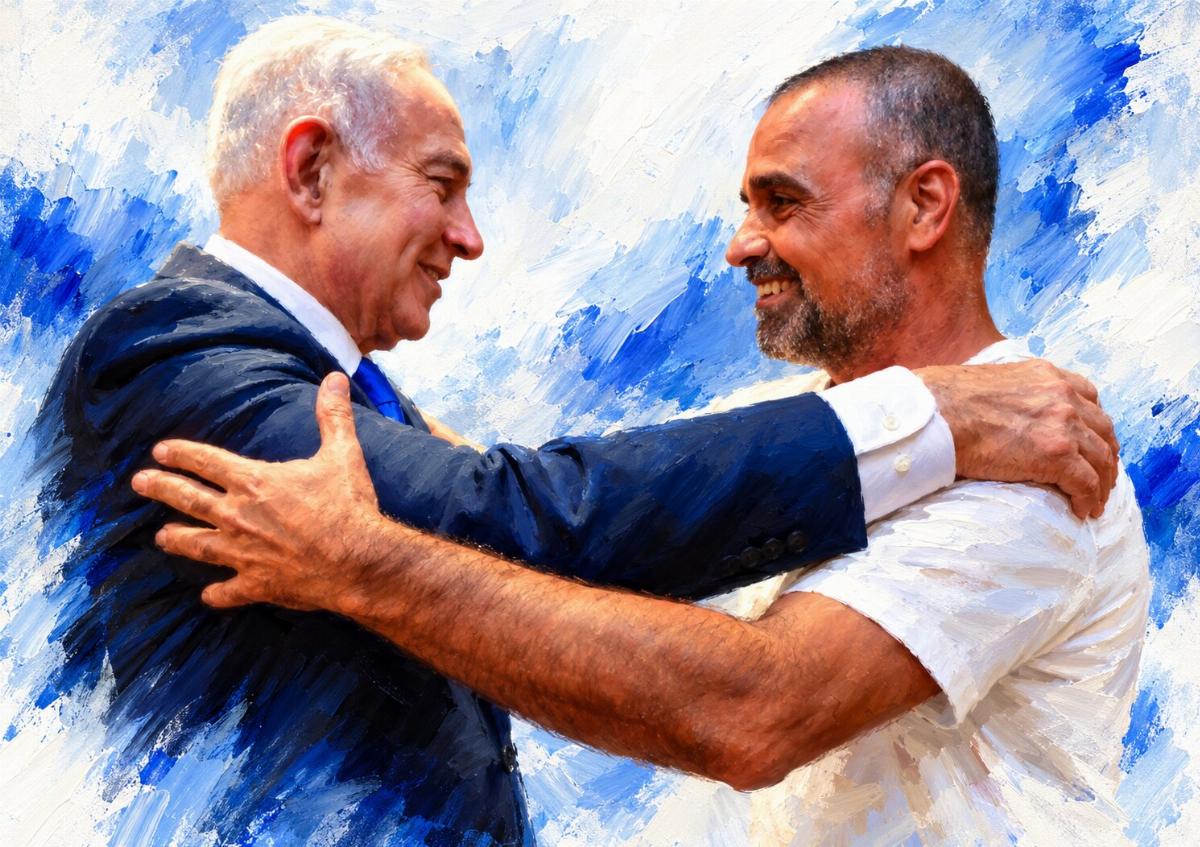
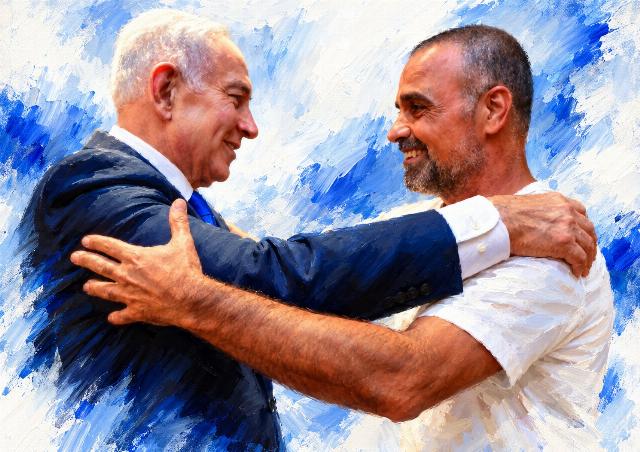
Into that frame steps Benjamin Netanyahu. The prime minister’s decision to sit down with Hayun and ask him to recount the thwarted hijacking is, in Ponton’s reading, not a public relations exercise. It is one soldier speaking to another — an acknowledgment that what Hayun did was brave and selfless, and that a nation is grateful. The distinction matters to the columnist, who seems to be pushing back against the cynicism that greets any head-of-government photo opportunity. This one, he insists, is different.
To make that case, Ponton spends time on Netanyahu’s biography, and not the parts usually trotted out in American commentary. He notes that as a boy, Netanyahu lived with his family in Cheltenham Township, Pennsylvania, playing in peaceful fields not unlike the one where Flight 93 came down. He and his brother Yonatan, Ponton writes, grew dissatisfied with what he characterizes as the superficiality of the 1960s youth counterculture and returned to Israel to serve in the Israel Defense Forces.
Yonatan Netanyahu was killed in the Entebbe raid of 1976, part of the Israeli operation to rescue more than a hundred Jewish hostages held after the hijacking of Air France Flight 139. His brother went on to lead the country. The implication Ponton draws is that Netanyahu’s understanding of America is neither naive nor sentimental. He knows the country, and according to the columnist, harbors no illusions about it.
What the column is really arguing
Stripped of its rhetorical flourishes, the American Thinker piece is making a few interlocking claims. The first is that the FlyDubai plot belongs to a pattern rather than an aberration. The second is that Israeli resolve is not a slogan but a lived response to that pattern, forged by generations who have seen where submission ends. The third is that the relationship between Israel and the United States, however warm at the leadership level, should not be mistaken for dependence on American goodwill — the column’s portrait of Netanyahu is of a man who appreciates the alliance without romanticizing it.
There is also an unstated fourth claim, aimed squarely at the publication’s American audience. By linking Hayun’s actions to those of the Flight 93 passengers, Ponton is inviting readers to see the two countries as bound by a shared understanding of what it means to face an enemy that cannot be negotiated with, only resisted.
Whether that framing resonates depends on where a reader starts. What the column does not do is offer a detailed accounting of the FlyDubai incident itself, the investigation into the co-pilot, or the official Israeli response beyond the prime minister’s meeting. It is an argument about character and memory, not a news report, and it reads as an effort to shape how its audience interprets an event still fresh in the headlines.
What emerges is less a portrait of a single meeting than of a national self-conception. In Ponton’s telling, the sit-down between Netanyahu and Hayun is a small ceremony of gratitude, the kind a country performs when one of its own steps forward at the worst possible moment. The columnist’s closing note — that the ability to speak one’s mind is crucial to the republic — is a familiar appeal from American Thinker to its readers, but here it doubles as a quiet warning: the same forces that produced the FlyDubai plot, in his view, are not finished, and the nations that value open societies should not assume they are safe from them.
Source: www.americanthinker.com — https://www.americanthinker.com/blog/2026/10/never-again-once-again/