
The New York Times found itself in the unusual position of having to explain why it published deeply critical reporting about a Democratic Senate candidate—and the newspaper’s defense has sparked a new debate about journalistic ethics and false equivalencies.
In a recent interview, Times reporters Kellen Browning and deputy politics editor Amy Gardner discussed their decision to publish two damaging stories about Alaska Democrat Mary Peltola’s Senate campaign in the weeks leading up to the November election. While their commitment to journalistic integrity earned praise, their attempts to soften the blow by drawing parallels to Republican tactics have come under scrutiny.
The Original Reporting That Sparked Questions
The controversy began in September when the Times published what can only be described as a brutal examination of Peltola herself. According to American Thinker, the piece included documented allegations that Peltola had wished death through a botched abortion on a local Planned Parenthood board member, ended a message about the organization with “FUCK THOSE BITCHES,” used the slur “retard” to describe someone who had offended her, and inappropriately used campaign staffers for personal pet-sitting duties. Peltola denied some accusations and apologized for the slur.
But the follow-up story proved even more consequential. The Times reported that Peltola’s campaign had actively sought out a candidate named Daniel J. Sullivan—a self-described centrist with a voting record that included supporting Hillary Clinton, Joe Biden, and Kamala Harris. The catch? His name was remarkably similar to sitting Republican Senator Daniel S. Sullivan, creating what critics characterized as deliberate voter confusion.
The unusual nature of these reports—critical journalism about a Democratic candidate from a newspaper often accused of liberal bias—raised eyebrows across the political spectrum. Why would the Times publish such damaging material about a Democrat so close to an election?
The Ethical Defense
In their interview, Browning and Gardner offered straightforward answers that harkened back to traditional journalistic principles. Gardner explained that they published “as soon as we had it nailed down,” and crucially, that withholding the story would have been “a more overt act of putting our finger on the scale of this election.”
“Publishing what we knew, and letting readers decide how they felt about it all, was the only ethical option,” Gardner stated. Browning echoed this sentiment, saying he didn’t “have a side in this race” and simply wanted “people to be informed about what’s happening in it.”

These statements represent a refreshingly old-school approach to journalism—publish the facts and let readers make their own judgments. For critics who have long accused mainstream media of suppressing negative Democratic stories while amplifying Republican scandals, the Times’ willingness to publish appeared to represent genuine editorial courage.
The Problem With “Both Sides”
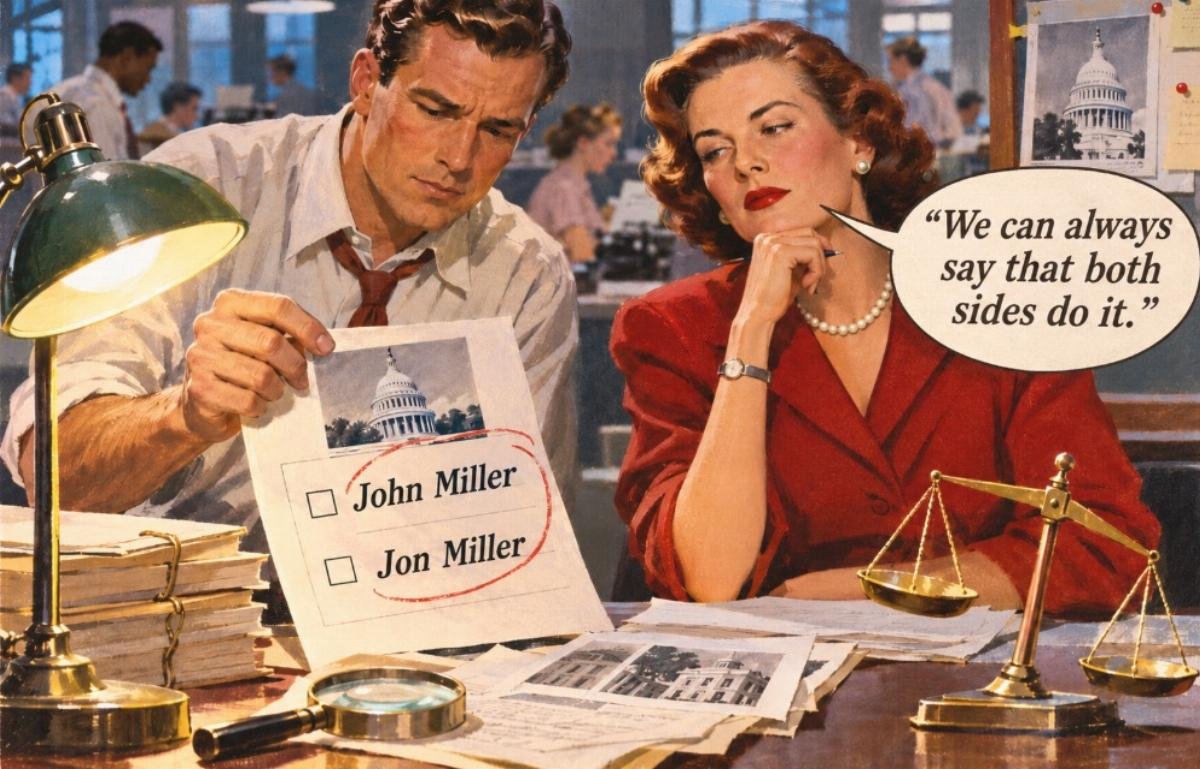
But according to American Thinker, the Times then undermined its ethical stance by repeatedly suggesting that what Peltola’s campaign did amounted to standard “ballot-stacking”—and that Republicans, including in Alaska, had done the same thing.
The interview included multiple assertions of Republican equivalency. The interviewer noted that “ballot-stacking is generally considered legal” and that “Republicans have used the tactic in Alaska.” Gardner claimed the Times had “written extensively about other ballot-stacking efforts, by both parties—including in Alaska this year.” Browning added that “Democrats have made the point that Republicans have done this, which is true.”
Yet American Thinker points out a crucial detail: the Times interview provided no specific examples of Republican ballot-stacking comparable to Peltola’s alleged actions.
Apples and Oranges?
To understand the critique, it’s important to distinguish between different types of electoral maneuvering. Traditional ballot-stacking involves supporting existing candidates whose platforms might split your opponent’s vote. A classic historical example came in 1912, when Theodore Roosevelt’s third-party candidacy split the Republican vote and helped Democrat Woodrow Wilson win the presidency.
According to American Thinker, Alaska Republicans did engage in ballot-stacking during the Senate primary, spending money to promote Democrat Carol “Kitty” Hafner and Green Party candidate Richard Grayson—both already in the race—hoping to weaken Peltola. In the 2024 House race, when two Republicans withdrew leaving only Nick Begich on the ballot, a Democrat named Eric Hafner (Carol’s son, who was serving a prison sentence in New York and had never lived in Alaska) ended up on the ballot. Republicans intervened in a lawsuit to keep him there, seeing it as beneficial to having consolidated their own ballot.
But American Thinker argues that what Peltola’s campaign allegedly did was fundamentally different. Rather than supporting an existing candidate, the campaign reportedly conducted “a concerted effort to find someone whose name was virtually indistinguishable from Senator Sullivan’s.” The suggestion is that this crossed a line from strategic ballot management into deliberate voter deception—making voters believe they were voting for someone other than their intended choice.

The Legal Verdict Adds Complexity
The situation gained additional gravity when, according to the reporting, the director of Alaska’s Division of Elections concluded in June that Daniel J. Sullivan had attempted to use the incumbent’s ballot name and political affiliation to confuse voters. The Alaska Supreme Court subsequently restored Sullivan’s place on the ballot—not because it found his intentions innocent, but because it determined election officials lacked the authority to disqualify him on those grounds.
This legal twist suggests that while the conduct may have been ethically questionable, it navigated the boundaries of what election law could address. The court essentially said: this looks bad, but we don’t have the tools to stop it.
The Deeper Question About Media Standards
American Thinker’s critique ultimately focuses less on the Times’ decision to publish and more on its apparent need to cushion the blow with Republican comparisons. The argument is that by repeatedly suggesting both parties do the same thing—without providing equivalent examples—Browning and Gardner undermined their own stated commitment to letting readers judge the facts.
If the reporting about Peltola’s campaign is accurate, and if it does represent a different level of electoral manipulation than standard ballot-stacking, then drawing false equivalencies serves neither truth nor readers. It’s the journalistic equivalent of saying “everyone does it” without establishing that everyone actually does do that particular thing.
The irony is that the Times’ original decision to publish—to trust readers with uncomfortable information regardless of partisan impact—represented genuine journalistic courage. But the subsequent need to contextualize that decision by minimizing what Peltola’s campaign allegedly did, or by suggesting Republicans routinely do the same, potentially compromised that initial ethical stand.
As American Thinker puts it, “while Kellen Browning and Amy Gardner purport to speak out for journalistic ethics, there’s no getting around the fact that both imply Peltola’s campaign did nothing different from what Republicans have done. And in my opinion, that’s not ethical at all.”
Whether readers agree with that assessment may depend on their own evaluation of the examples provided—and whether recruiting a near-namesake candidate truly differs in kind, rather than just degree, from other forms of political gamesmanship that both parties employ. What’s clear is that even when major news outlets try to play it straight, the impulse to contextualize can itself become a form of editorializing.
Source: www.americanthinker.com — https://www.americanthinker.com/blog/2026/11/the-times-feels-compelled-to-justify-reporting-on-dem-shenanigans-in-alaska/