
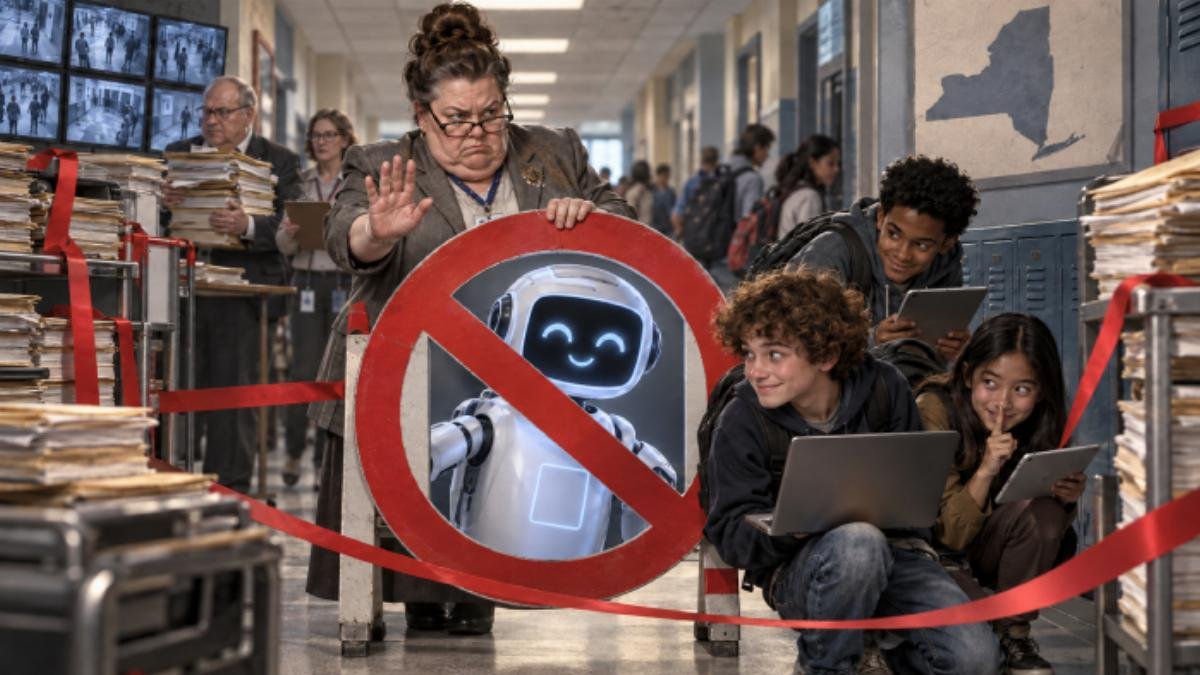
New York has banned artificial intelligence tools in its schools, and one commentator thinks the state just handed itself a problem it can’t enforce its way out of. Writing for American Thinker, Raushan Gross argues that the ban will accomplish the opposite of what lawmakers intend — much like every other prohibition in history.
His case rests on a simple historical observation: bans rarely eliminate a cause, and often barely dent the effect. What they reliably produce, he writes, is two things — more jobs for bureaucrats and a thriving underground market.
The piece, published September 14, opens with a question that cuts straight to the practical absurdity of the policy: who is actually going to chase down students who use AI for a school assignment?
The Enforcement Question Nobody Has Answered
Gross predicts New York will soon find itself hiring people to do exactly that — tracking down eighth-graders and their parents who work around the ban to finish homework. He describes the emerging enforcement posture as an “inquisition” of school-aged kids, and asks the obvious follow-up: what happens when a student gets caught?
There’s no satisfying answer in the piece, and that’s rather the point. The columnist’s broader contention is that bans throughout history have served the people enforcing them more than the people living under them. “There is now, in effect, an inquisition of school-aged kids using AI for school-related purposes,” he writes, framing the policy as less about learning outcomes than about control.
What he finds genuinely surprising is who is doing the banning. The people imposing these restrictions on select grade levels, he notes, grew up with the internet, high-powered computers, and calculators — tools their own predecessors and teachers neither had access to nor understood. When they needed information, nobody demanded they produce original thoughts from thin air. They Googled it.

Students today are doing something functionally similar, Gross argues, just with different names on the software. They’re also told to think critically for themselves, even as the adults setting the rules remember downloading music from friends without paying for it and using calculators instead of pen and paper to grind through hard math problems. That generation was also the first to build its social life on social media, sharing ideas online long before anyone thought to regulate it.
Bans Don’t Kill Demand — They Relocate It
The core of Gross’s argument is economic rather than educational. Bans imposed on the general public, he writes, aren’t always imposed out of concern for the general public. And if you ban AI tools in the name of protecting student originality, you don’t get originality — you get a black market.
Such markets form whenever people want a banned product or service badly enough, he explains, and believe they have to go around the rules to get it. That logic applies to AI homework assistance just as readily as it applied to anything else that’s ever been outlawed.
Gross runs through a list to make the point: firearms, gasoline-powered leaf blowers, free music downloads, plastic grocery bags. In each case, the demand didn’t vanish when the decree landed. The product or service found its way back into society regardless. There’s no reason to expect AI to behave differently.
His most pointed prediction is about what happens to middle and high schoolers who obtain AI help through these informal channels. Will they be prosecuted? Chased down? Fined? The AI inquisitors, as he calls them, are essentially telling kids not to use tools powered by the same technology that increasingly runs social media and countless other applications they interact with daily. In his telling, that’s impossible — the AI ship has already sailed, and we live in an AI world whether the state’s education bureaucracy likes it or not.
The Jobs Nobody Was Hoping For
There’s a fiscal thread running through the essay too. Gross argues that mandated bans create jobs that aren’t tethered to market supply and demand — positions taxpayers are forced to fund. In this case, that means third parties monitoring students’ AI use both inside and outside of school.
These new “AI vigilantes,” as he describes them, would be tasked with hunting down attempts to circumvent the ban. The bill for all that surveillance, he contends, will run higher than simply teaching students how and when to use AI tools for learning would have cost.
At least, he concedes wryly, supporters could claim AI created new jobs — just not the ones anyone wanted. Particularly awkward timing, he adds, given that demand for AI skills in the future workplace keeps climbing. The state is simultaneously preparing students for a labor market that rewards AI fluency and punishing them for developing it on their own time.
An Underground Market for Homework Help
The essay’s sharpest image is of students illegally paying for AI or AI-assisted homework help from an underground provider. When that happens, Gross writes, the policy is moving in precisely the opposite direction from the one intended — and it’s all being done in the name of creativity.
He treats it as a near-certainty rather than a hypothetical. Whenever people prize a banned product that isn’t readily available through legal means, some will find a way to make illegal transactions. Bad actors step in fast to build illegal markets where legal ones used to operate. That pattern, he notes, has repeated itself since time immemorial.
The piece ends by circling back to the question in its own headline — the squeeze worth the juice? — and to a broader concern about open expression. “Now more than ever,” Gross writes, “the ability to speak our minds is crucial to the republic we cherish.”
Whether or not readers share his framing of the policy as an inquisition, the enforcement gap he identifies is a real one. New York can write the ban. It’s considerably less clear who’s supposed to make it stick — or what it will cost to try.
Source: www.americanthinker.com — https://www.americanthinker.com/blog/2026/09/banning-ai-in-ny-schools-is-the-juice-worth-the-squeeze/