
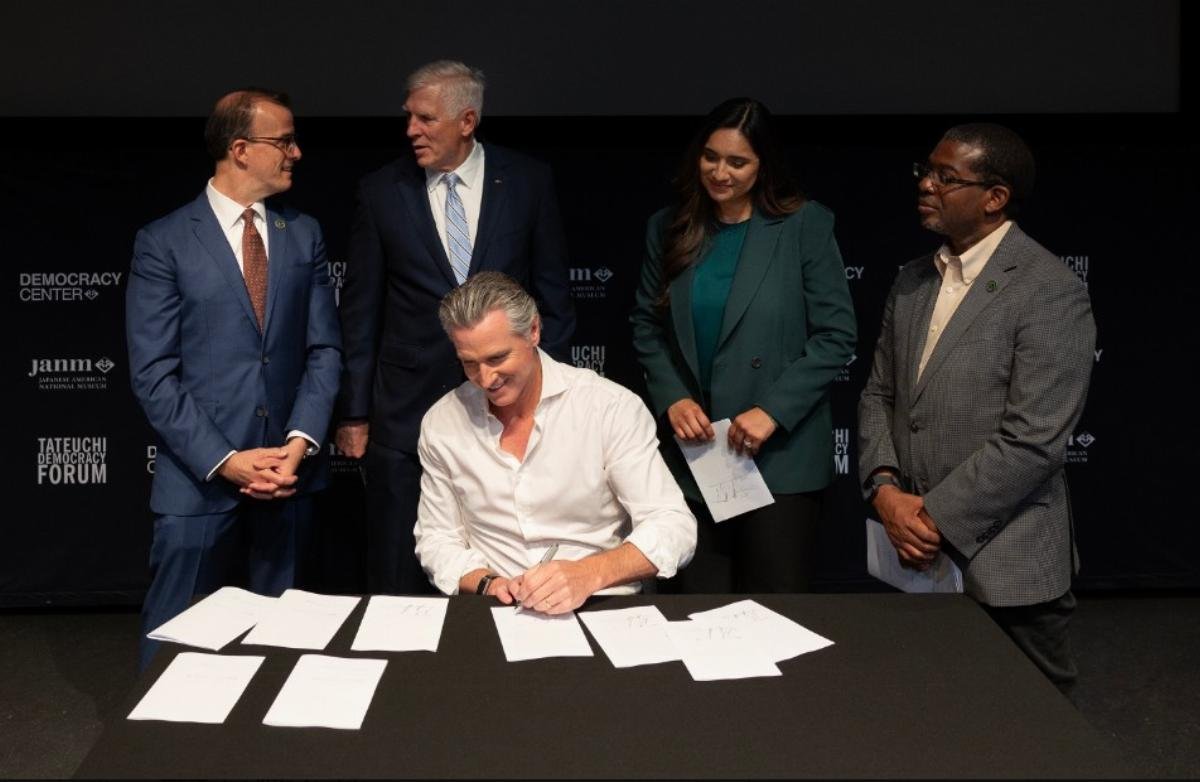
California Gov. Gavin Newsom has signed legislation making it a felony to illegally seize or interfere with ballots before an election is certified, a move he framed as a defense of the state’s elections. The response from the U.S. Department of Justice was swift and blunt: nothing a governor signs can stop federal prosecutors from investigating voter fraud.
Writing in American Thinker, Monica Showalter argues the new law is less about protecting voters than about shielding what she calls the “Democrat cheating machine” from federal scrutiny. Her piece, published September 20, 2026, is less a neutral account of the legislation than an indictment of the governor’s motives and a catalogue of election-fraud cases she says prove the point.
What Newsom signed, and what the DOJ said back
Announcing the signature, Newsom said the law makes it a felony to illegally seize or interfere with ballots before elections are certified, adding that California is “not messing around” when it comes to its elections. The framing invites an obvious question, and Showalter asks it directly: who exactly is trying to seize California’s ballots? Her sarcastic answer — the Chinese? The Mexicans? — sets up the real target of the piece, which is the federal government.
The Justice Department’s response, quoted in the article, leaves little room for interpretation. “Just so there’s no confusion, nothing a state governor signs can prevent @TheJusticeDept from conducting lawful investigations into voter fraud,” the office said, adding that it has already begun indicting election fraud in California and will keep investigating, arresting and prosecuting violations.
That exchange is the hinge of Showalter’s argument. If the Justice Department is already bringing election-fraud cases in the state, she reasons, then a state law aimed at blocking interference with ballots functions as a shield for the people being investigated.
The counting problems she points to
Showalter’s case rests heavily on the mechanics of California vote counting. She describes elections that stretch on for weeks until Democrats get the result they want, and races that flip overnight as late-arriving ballots break overwhelmingly for a candidate who had been trailing in the initial count. She cites Los Angeles as her example of that pattern.
She also points to a mayoral primary earlier in 2026, describing it as a contest in which DSA-linked candidate Nithya Raman took second place over Republican Spencer Pratt, who had been tallying strongly until what Showalter characterizes as last-minute irregularities. The article treats the episode as evidence that the problems are not hidden but out in the open.
The fraud cases cited in the piece
The article highlights two specific prosecutions it presents as representative. In the first, a Marina del Rey woman pleaded guilty to paying homeless people on Skid Row between two and three dollars each to register to vote. According to the piece, Brenda Lee Brown Armstrong admitted to the federal crime of buying voter registrations from vulnerable people living on the street.
The second involves a building manager arrested for voting multiple times in 2024 by filling out ballots on behalf of former tenants. Showalter names the woman as Esperanza Contreras and stresses that the fraudulent mail-in ballots were counted.
Her characterization of these cases is pointed: she describes them as involving people who do not vote themselves but whose ballots are useful to nonprofit rackets that serve, in her telling, as foot soldiers for Democrats.
She then widens the frame. White House senior advisor Stephen Miller, she notes, argues that noncitizens are voting as well, and that federal authorities are apprehending more fraudulent voters than ever. The article quotes Miller saying noncitizen voting is “widespread, commonplace and pervasive,” and that blue states have refused to share their voter rolls while liberal judges have blocked the Department of Homeland Security from scrubbing them.
The hypocrisy charge
From there, Showalter turns to what she considers the central contradiction. Why, she asks, does Newsom speak so piously about “our democracy” when what he means, in her reading, is “our Democrat machine” — the same machine she says is already taking from voters?
Her sharpest grievance concerns redistricting. She writes that roughly half of California votes Republican and that those votes are being openly stolen, claiming the state’s congressional map, drawn under Newsom, ensures Republicans can never win a congressional race in California. Having already disenfranchised those voters, she argues, the governor is now extending the same approach through what she calls a protection racket dressed up as democracy-saving.
She asks whether there has ever been a bigger hypocrite in the history of the Democratic Party and answers her own question with a flat no. Looking ahead to the inevitable court fight over the new law, she predicts a showdown she describes, with heavy irony, as “fiery but peaceful” for the governor.
What the dispute is really about
Strip away the rhetoric and the disagreement is a familiar one about federalism and elections. States run their own elections, but federal law gives the Justice Department authority to prosecute voter fraud, and the department is asserting that authority in California right now. Newsom’s law targets interference with ballots before certification. The federal government says that changes nothing about its investigations.
Whether the statute survives a legal challenge, and how courts reconcile a state’s interest in protecting ballots with Washington’s interest in prosecuting fraud, is the fight Showalter anticipates. Her column is not a prediction of how that fight ends. It is an argument that the governor picked the wrong side of it — and that the timing of the law, arriving as federal indictments land in his state, tells you everything about why he signed it.
Source: www.americanthinker.com — https://www.americanthinker.com/blog/2026/09/why-is-california-s-gov-gavin-newsom-so-interested-in-stopping-federal-election-fraud-investigations/