
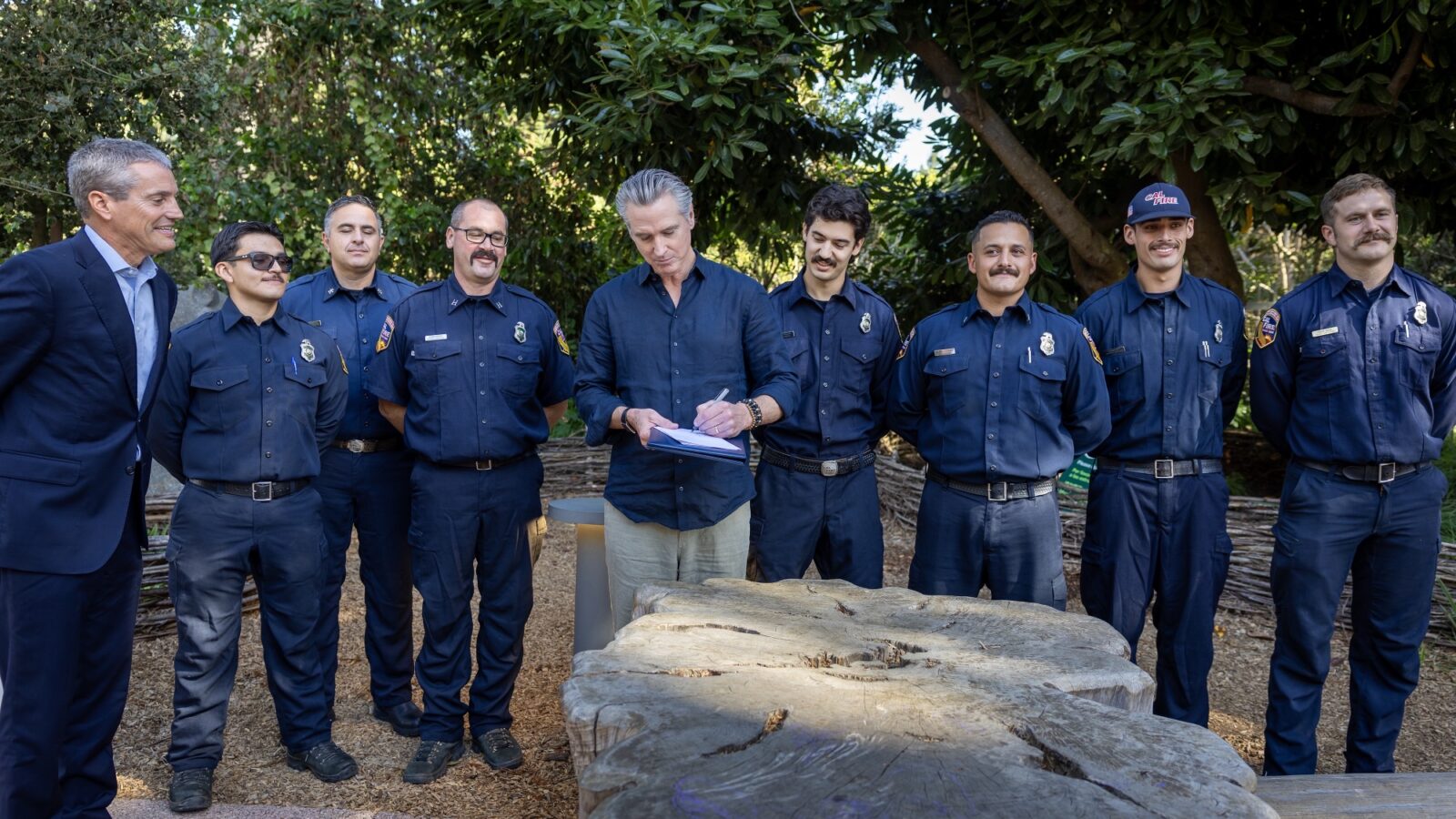
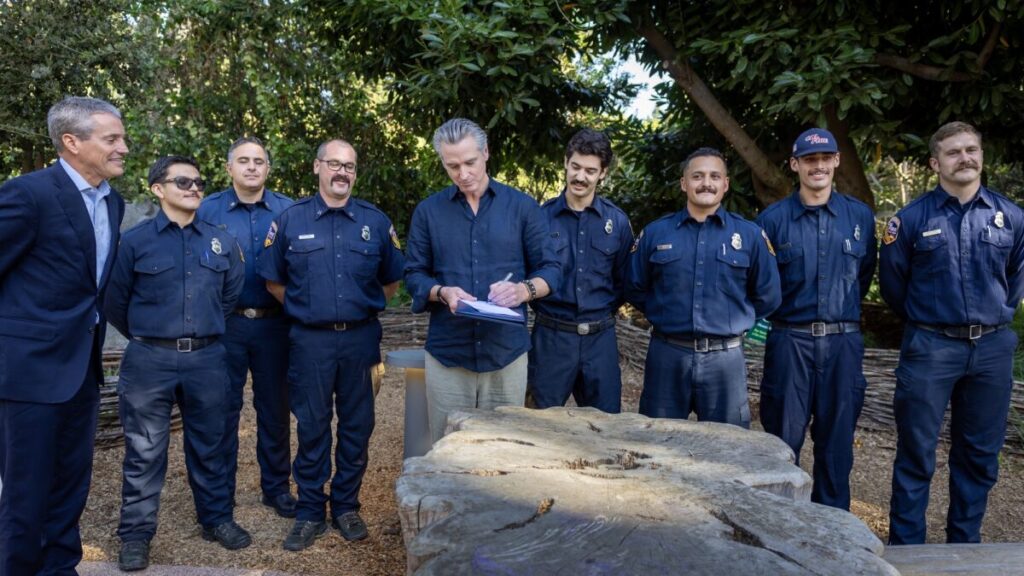
California Gov. Gavin Newsom signed a package of wildfire-related bills on Sept. 29, touting the measures as new tools to prevent and fight fires across a state that has endured years of devastating blazes. But one bill in the package is drawing sharp criticism — not for what it spends, but for what it shields.
According to The Federalist, the announcement’s descriptions of the legislation tended toward the vague. SB 1153, authored by Sen. Anna Caballero (D-Merced), is listed simply as “Disaster preparedness: urban retail water suppliers and public water systems: wildfire.”
The bill’s substance, as reported by The Federalist, is more specific: it releases public water systems from liability connected to wildfires. Under its language, the failure of an urban retail water supplier to implement or comply with certain required actions — or the inability of a public water system to maintain water supply or water pressure during a wildfire — “shall [not] be considered a substantial cause of the damages resulting from a wildfire.”
A legal shield arrives amid active litigation
The signing comes as residents of Pacific Palisades, the Los Angeles neighborhood leveled by fire, are suing the City of Los Angeles and the state of California over the destruction of their community. At the center of their argument is an offline reservoir in the neighborhood that they say deprived firefighters of a critical water source.
Hydrants frequently struggle to keep pace with demand during major wildfires, but Palisades residents contend in court that the empty reservoir made a bad situation worse. Documentary filmmaker Gabriel Mann, whose work focuses on wildfire and wildland firefighting, has publicly backed that argument, writing that the reservoir “has a Helispot” — a landing zone for helicopters.
“Since it was offline, the copters — which were the first resources on scene — had to fly miles away to reload, delaying their initial attack at the most critical time: when the fire was still small and manageable,” Mann wrote, according to The Federalist. “Because that Helispot was offline, copters spent over 6 additional hours outside the fire zone to find water.”

The timing has not gone unnoticed. As the Palisades litigation proceeds, the newly signed law limits the grounds on which water agencies can be held responsible for wildfire damages — precisely the theory the residents are advancing.
Reaction from those who lost homes
Spencer Pratt, the former Los Angeles mayoral candidate who lost his own home in the Palisades fire, has commented on the bill. The Federalist noted that readers may want to avoid clicking through to his remarks “if you don’t like to read profanity” — an indication of just how blunt the reaction has been from fire survivors.
Newsom signed the legislation in the presence of firefighters, and his office framed the package as supporting “new tools to prevent and fight wildfires.” The governor has made wildfire response a centerpiece of his public messaging in recent years, particularly as the state has faced scrutiny over preparedness and utility infrastructure.

The liability provision in SB 1153 is not the only element of the package, though the announcement’s summaries of the other bills were similarly broad. What stands out to critics is the pairing of the celebration with a provision that could foreclose a category of claims from the very residents still seeking accountability in court.
For supporters, such liability limits are a matter of protecting public agencies from suits that could make it harder to recruit and retain water system operators, or that could impose costs that ultimately fall on ratepayers. Water systems, the argument typically goes, are not firefighting agencies and should not be treated as guarantors of water pressure at every hydrant during an inferno.
For critics, the bill sends a different message: that the state is insulating itself from the consequences of infrastructure failures at the moment the public most needs someone to answer for them.
What comes next
The Palisades lawsuits will now proceed against the backdrop of the new law. Courts will have to sort out how SB 1153 interacts with the residents’ specific claims, including whether the offline reservoir falls outside the protection the legislature just enacted or whether the provision is retroactive in effect. Those questions are likely to be litigated for months, if not years.
Meanwhile, the broader debate over wildfire liability in California — who pays when a community burns, and whether the answer should ever be “no one” — is far from settled. Newsom’s signing statement cast the package as a step forward. The fire survivors pursuing claims in Los Angeles may see it differently.
According to the source reporting, the governor’s office did not offer detail beyond the bill summaries in its announcement, leaving the specifics of SB 1153 to be discovered by those who read the underlying text — which, as The Federalist noted pointedly, is where the liability shield actually lives.
Source: thefederalist.com — https://thefederalist.com/2026/09/30/california-protects-itself-from-accountability-then-brags-about-it/
Source: thefederalist.com
Related coverage
- GOP Pushes Amnesty Despite Midterm Losses, Sparking Fury Among Conservatives
- Cornell President Says University Must Teach ‘Responsibility’ in Jane Doe Lawsuit Fallout
- White House Revokes CNN and MS NOW Press Badges as Trump’s Media Ban Begins
- Wisconsin Man Charged With Filming Women and Girls in Racine Target Fitting Rooms