
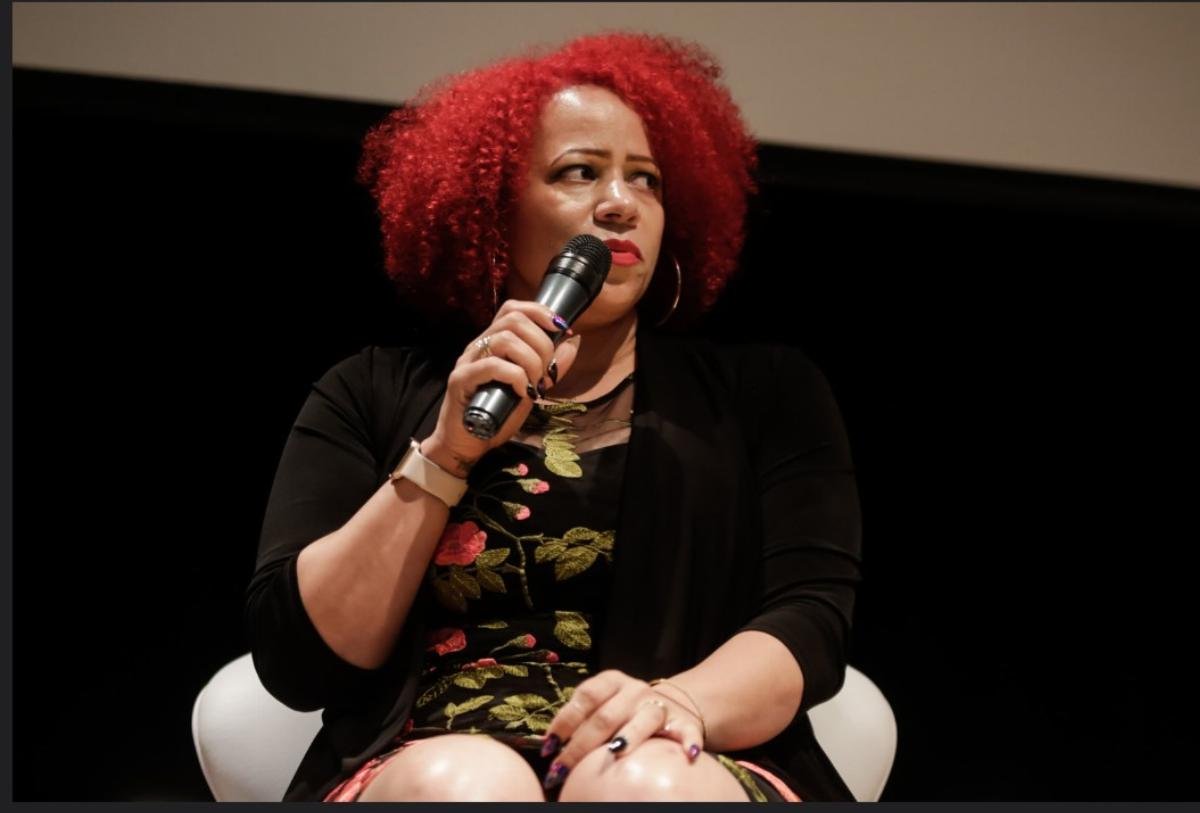
Nikole Hannah-Jones, the journalist behind the 1619 Project, has published an essay expressing remorse for placing her daughter in a struggling Brooklyn public school — and the admission is drawing fresh scrutiny not for what she wrote, but for what she left out.
In the piece, according to an American Thinker column by Monica Showalter, Hannah-Jones recounts how her daughter Najya eventually confronted her with a pointed question: whether her mother knew the school was bad when she enrolled her there. By then, the girl had gaps in fundamental skills that made it impossible to test into a strong high school.
The outlet reports that Hannah-Jones had framed the decision as an act of solidarity — banking on her stature to push a majority-Black school into improvement and lift other inner-city students along with her own child. Instead, the columnist writes, the school was plagued by absent teachers, substitutes who didn’t instruct, an absentee principal, and stretches with no teacher at all.
A school described in stark terms
Showalter’s critique details the conditions at P.S. 307 in Brooklyn as catalogued in the essay: no homework assignments, ungraded classwork, and repeated emails to teachers that went unanswered after Hannah-Jones was told her daughter was not proficient in any subject. When she requested test scores and graded work to understand the problem, the columnist says, the requests were ignored. Her daughter was moved along with all A’s, a result attributed in part to grading on a curve.
Discipline emerges as a central theme in the account. The columnist quotes Hannah-Jones describing a visit during first-grade lunch, when she says she found two classes seated in the cafeteria with no food and no supervision, children chasing, hitting and pushing one another while aides and cafeteria workers looked on. In the quoted passage, Hannah-Jones says she twice intervened, at one point physically separating two boys, and was told by an aide that the lunch period was short-staffed. Her daughter’s response, as quoted in the essay: “It’s always like this, and that’s why I don’t want to go to this school.”
Rather than withdraw her child, Showalter writes, Hannah-Jones continued on to Urban Assembly Unison, a middle school the columnist describes as a woke institution with a food justice club and poor rankings. There, the essay reportedly says, students who caused disciplinary problems commanded teachers’ attention while those who did their schoolwork were ignored.
According to the column, Hannah-Jones raised the resource-allocation complaint with the principal, whom she described as responsive but constrained by the poverty of the student body. Showalter seizes on that explanation, noting that Asian students from immigrant families with fewer financial resources than their Black classmates nonetheless managed to excel academically.
The reckoning at the heart of the essay
The exchange between mother and daughter anchors the piece. Riding in a car, Hannah-Jones recounts telling Najya that test scores alone don’t define a school, and that because her parents could afford tutoring and other supports, they could compensate for whatever the school lacked. She describes the choice as an obligation to participate in a broader struggle for educational equity.
Her daughter’s reply, as quoted by Showalter, cuts straight to the contradiction: “So you had money to send me to one of the best schools, and you chose not to? Because other kids are disadvantaged, you didn’t want to put me in a great school?”
Hannah-Jones’s own conclusion, per the column, is an admission of uncertainty and regret — that she doesn’t know what she accomplished and that she feels she failed both her values and her child.
But it is the blame list that Showalter finds most telling. She writes that Hannah-Jones pointed at whites and Asians for declining to attend failing schools, at the sorting of students at elite institutions, at racism, and at segregation. The columnist also notes that the middle school, by her account, sought to be majority-Black because of federal Title I funding.
The omission the columnist flags
In Showalter’s telling, one culprit never appears: the teachers’ unions.
She argues that the indifferent adults who ignored emails, the teachers who didn’t assign or grade work, the staff who stood by during cafeteria fights, the absent employees, and the disengaged principal all trace back to unions that she says run New York’s schools for themselves rather than for students. The column asserts that the three primary unions are the United Federation of Teachers, the Council of School Supervisors and Administrators, and District Council 37, and that teachers are shielded from dismissal regardless of performance.
Showalter also raises the financial angle, criticizing what she describes as six-figure salaries for underperforming teachers and per-pupil spending of $52,000 annually for the results she documents.
She ties the argument to Randi Weingarten, president of the American Federation of Teachers, which she describes as the UFT’s parent body. In her telling, Weingarten embraced prolonged COVID school closures and promoted the 1619 Project in schools — the same project Hannah-Jones created. Showalter suggests a conflict of interest, citing an AFT website page featuring the two women on a panel together, and speculates that the association may explain why the union escaped criticism.
The column closes by invoking Eric Hoffer’s dictum that those who would sacrifice a generation to realize an ideal are enemies of mankind, and by noting that Hannah-Jones did not spare even herself in her self-assessment — just the institution she left out of her account. As Showalter puts it, some things, in her reading, are bigger than a mere daughter.
The debate lands in a long-running argument over how much responsibility individual families bear for educational outcomes, and how much is structural. For Hannah-Jones, the essay stands as a personal reckoning. For her critics, it’s an incomplete ledger — one that names many institutions while skipping the one that holds the most direct power over the classrooms her daughter sat in.
What remains undisputed across the disagreement is the child at the center of it, whose own question — whether her mother knew — carries more weight than any policy argument built on top of it.
Source: www.americanthinker.com — https://www.americanthinker.com/blog/2026/09/that-one-little-thing-nikole-hannah-jones-failed-to-bring-up-in-her-remorse-over-the-wretched-public-school-where-she-dumped-her-daughter/