
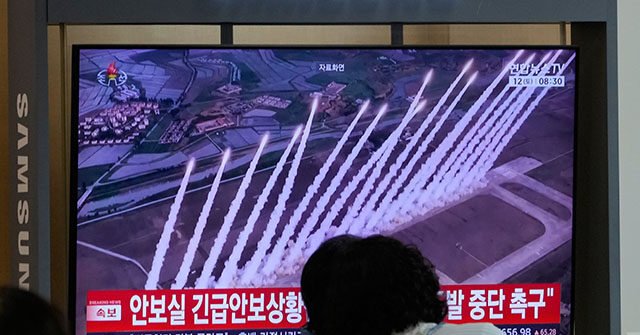
North Korea announced Monday that it carried out a “firepower attack drill” over the weekend involving attack drones, a tactical cruise missile, a large-caliber thermobaric multiple rocket launcher and a tactical ballistic missile, according to the state-run Korean Central News Agency. The disclosure came two days after the exercise reportedly took place, a delay that South Korean observers read as a signal Pyongyang is not trying to antagonize Seoul or Washington.
KCNA said the drill tested “new combat systems” operating together, describing the event as an opportunity to evaluate how multiple weapons perform as a combined force. The agency reported that all strike systems hit their targets with what it called “100 percent hit accuracy,” and quoted military leaders as saying the exercise was meant to ensure “the army does what it should do” and to raise troop morale.
Absent from the proceedings was Kim Jong-un. KCNA made no mention of the North Korean leader attending, and the agency framed the drill in narrowly military terms, offering no broader political commentary. That combination — a low-profile state media write-up and the dictator’s nonattendance — drew attention from analysts in the South, who suggested the exercise was calibrated for restraint rather than provocation.
A signal aimed at Washington?
South Korea’s Korea JoongAng Daily noted that the drill followed closely on the annual Ulchi Freedom Shield exercises between South Korean and American forces, which President Donald Trump moved to scale back in August. In a Truth Social post at the time, Trump said he was “not happy” with the longstanding U.S. commitment to joint exercises with South Korea, calling them costly and saying they “send a signal that is totally inappropriate and hostile” to a country that had been “unthreatening and respectful” under his presidency. He tied the decision to what he described as his “very good relationship” with Kim Jong-un.
According to JoongAng’s reading, the proximity of the North Korean drill to the allied exercises suggests Pyongyang wanted to demonstrate it could respond to an attack mounted by multiple countries at once — while the muted rollout suggests it is simultaneously seeking to “manage” tension with Washington. Trump has also publicly lamented that South Korea’s government, led by leftist President Lee Jae-myung, was reluctant to assist the United States in keeping commerce moving through the Strait of Hormuz, despite Seoul’s heavy reliance on Middle Eastern oil.
Kim never answered the overture directly. His sister, senior official Kim Jo-jong, did — mocking South Korea for depending on Washington for its security while describing her brother’s relationship with Trump as “excellent.”
Questions about Russian help
One detail in KCNA’s account stood out to analysts: the inclusion of a large-caliber thermal-pressure, or thermobaric, rocket launcher. JoongAng observed that Russian forces have used thermobaric weapons in Ukraine and speculated that North Korea may have drawn on Russian operational experience and battlefield lessons.
Moscow and Pyongyang signed a mutual defense agreement in 2024, an arrangement that led Kim to deploy North Korean troops to support Russia’s invasion of Ukraine. Analysts have suggested the deployment was made in exchange for Russian assistance with North Korea’s military technology. Whether the systems tested Saturday reflected direct Russian transfers or know-how absorbed from observing Russian operations remains an open question.
KCNA’s summary was specific about the hardware but silent on politics. The agency listed “attack drones of various kinds, tactical cruise missile, large-caliber thermal-pressure multiple rocket launcher and tactical ballistic missile” as the systems involved, and said the drill was designed to ensure “the unity and simultaneity of firepower attack.” It quoted military officials as saying the ultimate purpose of such attacks would be to “bring down the enemy’s armed forces organizationally and structurally once an order is issued.”
Seoul offers aid, not warnings
South Korea’s response was notably mild. Rather than issuing a warning over the drills, Seoul announced Tuesday that it is open to providing humanitarian assistance to its impoverished neighbor. The Unification Ministry released a report indicating South Korea is prepared to deploy emergency medical aid immediately if requested, including medical equipment for which Seoul has sought a sanctions waiver from the United Nations.
An unnamed South Korean government official told the Yonhap news agency that the approach is “ready to go,” with sanctions and funding questions addressed in advance so that assistance could move immediately if North Korea agrees to accept the equipment.
Washington, for its part, has largely declined to comment on North Korea since Trump’s August announcement on the exercises. No major declaration on the drill has come from the administration, leaving the response to Seoul — and to Kim’s own state media — so far.
Source: www.breitbart.com — https://www.breitbart.com/asia/2026/09/15/north-korea-tests-new-combat-systems-including-advanced-drones-in-strike-drill/