

Two hundred and fifty years ago this week, a Massachusetts colonel climbing a rise near Manhattan looked through his spyglass and saw what military historian Patrick K. O’Donnell describes as his worst nightmare: more than 150 British warships moving up Long Island Sound, with hundreds of Redcoats already coming ashore on a small peninsula.
That officer was John Glover of Marblehead, and the date was October 18, 1776. In an exclusive piece for Breitbart, O’Donnell argues that what Glover did over the next several hours at Pell’s Point in Pelham, New York, deserves a larger place in the story of the Revolution than it usually gets — because it bought George Washington’s army the time it needed to slip away.
A landing five miles north
The British had already tried once. Days earlier, Lord Howe’s forces had been turned back by Revolutionary riflemen at Throggs Neck, prompting Howe to load his men back onto their ships and hunt for another place to come ashore. About five miles north they found Pell’s Point, from which the Eastchester Road led toward King’s Bridge — and, if uncontested, to the trap that could have cut off Washington’s retreat from Manhattan and possibly ended the war.
Local militiamen opened fire on the British soon after they landed, then fell back and joined Glover’s Massachusetts men. By the time Glover’s brigade arrived, according to O’Donnell, the British had pushed a mile and a half inland and taken the high ground.
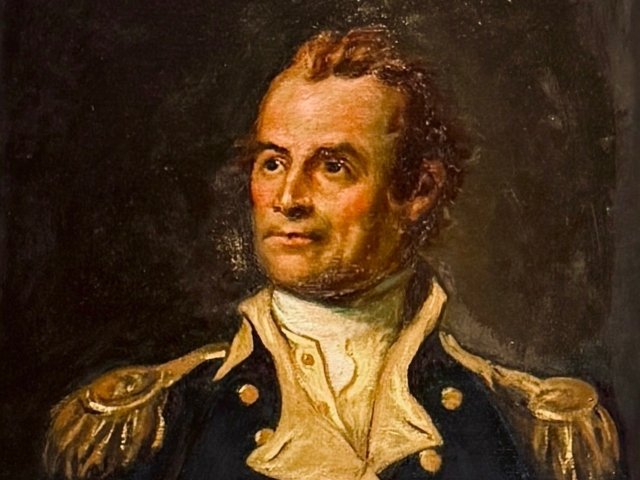
Glover was badly outnumbered — O’Donnell puts the invading force at roughly 4,000 against about 750 Americans — and he knew it. O’Donnell quotes Glover’s own account of the moment: “the lives of seven hundred and fifty men immediately at hazard, and under God their preservation entirely depended on their being well disposed of; besides this, my country, my honour, my own life, and everything that was dear, appeared at that critical moment to be at stake.” Glover added that he “would have given a thousand worlds” for an experienced officer like General Lee to be on hand to direct him, or at least approve what he had done.
He didn’t wait for one. Instead, O’Donnell writes, Glover improvised a defense in depth — a formation the historian calls novel for 18th-century warfare.
Stone walls and staggered fire
The colonel’s plan leaned on the terrain. Split Rock Road, the main route inland from the beach, was lined with stone fences, boulders and rocky outcroppings that would funnel the British into a column along the roadway. Glover sent a small advance party forward to slow the British, posted one regiment with three field pieces to the rear, and strung the rest of his men in successive lines behind the walls.
The advance guard let the British come within about fifty yards before firing a brief volley and falling back. Believing the Americans were running, the British cheered and pushed ahead. When their elite light infantry closed to within thirty yards, the Americans rose together, rested their muskets on the stone wall and fired into the packed column. Dozens of Redcoats and Hessians went down, and the survivors fell back rather than pressing a bayonet charge.

The pattern repeated. When the main British body arrived and charged, the Americans rose and fired again, and the two sides exchanged fire for roughly twenty minutes while British artillery lobbed cannonballs at the men sheltered behind the wall. After about seven rounds the Americans withdrew, covered by the fences, to the next line waiting across the road.
There, Colonel William Shepard — a French and Indian War veteran — had his men stagger their fire to keep a steady stream of lead on the enemy. O’Donnell writes that they exchanged seventeen rounds and drove the Redcoats back several times, at one point far enough that an American soldier vaulted the wall and took a hat and canteen from a dead British captain.
Among the British dead was Captain William Glanville Evelyn, a light infantry officer. Shepard himself took a bullet to the neck, but according to O’Donnell he regained consciousness while surgeons probed the wound, asked for his canteen, found he could drink, and told the doctor: “It is all right, doctor, stick on a plaster and tie on my cravat, for I am out again.”
A retreat that held
Numbers eventually told. Glover’s men pulled off the maneuver a third time, but with less success, and the British forced them back faster. The Marblehead colonel led his men across a small creek and up a hill to the rear guard and its artillery, where a cannonade traded back and forth until nightfall. The British, having learned that chasing the retreating Americans was costly, halted.
Howe then declined to pursue further. O’Donnell notes that the exact British casualty count is unknown, but argues it must have been substantial, since Howe overestimated the size of the force he had faced by more than ten times. The Americans, by contrast, lost six killed and thirteen wounded, Shepard among the latter — a man Glover called “a brave officer.”
The stand at Pelham, O’Donnell writes, gave Washington’s Continental Army the time to escape to White Plains and fight another day.
Ground still visible — and a new book
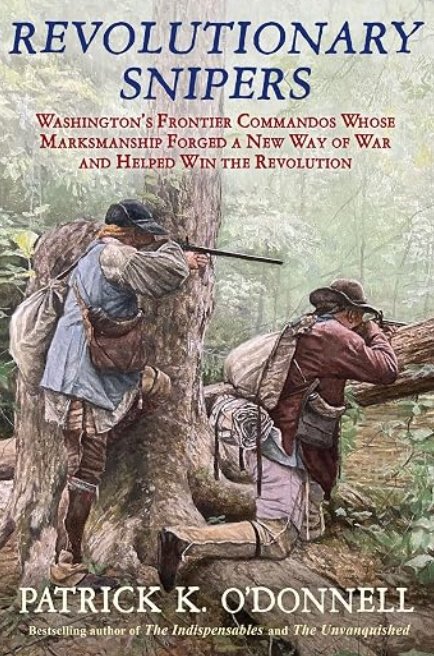
O’Donnell, a bestselling military historian and senior fellow at Mount Vernon, is out with a forthcoming book on the war’s riflemen: Revolutionary Snipers: Washington’s Frontier Commandos Whose Marksmanship Forged A New Way of War and Helped Win the Revolution, published by Atlantic Monthly Press. A portion of the Pelham battlefield now runs through the early holes of the Split Rock Golf Course, where O’Donnell notes the remains of the stone fences and rocks can still be seen. A boulder known as Glover’s Rock marks the spot where riflemen opened fire as the British landed.
His piece lands as the country approaches the 250th anniversary of independence, with a national book tour beginning November 9. O’Donnell, who served as a combat historian with a Marine rifle platoon during the Battle of Fallujah, has written fourteen books, including a trilogy on the Revolution’s elite units: The Indispensables, Washington’s Immortals and The Unvanquished.
His central claim is a simple one: sometimes the right man at the right place and moment changes the course of history. On October 18, 1776, he argues, that man was John Glover.
Source: www.breitbart.com — https://www.breitbart.com/politics/2026/10/18/exclusive-odonnell-the-forgotten-battle-that-saved-washingtons-army/