
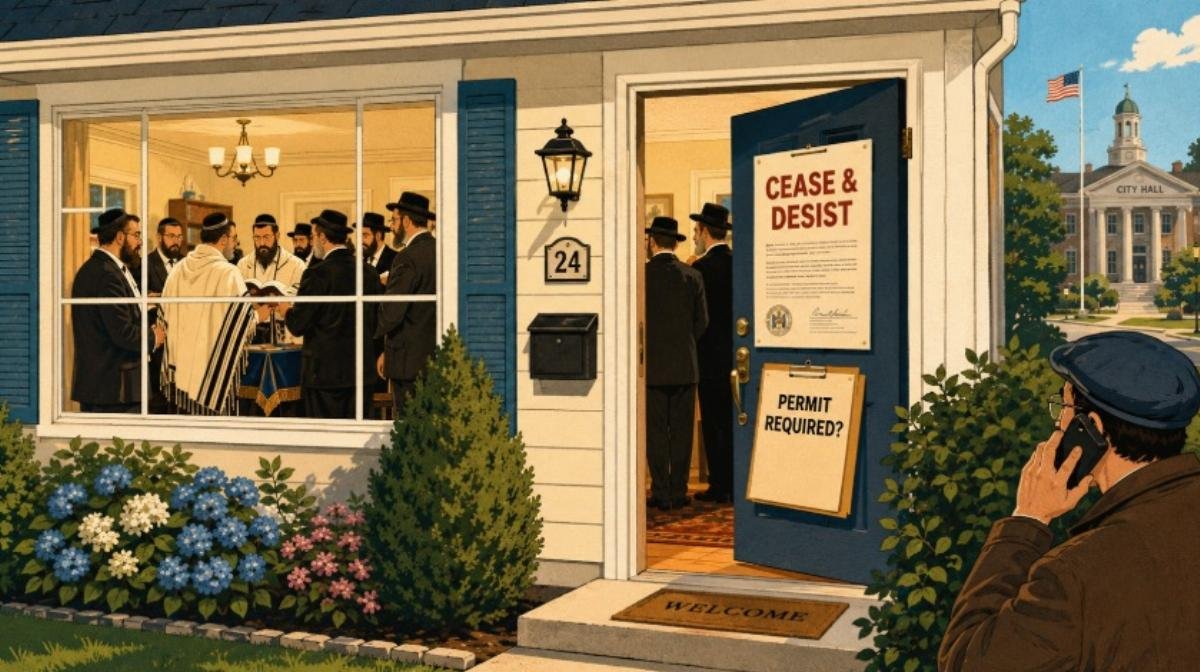
When Daniel Grand emailed about a dozen friends in January 2021 to invite them to his University Heights, Ohio home for a Shabbat minyan—a traditional Jewish prayer gathering—he likely didn’t expect to trigger a five-year legal battle that would ultimately reach the Supreme Court. But that’s exactly what happened after a neighbor forwarded the email to the mayor, asking him to “put a stop to it.”
According to the Washington Post, the Supreme Court agreed last month to hear a case posing what the outlet calls “a remarkable question”: Can the government require a homeowner to obtain a permit before inviting friends over for prayer?
The dispute centers on University Heights’ zoning ordinance, which requires “houses of worship” to obtain a special-use permit. Acting on the neighbor’s complaint, the mayor called Grand about what he termed an “urgent matter,” and a city official subsequently ordered Grand to “immediately cease and desist” using his home as a “place of religious assembly” until he secured the necessary permit.
Grand maintained that hosting a minyan—a quorum of ten Jewish adults required for certain prayers—in his home didn’t transform his residence into a house of worship. Nevertheless, he complied with the order, canceled the gathering, and applied for the permit.
A Bureaucratic Maze
What followed was what observers describe as a contentious zoning process. More than 100 people attended a virtual public hearing on Grand’s application, after which the city’s planning commission tabled it indefinitely. For five years, Grand has been unable to host friends for prayer in his own home.
The situation escalated further when the mayor allegedly encouraged neighbors to report any suspected prayer gatherings at Grand’s home so the city could take him to court. Police surveillance of the residence reportedly followed. Rather than wait for prosecution, Grand filed suit against the city, alleging First Amendment violations among other claims.
The case has languished in various courts, tied up in technical legal arguments that never addressed the core constitutional question. Those procedural issues, however, eventually caught the Supreme Court’s attention.
The Core Question: Religious Freedom or Zoning Authority?
At the heart of the dispute is whether the city’s bureaucratic requirements and enforcement actions constitute an unconstitutional burden on Grand’s First Amendment rights. The case raises troubling questions about governmental power to regulate religious practice in private homes.
Critics argue that if municipalities can avoid judicial review through endless procedural requirements—more hearings, more information requests, more hurdles—what prevents them from extending such processes indefinitely? This approach, they contend, incentivizes bureaucratic gamesmanship that keeps constitutional questions perpetually out of court.
The timing of the neighbor’s complaint adds another dimension to the controversy. The complaint reached the mayor before the gathering even occurred, suggesting the neighbor learned of the plan through Grand’s email. How the email reached someone who wasn’t an invitee remains unclear, but the speed of the response—and the specific invocation of “house of worship” regulations—raises questions about whether the religious nature of the gathering motivated the complaint.
A Double Standard?
Commentary on the case points to an apparent inconsistency in enforcement. Homeowners regularly host gatherings that draw a dozen or more people—holiday parties, birthday celebrations, graduations—without facing permit requirements or municipal intervention. Such events often involve cars lining the street, outdoor cooking, and music, yet they proceed without official scrutiny.
The distinction appears to lie in the explicitly religious purpose of Grand’s gathering. Would a Christmas party at which guests held hands for a blessing require a special-use permit? Would carolers singing “Oh Holy Night” on a residential street face similar restrictions? The selective enforcement suggests the issue isn’t about numbers, noise, or parking, but about the nature of the gathering itself.
If a secular gathering of the same size—friends spinning records and dancing, or neighbors gathering for a barbecue—would proceed without incident, the permit requirement for a prayer service begins to look like content-based discrimination rather than neutral zoning enforcement.
Implications Beyond One Case
The Supreme Court’s decision to hear this case signals that the justices see merit in examining whether such regulations, as applied, burden religious exercise in violation of the First Amendment. The case could establish important precedent about the limits of municipal authority to regulate religious gatherings in private homes.
For Grand, the question is straightforward: can he observe his faith quietly, in his own home, with friends, without government permission? The answer, according to those troubled by the city’s actions, should be an unequivocal yes. Freedom of religious association, they argue, is fundamental, and citizens shouldn’t need a permit to exercise it.
The case tests where the line falls between legitimate zoning authority and impermissible restriction of religious practice. Can cities use “house of worship” regulations to control private religious gatherings? Does the number of attendees matter? The frequency? The formality of the religious observance?
As the case moves forward, it will likely clarify how much authority municipalities have to regulate religious activity in residential settings and what constitutional protections shield homeowners who wish to pray with friends in their own living rooms. For now, five years after that initial email invitation, Grand still awaits an answer to what many view as a simple question: Does the First Amendment protect his right to host a prayer gathering without government approval?
The Supreme Court’s eventual ruling will determine not just Grand’s case, but establish broader principles about religious freedom, government overreach, and the sanctity of private homes as places where constitutional rights—including the right to practice one’s faith—must be vigorously protected.
Source: www.americanthinker.com — https://www.americanthinker.com/articles/2026/07/a-permit-to-have-friends-over/