
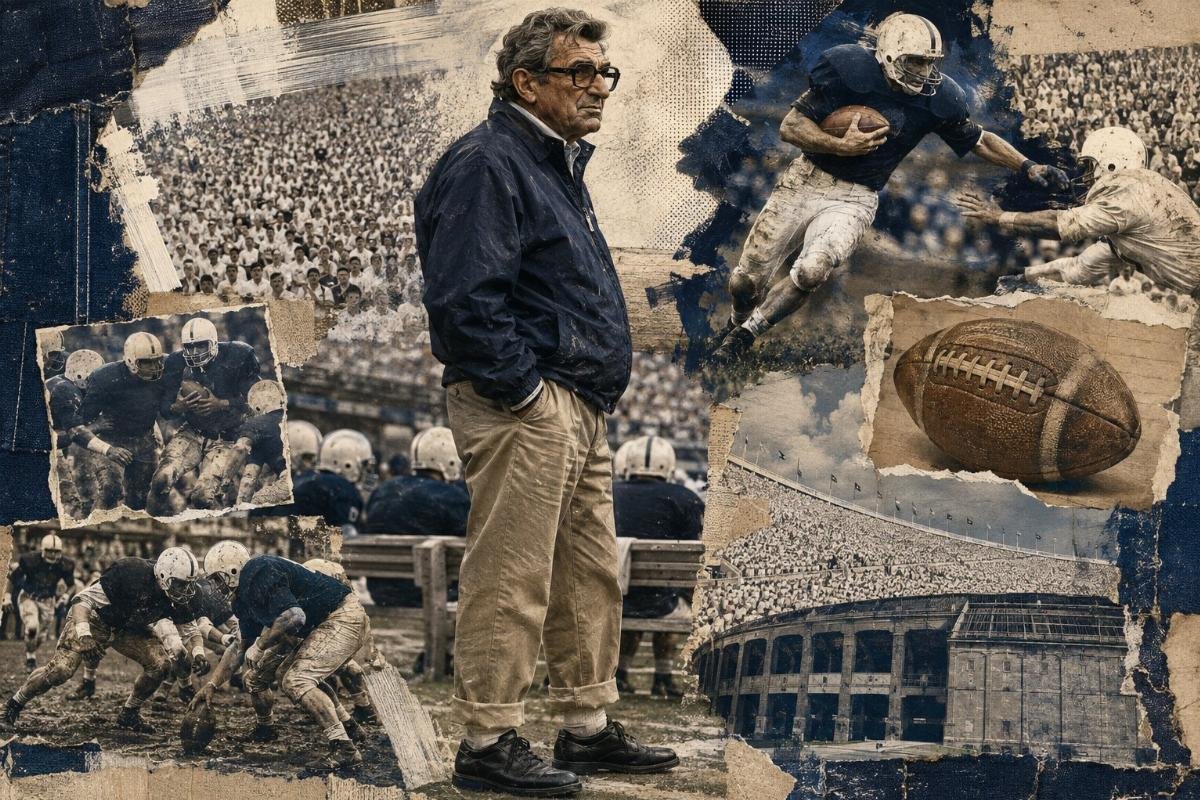
The opening of the Paterno Family Football Experience Room inside Beaver Stadium’s Penn State All-Sports Museum on Thursday marks a notable shift in the university’s approach to the legacy of its most famous coach, according to a commentary published on American Thinker.
For years, Penn State has attempted to distance itself from Joe Paterno in the wake of the Jerry Sandusky scandal. The statue outside Beaver Stadium was removed, his name vanished from prominent locations, and public discussion of his contributions became deeply uncomfortable. Yet the museum expansion suggests a measured move toward a more complete historical narrative.
The American Thinker piece, authored by Greg Maresca, argues that the university’s effort to erase Paterno’s presence ultimately became an erasure of an entire era of Penn State football. Paterno spent 61 years at the university, arriving in 1950 from Brooklyn, New York, and helping to build a program from the ground up into one of the most respected in the nation.
During those decades, Paterno’s record spoke for itself: two national championships, 409 victories, five undefeated seasons, and 24 bowl wins across 37 appearances. But the commentary stresses that his impact extended well beyond statistics. Paterno championed what he called the Grand Experiment—the idea that a football scholarship could serve as an educational opportunity, with players expected to attend class, graduate, and uphold standards larger than the game itself.
That philosophy, Maresca notes, stands in stark contrast to the modern college football landscape of NIL deals, frequent transfers, and coaches who move between programs for larger contracts. Paterno’s era emphasized loyalty and stability in ways that seem increasingly remote in today’s commercialized environment.
The Paterno family’s generosity to the university was not superficial, the commentary points out, but a sustained investment in academic and spiritual life. The Paterno Library remains among the university’s most recognizable buildings. Donations also supported the Pasquerilla Spiritual Center, home to Catholic ministry and other faith communities on campus, alongside numerous scholarships and cultural programs.
A complex historical record
The Sandusky scandal remains unavoidably tied to any discussion of Paterno’s legacy, and critics have argued that his name should never be rehabilitated. The American Thinker piece does not dismiss those concerns. Instead, it contends that a university cannot credibly celebrate more than a century of football tradition while pretending the individual most responsible for that tradition simply didn’t exist.
The new Experience Room appears to recognize this tension. According to Penn State’s Sports Information office, the exhibit includes Paterno’s desk, artifacts from his coaching career, and displays documenting the program’s history. The museum frames Paterno within the larger story of the university rather than placing him above it.
Preserving rather than sanitizing
Maresca’s argument can be stated plainly: universities exist to preserve history, not to sanitize it. The role of an educational institution is to teach, not to selectively edit the past according to prevailing sensibilities. An institution of Penn State’s standing should have the confidence to acknowledge both extraordinary achievement and painful controversy without letting either dominate the other entirely.
The piece concludes that Paterno was neither saint nor villain but a human being of outsized influence—whose successes were real, whose contributions were substantial, and whose imprint on Pennsylvania’s flagship university is simply impossible to deny.
Whether the new museum room signals a broader cultural shift in how Penn State tells its own story remains to be seen. But the physical space inside Beaver Stadium is a tangible step toward a fuller, more honest reckoning with a legacy that sits at the center of the university’s history. History demands honesty even when that honesty is uncomfortable, Maresca writes.
The commentary reflects a growing discussion among observers who believe Penn State’s attempts to wash its hands of Paterno were never sustainable. The school cannot tell the story of Beaver Stadium, the Nittany Lions, or the rise of a national brand without acknowledging the man who built it.
This museum opening—a modest addition to an existing space—has taken on symbolic weight precisely because of everything that preceded it. A university that wanted to move forward by looking away has begun, at least in one room, to look honestly at what came before.
This article is based on an opinion column published by American Thinker, available at the original source.
Source: www.americanthinker.com — https://www.americanthinker.com/blog/2026/09/penn-state-s-necessary-correction/