
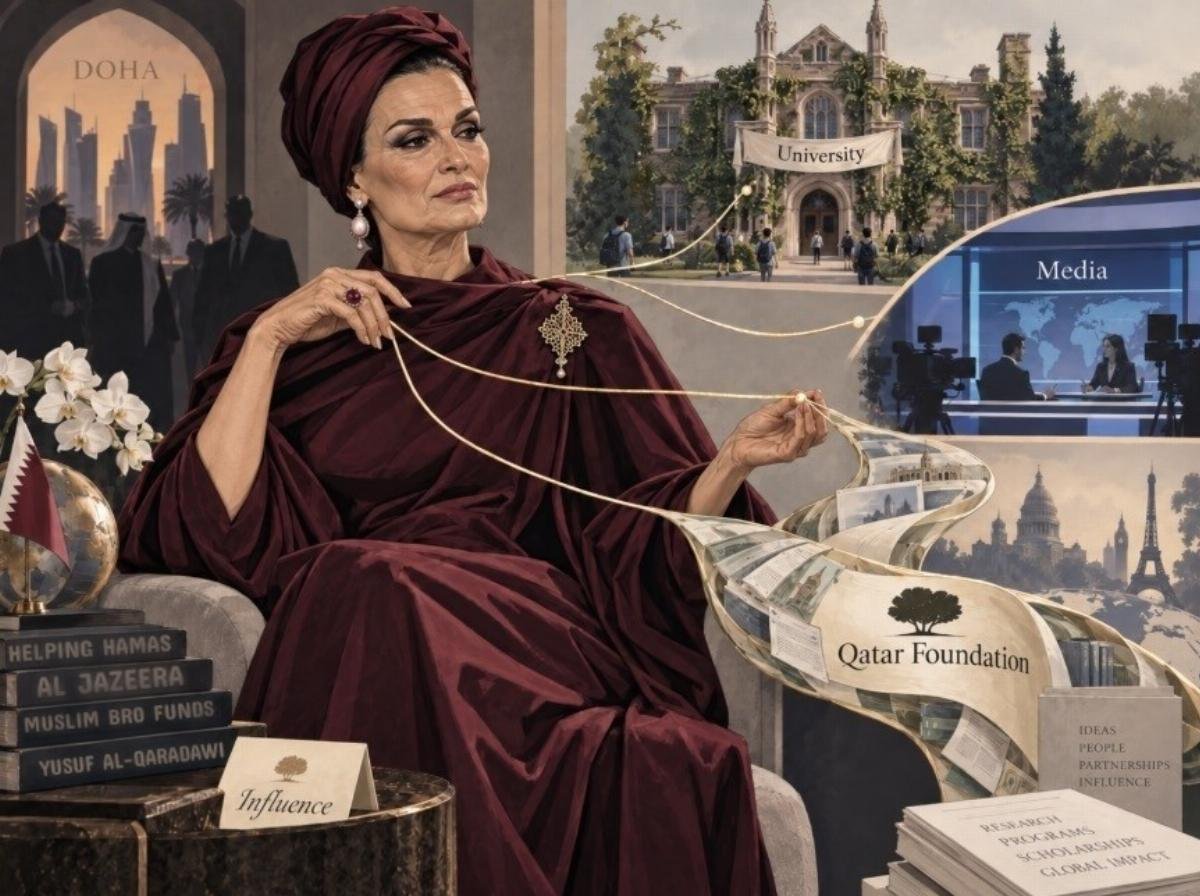
Americans spent years hearing about foreign interference in their elections. An Israeli-American writer now argues they should have been asking a different question: who is paying for influence inside the institutions that train the country’s next generation of journalists, diplomats, lawyers and political leaders?
In a commentary published by American Thinker, Tsahi Shemesh, an IDF veteran who runs a Krav Maga studio in New York City, traces what he calls the machinery behind the wave of anti-Israel sentiment that flooded American campuses after October 7, 2023. His answer centers on Qatar and, more specifically, on one woman most Americans have never heard of: Sheikha Moza bint Nasser.
Shemesh is explicit that he is writing as a commentator, not a disinterested observer. He describes spending years teaching self-defense and studying how threats develop long before the physical attack occurs. Behavior, intent, preparation, capability — those are the things you learn to read, he writes. Watching only the final act means you missed everything that preceded it.
The Scale of the Money
According to the piece, American universities reported more than $1.1 billion in gifts and contracts from Qatari sources in 2025 alone, making Qatar the largest foreign source of such funding reported that year. Georgetown, Northwestern, Carnegie Mellon and other American schools have built operations in the Gulf state.
Shemesh notes that the Department of Education’s own inspector general has said foreign-funding disclosure requirements exist partly because these relationships can create risks involving foreign influence, academic freedom and national security. That disclosure regime, in other words, is not a bureaucratic formality — it exists because the government itself considers the underlying relationships sensitive.
The institutions Qatar has invested in are not marginal. They educate the people who go on to shape coverage, policy and legal argument in the United States and abroad. Shemesh argues that an authoritarian Gulf monarchy spending billions to build relationships inside those institutions should have drawn far more scrutiny than it has.
Hamas, Al Jazeera, and the Qaradawi Connection
The commentary lays out Qatar’s other relationships as context. Qatar provided a home to senior Hamas leaders and maintained Hamas’s political office in Doha — a fact, Shemesh notes, confirmed by the Congressional Research Service. He also writes that Qatar provided substantial financial assistance to Gaza for years, and acknowledges that some of that money entered with Israeli approval, a policy he says Israel should admit was a serious mistake.
Qatar also gave enormous reach to Yusuf al-Qaradawi, one of the Muslim Brotherhood’s most influential clerics, according to the piece. Shemesh points out that Hamas itself grew out of the Palestinian Muslim Brotherhood. And then there is Al Jazeera, which Qatar funds and which carries substantial influence across the Arab world.
Against that backdrop, Shemesh returns to Sheikha Moza, the mother of Qatar’s current ruler and chairperson of the Qatar Foundation, the organization behind much of Qatar’s investment in Western education.
Five weeks after October 7, he writes, she accused Israel of spreading fabricated narratives and called for confronting them through media, culture and intellectual channels. She also described antisemitism as a problematic concept, he adds, citing her own website. Shemesh’s point is not simply what she said, but where she said the fight should happen — in the same media, educational and elite institutional terrain Qatar had spent decades cultivating.
‘Influence Does Not Require a Phone Call’
This is where the commentary pushes back on its own potential strawman. Shemesh writes that influence does not require somebody in Doha calling a professor and dictating tomorrow’s lecture. A foreign government gains influence, he argues, by becoming useful, respected and financially connected to institutions whose leaders want the relationship to continue.
That framing matters. It avoids the conspiracy-theory version of the argument — the one that requires secret directives and paid agents — and replaces it with something more mundane and, arguably, harder to unwind. Institutions defend funding relationships they have come to depend on. Leaders who value the prestige and revenue that come with them have an incentive not to ask uncomfortable questions.
After October 7, Shemesh acknowledges, Qatar’s relationship with Hamas also became useful in a different way. Washington and Jerusalem needed an intermediary who could reach the terrorists holding American and Israeli hostages, and Qatar could play that role because it had maintained access to Hamas for years. Shemesh concedes that using the channel to free hostages was necessary.
But he argues that treating Qatar as a neutral peace broker requires forgetting how it obtained that access in the first place — a point that cuts against the prevailing diplomatic framing of Doha as an even-handed mediator.
The Question He Wants Americans to Ask
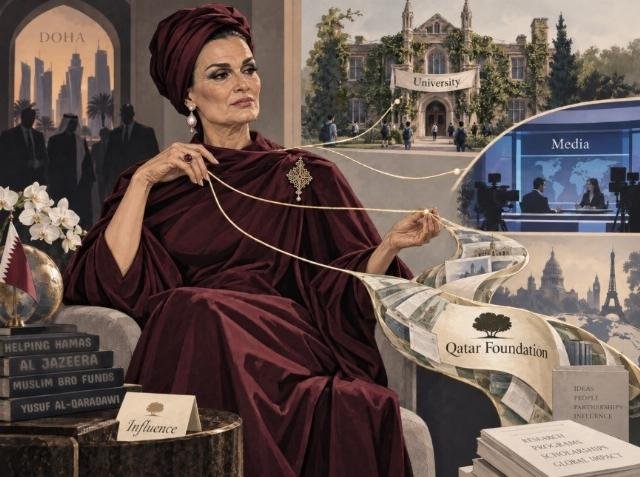
Shemesh is careful to place limits on his own claim. Qatar did not create the entire anti-Israel movement in America, he writes, and it does not need to have done so for Americans to ask a more uncomfortable question: why did some of the country’s most prestigious universities become financially intertwined with a government that hosted Hamas leadership, gave the Muslim Brotherhood’s ideological world a major platform, funded Al Jazeera, and built diplomatic leverage through its relationship with Hamas?
He describes the campus explosion after October 7 as the final act — visible, dramatic, and easily condemned — while the earlier acts, the years of ideological education, institutional relationships and foreign money flowing into universities, went largely unexamined.
Sheikha Moza, in his telling, helped give Qatar a respectable face in the West. After October 7, he writes, she told the world exactly where she stood.
Americans, his argument concludes, should stop admiring the philanthropy long enough to follow the money, examine the relationships, and ask what Qatar received in return for becoming so deeply embedded in American institutions.
That is a claim about influence, not proof of a plot — and it is framed as such throughout. But it lands at a moment when foreign funding of American higher education is drawing increasing congressional and regulatory attention, and when the ties between Gulf money and campus politics have become a live political fight rather than a niche academic concern.
Shemesh writes from a clearly stated position: an Israeli-American educator, IDF veteran and father who says he writes about Jewish identity, resilience and the ethics of strength amid rising antisemitism. Readers will weigh his argument accordingly. His central factual claims — the scale of Qatari funding, Qatar’s hosting of Hamas leadership, its funding of Al Jazeera, and Sheikha Moza’s own published remarks — are ones he attributes to public records and to her own words.
The question he leaves hanging is less about any single institution and more about what Americans are willing to accept as normal: that a government with those relationships became, over decades, a respected partner to the universities that shape how the United States understands the Middle East.
Source: www.americanthinker.com — https://www.americanthinker.com/blog/2026/09/the-woman-behind-qatar-s-influence-in-america/