
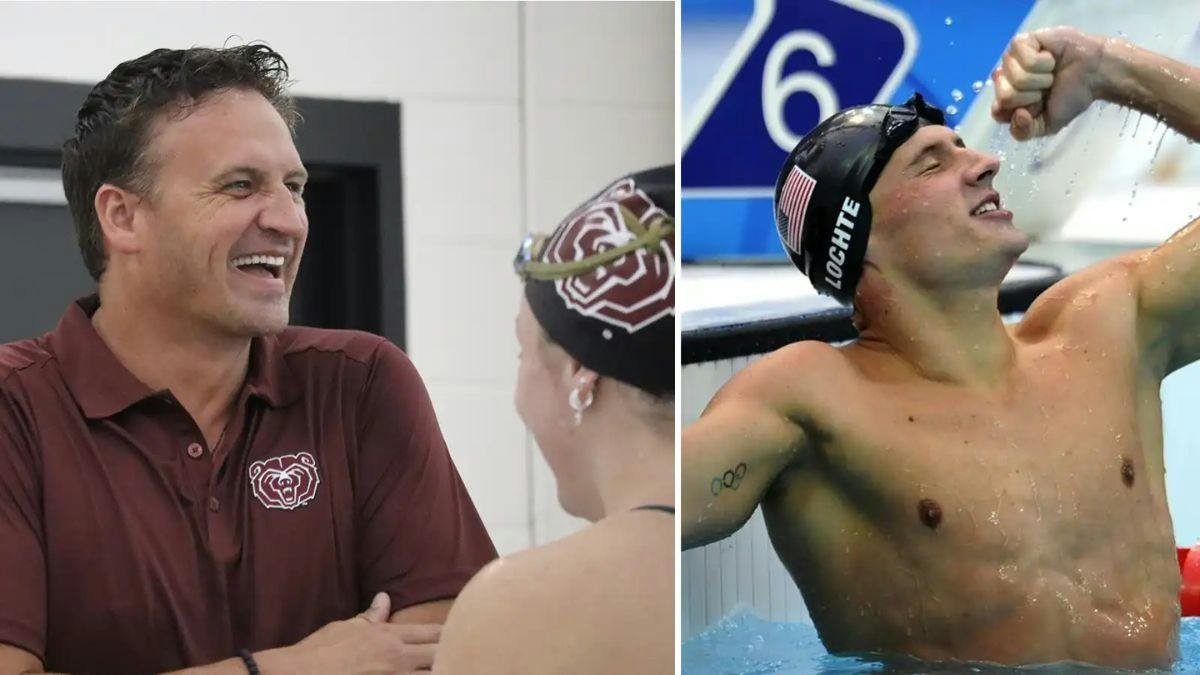
SPRINGFIELD, Mo. — When Dave Collins answered the phone, the last name he expected to hear on the other end belonged to a 12-time Olympic medalist.
Ryan Lochte, the one-time world record holder who graced magazine covers from Time to Vogue, was cold-calling the Missouri State swimming and diving coach to ask for a job. Collins, who has led the program since 2012, recalled asking whether he was being punked. It didn’t take long for him to conclude the call was real — and that the man on the line had changed.
“He had been humbled a little bit,” Collins told Sport & State, the outlet founded by Clay Travis that published the interview. “He realized he needed to start somewhere, and he was looking for someone to give him a chance.”
Roughly a month into his first entry-level job at 42 years old, Lochte looks and sounds, in Sport & State’s telling, like a man reborn. After a decade defined by his mistakes, he’s now the newest and greenest assistant on Collins’s staff — writing sets, offering stroke and turn feedback from the pool deck, and recruiting himself to a new vocation.
“I’m having a blast coaching,” Lochte said in a sit-down interview after a morning practice. “I’ve found my love and passion. This is what I’m meant to do.”
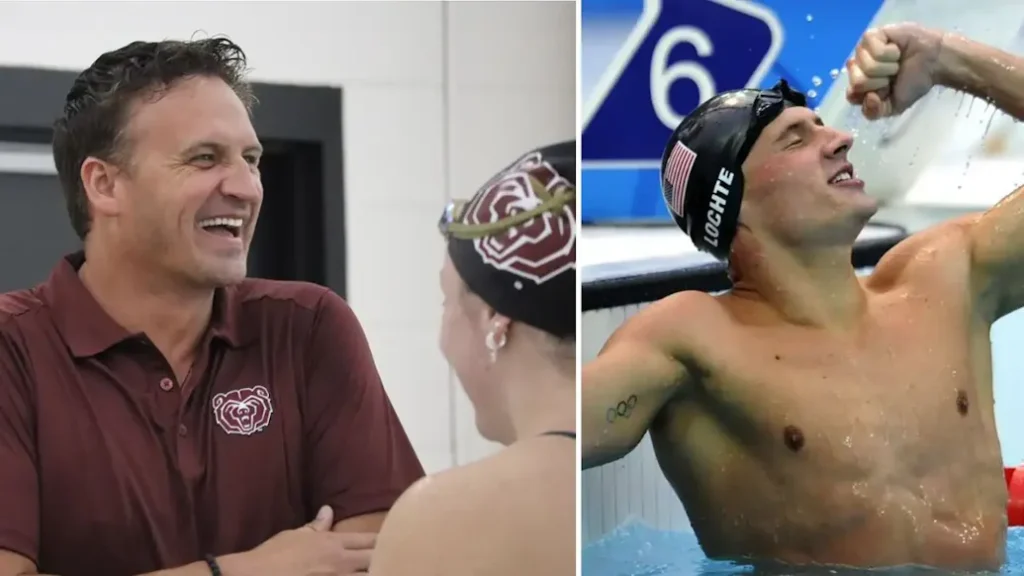
From Hollywood to the Ozarks
The path here was not a straight one. Lochte described being pulled into the Hollywood scene after the 2012 Olympics, a period he now sums up bluntly: “I lost myself.” He has acknowledged recreational drug and alcohol abuse tied to untreated depression and is emerging from an acrimonious divorce from the mother of his three young children.
His relocation to Springfield followed visits with his fiancée, Molly Gillihan, who grew up in the area. Lochte said he found the people unfailingly friendly and the parks, trails and greenways gave him room to breathe. Once the couple committed to the move, he researched local universities with swimming programs and reached out to Missouri State and Division II Drury. Missouri State topped his list, he said, because he wanted to get his “foot in the door” in a Division I program.
The compensation was not a sticking point. Lochte earns roughly $30,000 in base pay, with bonuses that could push it to $40,000 — a rounding error compared with the several million dollars a year he commanded through sponsorships in the 2010s.
“I don’t need the money,” he said. His primary income, he explained, comes from a franchise venture with a friend in finance that aims to build swim teams across the United States and eventually abroad, each fronted by an Olympian and backed by elite resources. His management is also in negotiations with Amazon about a podcast pairing him with another retired pro athlete named Ryan, whose identity he declined to reveal for fear of jinxing the talks. Lochte said he told the parties involved he can spare only one day a week away from campus because Missouri State comes first.
‘He’s been riding my ass a lot’
Collins’s early concern was that Lochte might not take his duties seriously or would tire of menial work. So far, those worries have not materialized. The coach described him as detail-oriented but blessed with a laidback surfer personality that helps swimmers absorb instruction — feedback that carries weight coming from a 12-time Olympic medalist.

That impact shows up in small technical details. Collins said Lochte has taught the team things about streamlining — the art of reducing drag while sharpening strokes and turns — that weren’t even in his own vocabulary.
Lochte doesn’t minimize what he brings to the deck. “I have a gift,” he said, “and I want to share it with the younger generation.”
At a recent practice, he wrote a set focused on breath control and stopped a swimmer who wasn’t breathing every five strokes as instructed. “Hey, buddy, can you count to five?” Lochte asked, calling him out good-naturedly in front of the team. The swimmer laughed, apologized and adjusted.
Few moments gratify him more than watching a correction take hold. “When I see it click, I get freaking pumped up!” he said. “I’ll throw my arms up in the air and scream, ‘THAT’S WHAT I’M TALKING ABOUT! NO ONE’S GOING TO STOP YOU NOW!'”
Collins noted that new coaches tend to gravitate toward the fastest swimmers. Lochte, he said, has been quick to spot those who need help but might otherwise go unnoticed — the athletes who are invisible because they aren’t among the fastest or don’t speak up. Sophomore Kayden Hedrick of New Orleans felt that attention immediately. “The first few days, he was telling almost every kid something,” Hedrick said, adding with a broad smile, “He’s been riding my ass a lot.”

Hedrick arrived at Missouri State as an Olympic trials qualifier and four-time high school MVP, coached by his father until college. He earned All-Missouri Valley Conference honorable mention as a freshman, but was disappointed to miss qualifying for the NCAA championships last season. When he learned Lochte was joining the staff, Hedrick recalled telling his father, “He’s going to help me get there.” He has since asked Lochte to work with him on an afternoon when he has no class and the team is off.
Drawing on his own struggles
Lochte believes he can relate to any athlete — good, bad or goofball — because he has lived every version of the experience. He was a lightly recruited freshman at the University of Florida who struggled early; after his first meet, coach Gregg Troy sent him home for a weekend to reconsider his commitment to the sport. Lochte returned with renewed drive. From then on, he said, he made a point of being first in the water every day and last to get out. He wasn’t the most naturally gifted swimmer, he said, but he turned himself into the hardest worker and the most technically proficient.
He is applying that same mindset to coaching, with ambitions that are hard to understate. Asked about his long-term goals, Lochte didn’t blink.
“My long-term goal is I’m going to be the best coach in the world,” he said.
The benchmark would be Bob Bowman, who has led Arizona State and Texas to men’s NCAA Division I team titles over the past three seasons, coaches Leon Marchand — the swimmer who last year erased Lochte’s 14-year-old world record in the 200 I.M. — and guided Michael Phelps, Lochte’s longtime nemesis, to 28 Olympic medals.
Would Lochte really put himself in that company?
“Oh, yeah,” he said, grinning. “I’m going to give him a run.”
Source: www.dailywire.com — https://www.dailywire.com/news/american-swimmings-biggest-goofball-turns-serious-about-leading-the-next-generation