
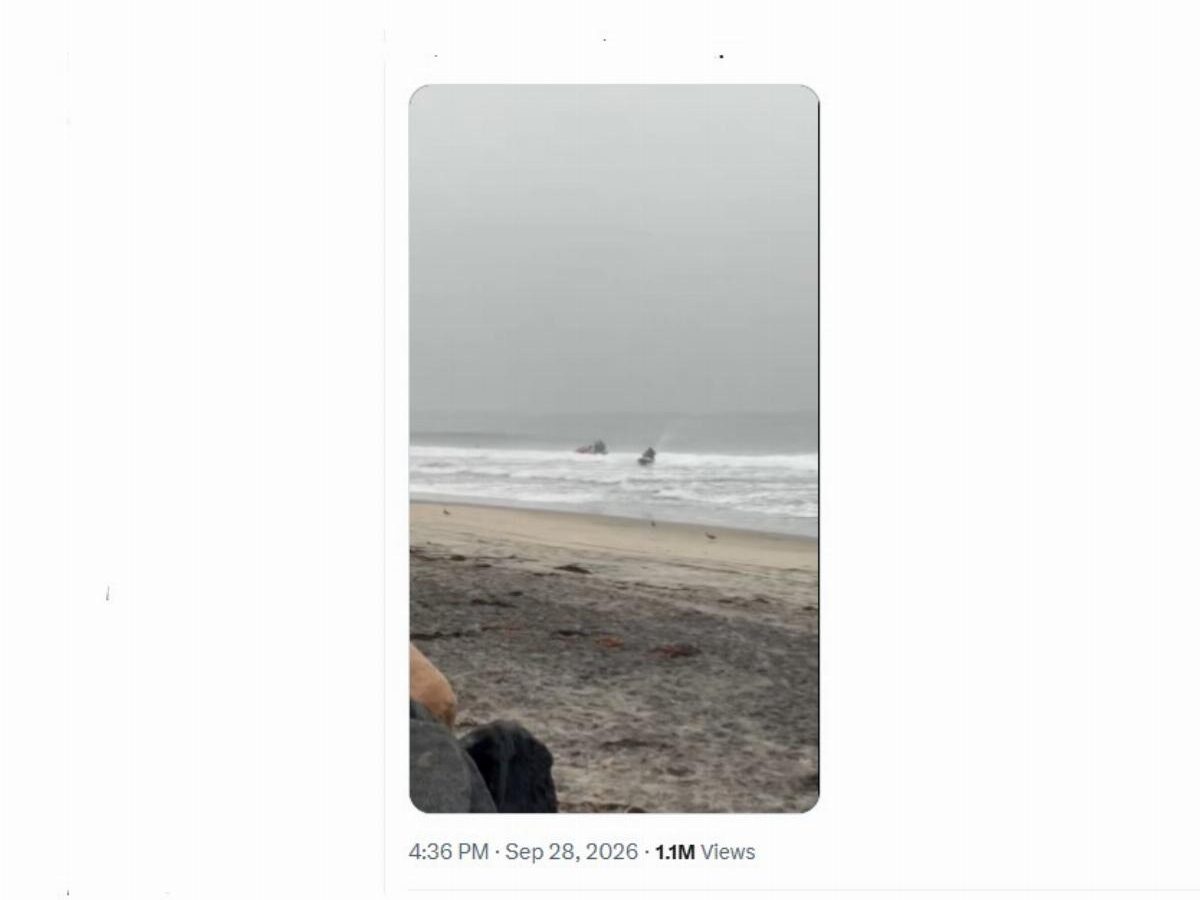
Migrant smugglers are reportedly back in the water off Imperial Beach, California, running jet skis straight to shore and ordering the people they are carrying to swim through the same raw sewage that has kept most everyone else out of the ocean there. According to a commentary in American Thinker by Monica Showalter, the operation unfolded on a Saturday morning in the shadow of the Tijuana River, where untreated sewage has long fouled the coastline on the American side of the border.
The piece describes a sequence that has become grimly familiar to residents and agents in the region: smugglers on personal watercraft racing toward the beach, offloading their passengers in the surf, and then peeling away before they can be caught. The migrants, per the account, are left to wade and swim through water the article bluntly characterizes as raw sewage, at which point U.S. Border Patrol moves in to take them into custody.
Showalter’s commentary is built around what it describes as exclusive video of the Saturday morning drop-off. She writes that the smugglers raced jet skis to shore, dropped off illegal immigrants, then took off, prompting Border Patrol to activate. The article does not name any of the individuals involved, does not provide a count of how many people were dropped, and does not identify the nationalities of the migrants or the smugglers. What it offers instead is a visceral, almost cinematic image of a smuggling route that is both brazen and physically hazardous.
The beach nobody uses
The central fact the commentary keeps returning to is the water itself. Imperial Beach sits at the bottom of the Tijuana River watershed, and the article states plainly that the surf there is contaminated with raw sewage — there’s a reason nobody goes to that beach, as the piece puts it. That is the point of the smugglers’ calculation, in the author’s telling: a stretch of ocean that ordinary beachgoers avoid precisely because it is unsafe is, for a smuggling operation, a stretch of ocean that is comparatively unwatched and un-crowded.
The commentary does not attempt to quantify the health risks, cite water-quality data, or name an agency responsible for monitoring the shoreline. It relies instead on the obvious: forcing people to swim through human waste in order to reach American soil is a cruelty layered on top of the usual dangers of an illegal crossing. The piece frames the sewage itself as an instrument of the smugglers’ trade rather than an incidental feature of the landscape.
A comparison to ‘El Norte’
Showalter reaches for a specific cultural reference to convey how the scene struck her: the rat-tunnel sequence in Gregory Nava’s 1983 film El Norte. In that movie, she recalls, poor Guatemalan migrants are forced to crawl through a nightmarish, rat-infested tunnel to reach San Diego on the other side. She writes that she remembered the rats crawling all over the characters when she first saw the film, and that it remains a scene no viewer forgets. The comparison is her own; the article presents it as an emotional response to the footage rather than a literal parallel.
It is worth being precise about what the source does and does not establish. The commentary asserts that smugglers were back to ferrying migrants through the sewage, presents video as evidence of a Saturday morning jet-ski drop-off, and describes Border Patrol responding. It does not cite a Border Patrol statement, a named official, a press release, or any independent confirmation beyond the footage it says it obtained. Readers should weigh the account accordingly: it is a commentary piece advancing an argument about border enforcement, illustrated by video the author says is her own outlet’s.
What the episode fits into
Even taken on its own terms, the incident fits a pattern that has been reported in the San Diego sector for years — maritime smuggling attempts using small, fast watercraft to close the last few hundred yards to shore. What is different here, according to the commentary, is the willingness to use the sewage-contaminated surf as cover, treating a public-health hazard as an operational asset.
The article’s framing is unmistakably political. American Thinker is an opinion outlet, and Showalter’s piece reads as an argument about the consequences of permissive border policy rather than a straight news report. It leans on disgust and dread — the sewage, the rats, the swimmers — to make a case that the border remains a live problem in a specific, tangible, and physically revolting way. That is a rhetorical choice, and it is worth naming as one.
What the piece does not do is offer policy prescriptions, name the officials responsible for the stretch of coastline, or explain how the jet skis evaded detection until they reached the sand. It ends where it began: with an image of people swimming through waste to reach California, and with the author’s insistence that this is happening again.
Whether the video becomes a broader flashpoint or remains a single weekend’s episode, the underlying geography is not in dispute. Imperial Beach has spent years at the receiving end of cross-border contamination, and the water there has been the subject of repeated complaints from residents and local officials. The commentary’s contribution is to argue that smugglers have folded that environmental failure into their business model — and that the people they carry pay the price in exposure to sewage before they ever set foot on dry land.
Source: www.americanthinker.com — https://www.americanthinker.com/blog/2026/09/migrant-smugglers-back-at-it-ferrying-illegals-through-san-diego-s-mexican-sewage/
Source: www.americanthinker.com
Related coverage
- Harmeet Dhillon Exits DOJ on Her Own Terms, Leaving Democrats Fuming
- Clancy Judge Impounds Juror List Only After Holdout Was Doxed, Threatened
- El Al’s Former Security Chief Warns the Next 9/11 Could Come Through a Cockpit Software Bug, Not a Checkpoint
- Menlo Park Fights High-Density Housing Plan That Could Reshape Suburban Life