
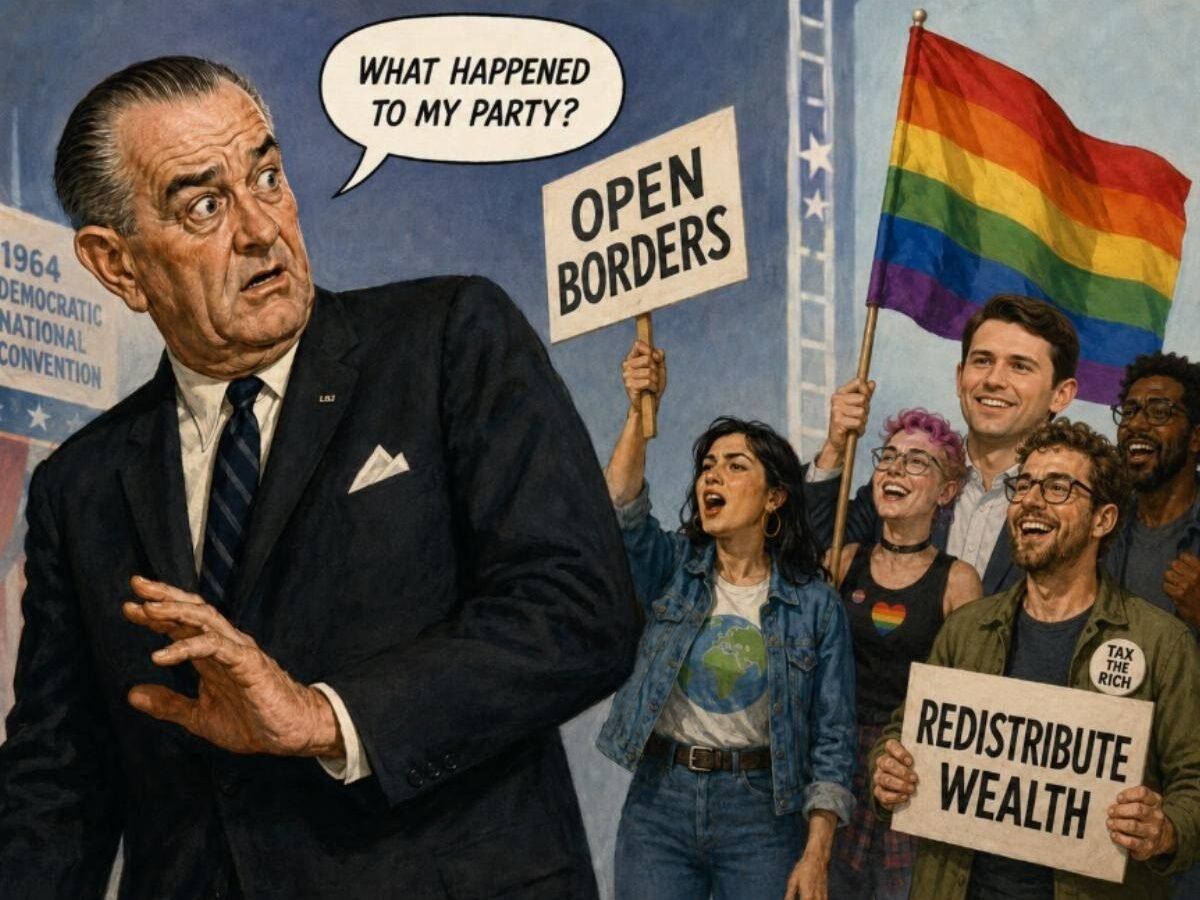
The campaign trail is a strange place. Candidates reach for the past to clothe themselves in borrowed glory, and in Texas these days, that reach has landed on the name of Lyndon Baines Johnson. But as Silvio Canto Jr. writes in American Thinker, the distance between the man born near Johnson City in 1908 and the Texas Democratic Party of 2026 is vast — perhaps too vast for the name to carry much weight.
Canto, riffing on Lloyd Bentsen’s famous 1988 debate line to Dan Quayle, puts it bluntly: “I remember LBJ, and you, Talarico, are no LBJ.” The target is James Talarico, the Democratic candidate who has mentioned Johnson and framed himself as running to fill the late president’s seat. But Canto wonders how many listeners in a youthful, liberal audience actually understood the reference — or whether they assumed he meant the LBJ Freeway, that concrete loop ringing Dallas, rather than the 36th president.
A legacy reduced to a road
It’s a striking image: a major Texas figure remembered primarily as an interstate. Canto recounts a family drive through South Texas that passed a sign marking Johnson’s birthplace, a reminder of how much the state’s politics have shifted since the days when Texas Democrats could point to Johnson, Bentsen, and a spectrum of ideology within one party.
The history is worth a look. In 1948, a young Johnson pulled off a near-miracle to win a U.S. Senate seat. In 1960, Texas voters backed the Kennedy-Johnson ticket in a controversial election. And in 1976, Texas gave then-Governor Jimmy Carter 26 electoral votes that helped push him past President Ford — a close contest that turned on Lone Star support.
The conservative Democrat who beat a ‘liberal’ Bush
Then there was Lloyd Bentsen, a conservative Democrat who defeated George H.W. Bush in the 1970 Senate race — at a time when Bush was the one being called a liberal. That sentence alone, Canto notes, shows how much the political ground has moved.

The Texas Democratic Party’s own history, as quoted by Canto from a lengthy party retrospective, shows a party that was once a battlefield of factions: liberals rallying around Ralph Yarborough, moderates and conservatives aligned with Johnson, and the two wings fighting over gubernatorial contests. John Connally, a moderate-to-conservative Democrat tied to the Johnson wing, won the governor’s mansion in 1962 after the liberal and moderate factions waged war in the primary.
Conservative Democrats held control of the party machinery through much of the 1960s, even as Johnson’s presidency reshaped Texas politics. The assassination of John F. Kennedy in Dallas in 1963 — which thrust Johnson into the White House — forced a degree of accommodation between moderates and liberals, but the party remained a coalition of distinct voices rather than a single chorus.
By 1968, Hubert Humphrey barely carried Texas. The cracks were already forming.
From ideological diversity to a single choir
Canto’s argument is that the party has completed its transformation. Texas Democrats today, he writes, all sound alike. There is no ideological diversity — no conservative wing, no moderates with a distinct platform. Just very liberal Democrats united around messages of income redistribution and identity politics.
“They are Obama Democrats rather than Texas Democrats,” he writes.
He asks where the voices are calling for a more centrist approach — and concludes they don’t exist. That, he argues, is why the party has become so predictable, so unelectable statewide in a state that has grown more dynamic and more competitive in its own way.
“Yes, there is calm in the Democrat ranks — the kind of calm that happens when nothing is going on,” Canto writes.
What would LBJ say?
The column closes with a question that lingers: What would Johnson think of the party that now claims his legacy? Especially, Canto notes wryly, the wing of the party that “believes in six genders.” Johnson, a master of Senate deal-making and coalition-building, would likely not recognize the current iteration — and, sadly, Canto suggests, most of today’s Texas Democrats wouldn’t recognize him either.
For Canto, the point isn’t just nostalgia. It’s about what the loss of that ideological diversity means for the party’s ability to compete and govern in a state as sprawling and varied as Texas. A party that once produced Johnson, Bentsen, and Connally — men with different views but a shared ability to win — has become a monolith. And monoliths, he suggests, don’t win elections in a state that rewards adaptability.
Whether Talarico’s appeal to LBJ’s memory will resonate with voters is another question. But if Canto is right, the reference may be lost on exactly the audience he needs — a generation that knows the freeway, not the president, and a party that has left the Johnson model behind.
Source: www.americanthinker.com — https://www.americanthinker.com/blog/2026/08/sorry-talarico-but-you-are-no-lbj/