

American paper currency has a rule most people absorb without ever thinking about: the faces on the bills are all dead. It is not a mystery of etiquette or an accident of design. It is the direct result of a nineteenth-century grudge match between a congressman and a federal bureaucrat, and the story reads less like monetary policy than like a workplace feud that got written into the statute book.
Writing at American Thinker, M. Walter recounts the strange origin of the ban on living portraits, citing an article titled “Why American Currency Can Only Feature Images of Dead People.” The short version: one man put his own face on the money, and Congress made sure no one could ever do it again.
The Congressman, the Superintendent, and the Amendment
The man with the grievance was Representative Martin Thayer, a Pennsylvania Republican who served during the Civil War era. The object of his irritation was Spencer Clark, the first Superintendent of the National Currency Bureau, the office that would eventually become the Bureau of Engraving and Printing.
Clark had done something that Thayer found intolerable for a public servant: he arranged for his own likeness to appear on a piece of paper currency. Whether this was vanity, opportunism, or something more mundane, Thayer was not amused. He decided Clark had gotten too big for his britches and waited for the right legislative moment.
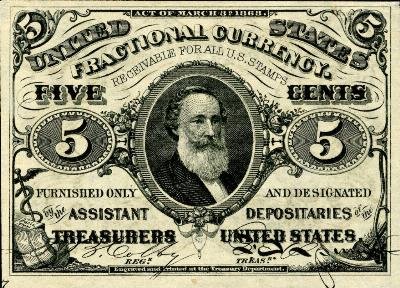
That moment arrived with the annual appropriations bill for the Treasury. Thayer attached an amendment that, in the words Walter quotes, provided: “Hereafter no portrait or likeness of any living person shall be engraved or placed upon any of the bonds, securities, notes, or postal currency of the United States.” The language was sweeping and, as it turned out, durable. It is the reason the portraits on U.S. money are drawn exclusively from the ranks of the deceased.
A Paperwork Loophole and a Questionable Reputation
How Clark managed to get himself onto the currency in the first place is its own small tale of bureaucratic improvisation. According to Walter’s account, a paperwork error had designated a “Clark” to be honored on a note, but no first name was ever specified. Because the instruction did not identify which Clark was meant, Spencer Clark decided that the Clark in question was him. He got away with it.
The notes bearing his image were not withdrawn and destroyed. They survive as curiosities, and Walter notes that they can still be found for sale on eBay and elsewhere. Clark’s placement in the pantheon of currency portraits is, by any measure, an oddity: as Walter puts it, he became one of only “53 [people] who’ve [ever] been featured on things like legal tender, silver certificates, Federal Reserve notes and, of course, your everyday currency notes.”
Clark’s record at the Treasury was controversial in other ways as well. He was accused of hiring only beautiful women and of paying them $1,000 in purloined Treasury notes to sleep with him. Other reporting, Walter acknowledges, describes a very different motive: that Clark was hiring the wives of Civil War soldiers as a purely altruistic effort to help them financially while their husbands were away, or in worse circumstances. Walter does not pretend to know which version is accurate, or whether the truth was some combination of the two. He leaves the question open, noting simply that it could have been a little of both, or a lot.

Clark also played what Walter describes as a minor but important role in the conspiracy trial of the men involved in Lincoln’s assassination, a detail that adds another layer to an already crowded résumé.
Why the Rule Still Matters
The story is amusing on its face, but it also explains a feature of American civic life that is easy to take for granted. Countries decide differently. Some nations put reigning monarchs, sitting presidents, or living national heroes on their money. The United States does not, and the reason is not a considered philosophical commitment to honoring only the dead. It is a reaction to one official’s self-promotion.
The practical effect is that the honor is conferred posthumously, which changes the character of the tribute. A portrait on a bill is no longer a statement about a person’s current status or influence. It is a judgment rendered after a life is complete, and it can only be revised by future generations who decide whether the figure still merits the space.
It also means that the question of who appears on American money is never settled permanently. The roster can change, but it changes slowly and only for the dead. Any living American hoping to see their face on a Federal Reserve note is, by law, out of luck — and they have Martin Thayer and Spencer Clark to thank for it.
Walter’s account is a reminder that some of the most enduring rules in American government were not designed in a fit of high-minded deliberation. They were the product of a specific quarrel, at a specific moment, between two men who could not stand each other. The amendment outlasted them both, and it governs the appearance of every dollar in circulation today.
Source: www.americanthinker.com — https://www.americanthinker.com/blog/2026/09/why-only-dead-men/