
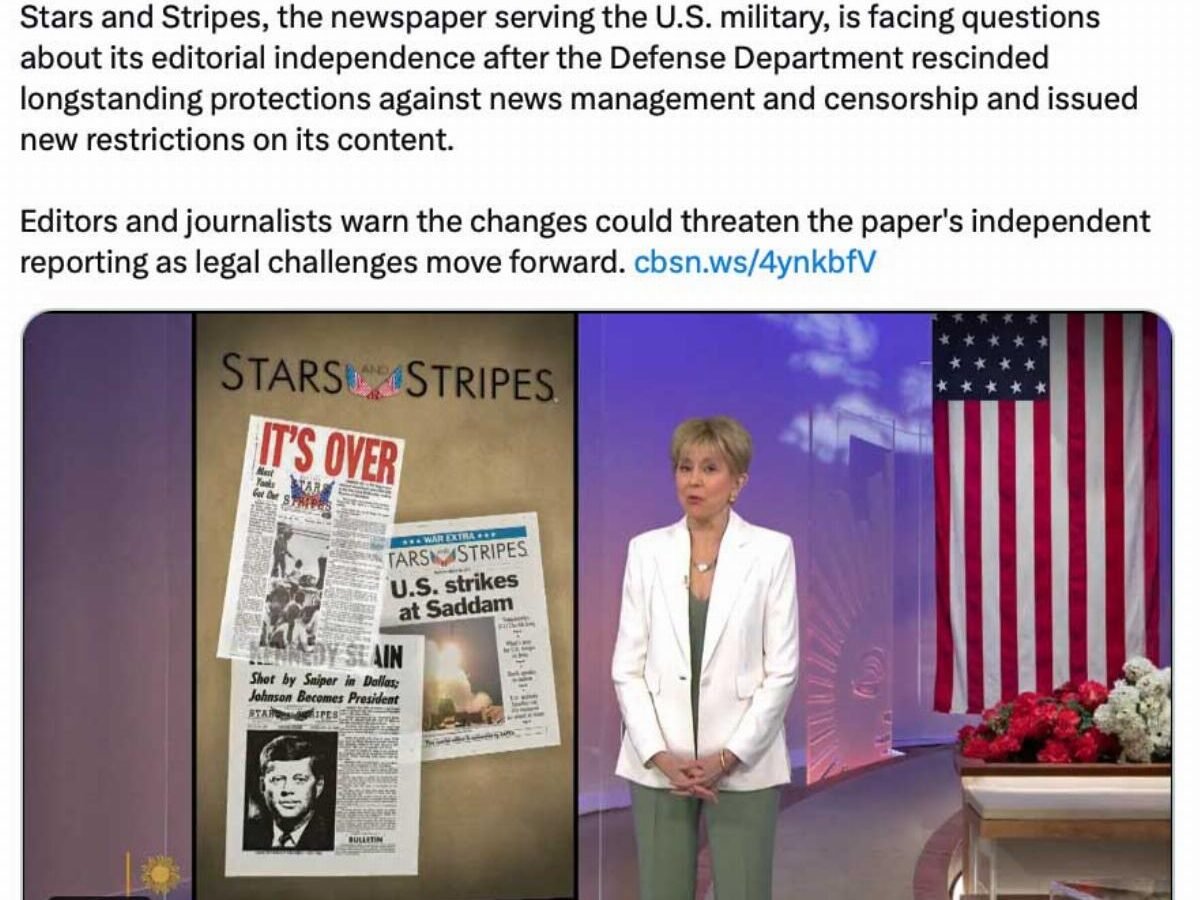
When the Supreme Court handed down Trump v. Slaughter in June, Democrats were not happy. The ruling, which struck down the Federal Trade Commission’s for-cause removal provision, dramatically reshaped the balance of power inside the executive branch. For the first time in over 90 years, presidents gained the authority to fire officials at so-called “independent” agencies — a move that Democrats argued would let Republican presidents, especially Donald Trump, gut agencies they couldn’t control.
Now, that ruling is colliding with a very different kind of fight: a lawsuit filed by three fired staffers at Stars and Stripes, the military’s long-running newspaper, who claim their dismissals were illegal retaliation.
The plaintiffs — publisher Max Lederer, editor in chief Erik Slavin, and Middle East reporter Lara Korte — were fired last week for “insubordination,” according to the complaint filed Thursday in federal district court in Washington. They argue the Pentagon’s decision violated federal administrative law and their First Amendment free-speech protections.
But as military affairs blogger Mike McDaniel writes in American Thinker, the timing could not be worse for the three journalists. The Supreme Court’s June decision in Trump v. Slaughter may have just erased the legal foundation their case depends on.
A ruling that changed the rules
For most of the twentieth century, “independent” federal agencies accumulated vast power — the ability to investigate, adjudicate, and impose severe financial penalties for regulatory violations — while their top officials remained largely shielded from presidential removal. Courts treated these agencies as if they were mere “judicial or legislative aids” from another era, insulating their leaders from the president’s authority for over 90 years.
On Monday, that era ended. The Supreme Court held in Trump v. Slaughter that the FTC’s for-cause removal provision violates the separation of powers enshrined in the Constitution. The Court reasoned that the Constitution creates a clear hierarchy within the executive branch, with the elected president at the top. And for that hierarchy to work, the officers directly below the president must be removable by him — otherwise, they can’t be held accountable.
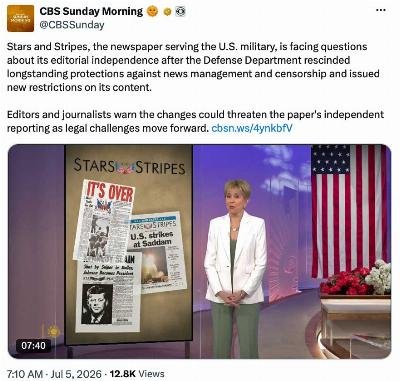
That logic, McDaniel argues, extends far beyond the FTC. It reaches directly into the Pentagon — and into Stars and Stripes.
The paper’s unusual position
Stars and Stripes is not a privately owned media outlet. It’s partially funded through congressional appropriations, and its staff are paid by the Pentagon. The paper’s more-or-less direct boss is Secretary of War Pete Hegseth, who reports to the president.
Given the structure, the three fired staffers’ argument that they’re independent of their boss — and of the Trump administration — is a tough sell, McDaniel contends. The military newspaper exists to serve service members and their families, but it operates within the chain of command, not outside it.
The lawsuit escalates a broader fight over the editorial independence of the paper. Earlier this year, two members of the paper’s advisory board sued the Pentagon over new restrictions on the outlet. A few weeks later, the paper’s former ombudsman filed her own suit, arguing she was fired in retaliation for criticizing those same policies.
Now, the three fired staffers have joined the fray. In a statement, they said their goal is to “protect the rights of service members and their families to a free and independent press.”
“Stars and Stripes has served them for generations, and that independence is essential to keeping military communities fully and accurately informed,” they said. “This lawsuit is about safeguarding that mission and ensuring our civilian and military journalists can do their jobs without retaliation.”
What sparked the firings
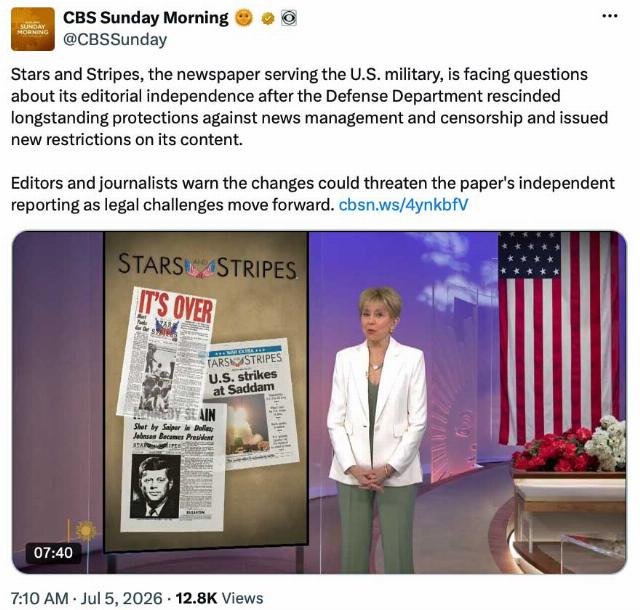
The immediate trigger, according to former editor in chief Erik Slavin, was a July 5 interview he gave to CBS News. In that interview, Slavin said that hypothetical censorship at Stars and Stripes would be a “red line” for him.
Those comments came just a month after the advisory board members sued the Pentagon over the new restrictions. The timing, McDaniel notes, makes the insubordination charge look less like a surprise and more like a consequence.
There’s also the paper’s recent reporting on conditions aboard the USS Abraham Lincoln. Some sailors and their parents had complained about being stuck on a ship in the middle of the ocean. The Democrat-leaning media, McDaniel writes, used the coverage to criticize President Trump and the military.
McDaniel dismisses those complaints, pointing to his own analysis titled “Are our sailors really starving?” His conclusion: No, they’re not. Sailors sign up to sail on ships, he notes, and ships move about on the world’s oceans. And like the reporters at Stars and Stripes, sailors are under the direct authority of the military chain of command.
The insubordination question
For McDaniel, the core issue is simple: orders were given, and the reporters refused to carry them out. That’s insubordination, and insubordination has consequences.
“The same applies to reporters hired and paid by the military,” he writes. “Orders were given; the reporters refused to carry them out, which was insubordination. Firing followed.”
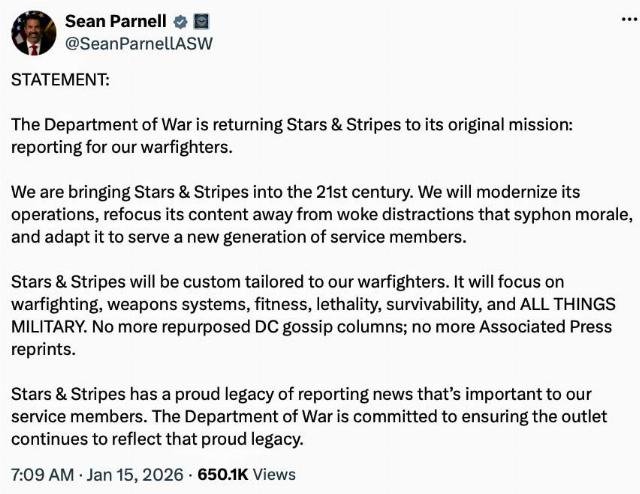
Whether a court agrees will depend on how far the logic of Trump v. Slaughter extends. The ruling was about agency heads at the FTC, but its reasoning about the president’s removal power reaches broadly. If the president can fire the head of an independent agency for-cause protections notwithstanding, why shouldn’t the Pentagon be able to fire military journalists who defy explicit orders?
The plaintiffs will argue that journalism is different — that a free press, even inside the military, exists to hold power accountable, not to take orders. But McDaniel is skeptical. Stars and Stripes is not an independent media outlet, he argues. It’s funded by the government, staffed by government employees, and serves a government mission.
“Ignoring for the moment Trump v. Slaughter, the Trump Administration had, months ago, charged the entire DOD with reordering its focus, most specifically toward war fighting rather than drag queens and pronouns,” he writes. “This included the Pentagon, which funds Stars and Stripes and pays the salaries of the three fired former journalistic revolutionaries.”
What happens next
The case is in its early stages, and the legal arguments will take months to unfold. But McDaniel expects the outcome to be predictable.
“Considering Trump v. Slaughter, it appears obvious that the three revolutionaries will inevitably discover what the rest of us have always known: ignore your boss at your own risk,” he writes. “It couldn’t happen to more feckless revolutionaries.”
Whether that prediction holds will depend on how a federal judge weighs the First Amendment claims against the new reality of presidential power. But one thing is clear: the legal landscape for anyone working inside the executive branch — including military journalists — has shifted significantly since June.
The lawsuit is yet another chapter in a long-running struggle over what Stars and Stripes should be: an independent voice for service members, or an arm of the military command structure. After Trump v. Slaughter, the answer may be more settled than the plaintiffs hope.
Source: www.americanthinker.com — https://www.americanthinker.com/blog/2026/09/stars-and-stripes-who-s-the-boss/