
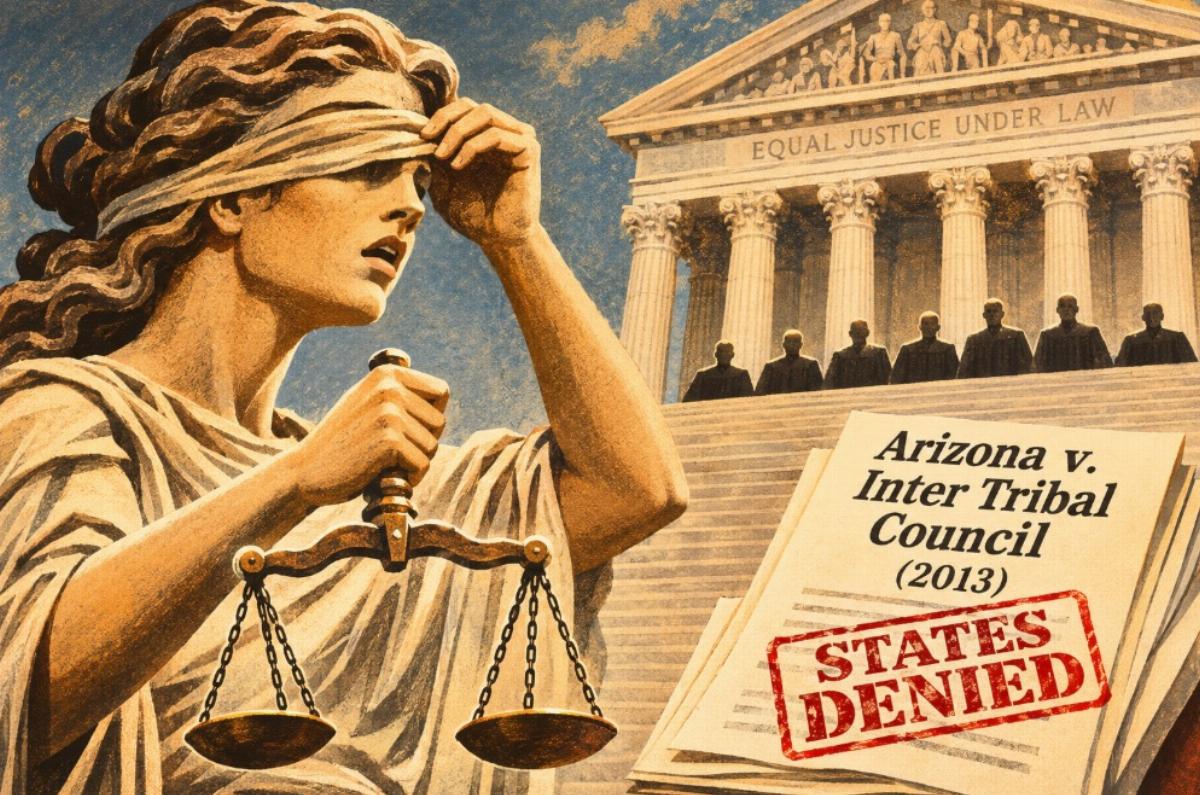
The Supreme Court is set to hear arguments next month in a case that could determine whether states retain any meaningful control over voter eligibility—or whether federal power will expand further into what was long considered a state prerogative. At issue in RNC v. Mi Familia Vota is Arizona’s requirement that voters submitting state registration forms prove U.S. citizenship, a rule Democrats are challenging despite its partial validation in prior rulings.
A Constitutional Collision
The conflict stems from two constitutional provisions pulling in opposite directions. Article I’s Elections Clause grants Congress authority to regulate federal election procedures, while the Qualifications Clause reserves to states the right to set voter eligibility standards. In 2013’s Arizona v. Inter Tribal Council, the Court ruled 7-2 that federal law preempted Arizona from demanding citizenship proof for registrants using a national form, even while acknowledging states could impose stricter rules on their own forms.
Justice Scalia’s majority opinion argued Congress could regulate the ‘manner’ of elections broadly—including registration—while dissenting Justices Thomas and Alito warned the decision neutered states’ constitutional role in setting voter qualifications. Now, with Mi Familia Vota, the Court must decide whether Arizona can fully enforce citizenship verification for state-level registrations without offering a federal-only fallback.
The Stakes in Practice
Currently, Arizona maintains a bifurcated system: those using state forms must show citizenship documents, while federal registrants need only check a box. The latter group—now numbering over 30,000 voters—can cast ballots in federal but not state elections. Critics note Biden’s 2020 Arizona victory margin (10,457 votes) was smaller than the pool of federal-only registrants, though no evidence links them to fraud.
Democrats now seek to extend federal-only registration to state-form applicants who don’t provide proof, contending disparate treatment violates equal protection. Arizona counters that doing so would erase the last vestige of state authority recognized in Inter Tribal, turning its dual-system compromise into unilateral federal control.
Originalism’s Crossroads
The case presents a test for the Court’s originalist wing. Since Inter Tribal, the conservative bloc has grown more assertive in overturning precedents deemed inconsistent with constitutional text, from Dobbs to Loper Bright. Yet here, they’d need to confront a decision authored by their late lodestar, Scalia.
As legal commentator Marc Garrett notes, one irony is that Scalia’s own reasoning—’the power to establish voting requirements is of little value without the power to enforce those requirements’—could now bolster Arizona’s case. But with three Inter Tribal dissenters gone and three liberal justices still on the Court, even limited state victories may hinge on Roberts or Kavanaugh’s willingness to revisit what Thomas once called a ‘truly strange’ interpretation of federal power.
Source: www.americanthinker.com — https://www.americanthinker.com/articles/2026/11/the-constitution-s-citizenship-conundrum/
Background and context
The latest developments around Supreme Court Showdown: Can Arizona Defend Its Voter Citizenship Rules? come amid a broader debate over opinion, institutional accountability, and the policy choices that shape everyday life. Understanding the immediate facts is only the first step; the wider impact depends on how officials, institutions, and the public respond in the days and weeks ahead.
FedFront’s coverage focuses on verifiable details, identifiable sources, and the practical consequences of political decisions. Readers should review official statements, primary documents, and court or agency records before drawing final conclusions about any disputed claims.
Why it matters
Stories like this can influence legislation, regulatory enforcement, public trust, and the balance of power between government institutions. Even when the immediate headline fades, the underlying policy, legal, or political questions often continue to shape future decisions.
What to watch next
- Official responses, statements, or policy changes
- Legislative, regulatory, or court action
- Follow-up reporting and independent verification
- Public reaction and broader political fallout
FedFront will continue monitoring this story and update coverage as new information becomes available.
Source: www.americanthinker.com
Related coverage
- American Thinker Essay Claims ‘Pluralism Is Not a Suicide Pact’ as Immigration Debate Collides With Free Speech
- DOJ Busts $270M ‘Ghost Student’ Fraud Ring Exploiting Federal Aid Programs
- North Korea’s New Tumen River Bridge Is a One-Way Trip for Troops Sent to Die in Ukraine
- American Thinker column: Irish politics has been feminized, and men are to blame