
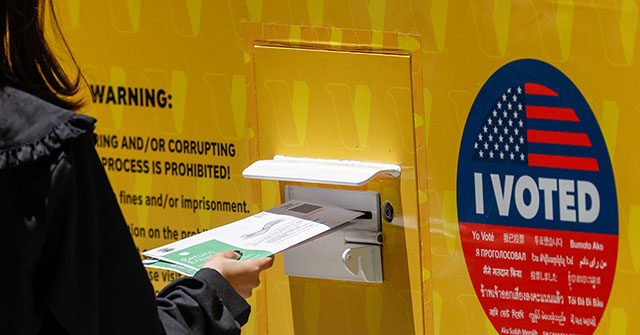
The U.S. Supreme Court handed President Trump a procedural win Monday, ruling that a coalition of states challenging his executive order on mail ballot security brought their lawsuit improperly. The unsigned order, which drew dissents from the Court’s three liberal justices, does not settle the broader legal fight over the order’s merits, but it removes a major obstacle just as states begin mailing ballots in early September.
The executive order, signed by Trump in March, directs the Department of Homeland Security to verify citizenship in each state and orders the U.S. Postal Service to initiate rulemaking ensuring that only verified, eligible voters receive mail-in and absentee ballots. Last week, USPS published its series of requirements in preparation for the order to take effect, according to a fact sheet summarizing the administration’s actions.
“President Trump is taking decisive action to prevent non-citizens from voting in Federal elections and to protect the security of mail-in and absentee ballots,” the fact sheet stated.
Court Avoids the Merits, Faults the Process
In its ruling, the Supreme Court made clear it was not deciding whether Trump’s order is lawful or constitutional. Instead, the justices took issue with the procedural posture of the case brought by the states. The opinion concluded that the states had not shown they were harmed by the order itself at this stage, and therefore the Massachusetts district court lacked jurisdiction to block it from taking effect.
“On that score, time will tell,” the opinion reads, signaling that the underlying legal questions remain open for future litigation. The Court’s decision effectively allows the executive order to remain in force while lower courts continue to examine the states’ substantive challenges.
The ruling comes at a critical moment: several states are set to begin distributing ballots to voters in early September, and the USPS’s newly published requirements are now poised to go into effect. Election officials and voting rights groups are likely to scrutinize how the verification process unfolds in the coming weeks.
The three liberal justices — typically Justices Sotomayor, Kagan, and Jackson — dissented from the unsigned order, though their dissent was not immediately detailed in the Court’s brief announcement.
What’s Next
Monday’s decision is not the final word on the executive order. The Court’s ruling leaves the door open for the states to renew their challenge if they can demonstrate concrete harm once the order is implemented. Legal experts say the dispute could return to the Supreme Court after the November elections, depending on how the lower courts handle the case.
In the meantime, the practical impact is immediate: the USPS’s new ballot verification requirements are set to take effect as states ramp up mail voting. The administration has framed these measures as necessary safeguards against non-citizen voting, a practice that is already illegal in federal elections but which Trump and his allies have claimed is widespread without providing evidence.
Critics, including the suing states and voting rights advocates, argue the order could disenfranchise eligible voters and create confusion in the mail-in ballot process. They contend that citizenship verification at the federal level could delay ballot delivery and disproportionately affect minority and low-income voters.
The ruling underscores the judiciary’s cautious approach to election-related disputes, often deferring to state and federal election administration while demanding that plaintiffs show concrete, particularized harm.
As the election season heats up, all eyes will be on how USPS implements the new rules and whether any further legal challenges emerge. For now, the Trump administration can claim a significant legal victory, but the constitutional battle over the order’s substance is far from over.
Source: www.breitbart.com — https://www.breitbart.com/politics/2026/08/24/supreme-court-rules-in-trumps-favor-on-mail-ballot-rules/