
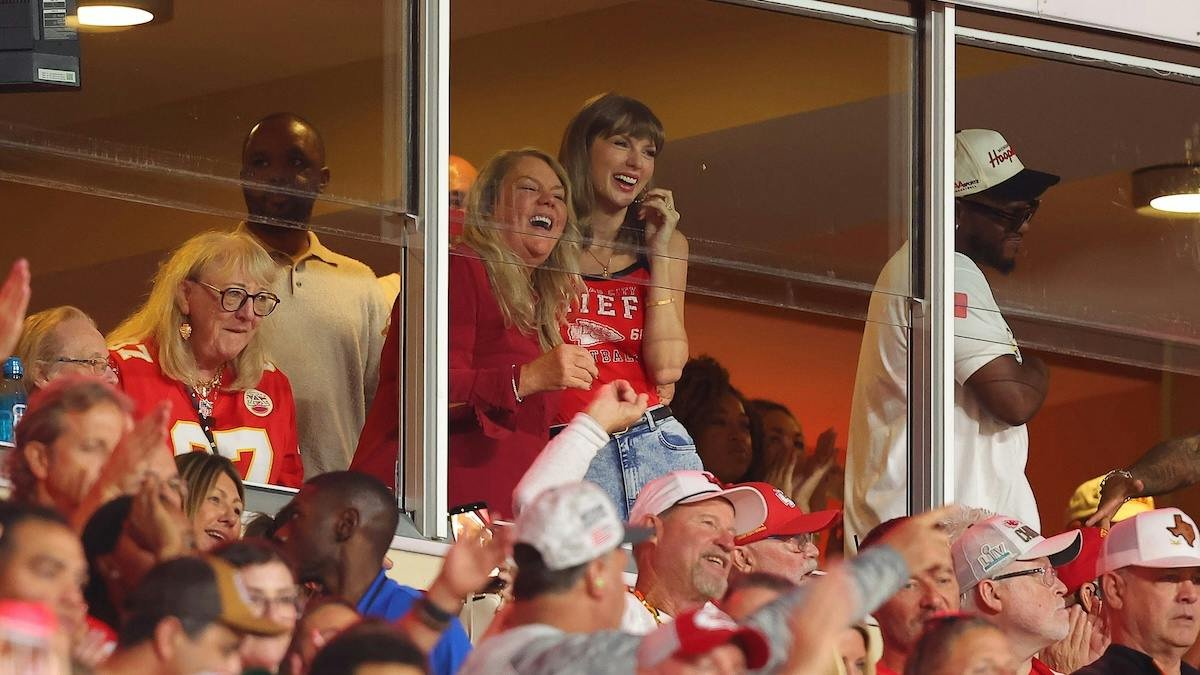
A brief moment caught on camera during a Kansas City Chiefs game has turned into an unlikely referendum on American marriage. In a clip circulating widely on social media, Taylor Swift is seen cheering for Travis Kelce during the Chiefs’ matchup with the Indianapolis Colts, beaming as she points to her wedding ring and mouths the words “that’s my husband.”
The reaction was immediate and sharply divided. Some viewers found the moment sweet and genuinely supportive. Others labeled it “cringe,” “performative,” and “fake” — a backlash that, according to Daily Wire columnist Clare Ath, says more about the state of modern marriage than most think pieces will manage all year.
Writing for The Daily Wire, Ath argues that the split reaction is itself the story. Her central claim is that over roughly the past three decades, American culture has quietly trained women to treat open devotion to a husband as naive — and to treat mild public mockery of him as the smarter, more relatable posture. The safe move, in this telling, is the joke about his incompetence; the risky move is saying out loud that you admire him.
The script, and where it shows up
Ath traces that script through everyday life and pop culture alike. She points to the familiar PTA-meeting introduction in which a mother describes herself as having four kids, “including my husband” — a line delivered as bonding but which, in her reading, functions as something closer to training. She also cites the trajectory of television fathers, from Al Bundy’s defeated persona in the 1990s through Phil Dunphy’s well-meaning bumbling on “Modern Family,” arguing that dads have been rewritten repeatedly as dumb or embarrassing rather than honorable, wise, or courageous.
The consequences, she contends, are not confined to a punchline. If wives are taught to see their husbands as burdens rather than leaders, she writes, husbands eventually learn that trying harder won’t change the joke — and many of them stop trying altogether.
For support, Ath cites the work of psychologist John Gottman, whose decades of research on marital stability identified contempt — the eye-roll, the mockery, the dismissive “you’re an idiot” — as the single strongest predictor of divorce.

What the research says about happy marriages
If contempt predicts divorce, Ath asks, what predicts satisfaction? She points to survey work from the Institute for Family Studies, which she says keeps arriving at the same answer: devotion.
Citing a 2025 IFS/Wheatley survey, Ath reports that wives who described their marriage as one of the most important things in their life were 399% more likely to say they were very happy in it compared to wives who did not express that level of commitment — nearly five times the odds, and a result she notes had nothing to do with a bigger house or a nicer vacation.
Feeling protected mattered as well. According to the same survey, wives who said it was “definitely true” that their husbands were protective were 137% more likely to report being very happy in their marriages. Ath highlights an observation from study co-author Brad Wilcox, who interviewed wives across the political spectrum and found that those who felt physically safe with their husbands were, in his words, “markedly happier.”

The audience that matters most
Ath, who describes herself as the mother of four boys, writes that the part of the debate she returns to most is what children absorb from how their parents speak about each other. If the culture’s default script is that Dad is a lovable moron, she argues, sons learn they are punchlines waiting to happen, and daughters learn that admiring a man is something to be embarrassed about.
She frames marriage as a form of instruction — “catechesis,” in her word — whether or not parents intend to teach anything, and says she intends to raise her sons to understand that the man of the house is someone to be honored rather than mocked.
Anticipating a particular line of criticism, Ath rejects the suggestion that her position amounts to “tradwife cosplay.” She notes that she works and writes, and says she sees no tension between those roles and her view that being a wife and mother is her central vocation.
A small assignment
Her proposed remedy is deliberately modest. Say the uncool sentence out loud, she urges: brag about your husband at the dinner table, point at the ring, tell him you’re proud of him. Children are listening, she writes, and they are learning from their parents what marriage is supposed to look like — not a decades-long competition over who is smarter, more competent, or less annoying, but two people who chose each other and chose to honor, protect, forgive, and delight in one another.
That, in Ath’s reading, is what made the Swift clip resonate. For a few seconds, she writes, there was no ironic detachment, no eye roll, no joke at a husband’s expense — just a woman in front of a stadium and a national audience, delighted to say: that’s my husband.
The essay appears as part of Upstream, The Daily Wire’s section for culture and lifestyle coverage.
Source: www.dailywire.com — https://www.dailywire.com/news/normalize-liking-your-husband