

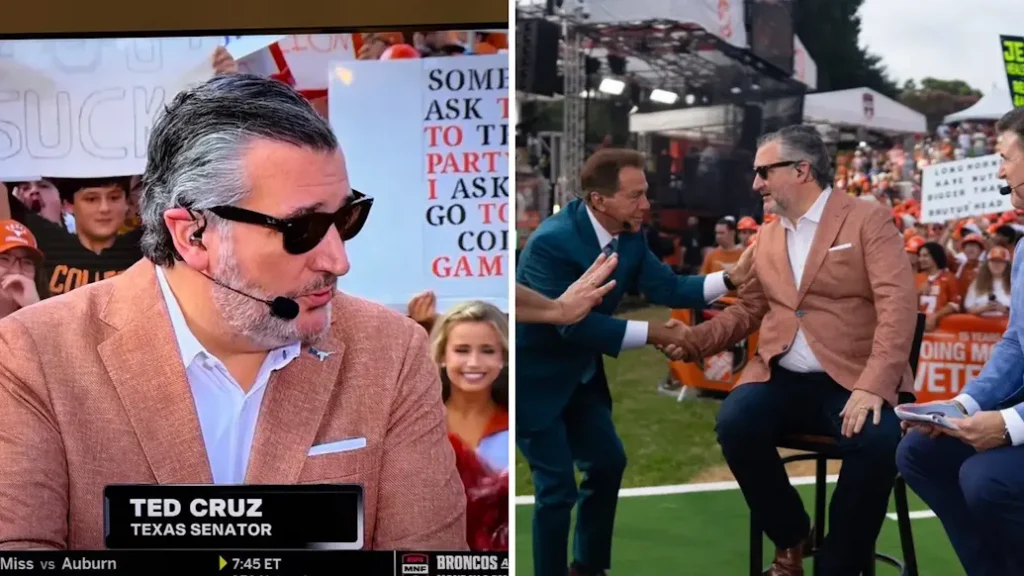
Sen. Ted Cruz took ESPN’s College GameDay stage in Austin to make a case for federal legislation on college athletics. Sports media figures spent much of the following week making a case against the appearance. The fans, according to viewership data reported by Puck sports correspondent John Ourand, apparently made no case at all — they simply stayed put.
The segment, which aired live on Sept. 12 ahead of a primetime matchup between Texas and Ohio State, drew 2.13 million viewers. Per Ourand’s reporting, that same 2.13 million were still tuned in when Cruz’s interview with host Rece Davis wrapped roughly ten minutes later. No detectable drop-off, no mass exodus, no surge of remotes clicking away in protest.
That detail cuts against the tone of the coverage that followed. Writing for Sport & State, the outlet founded by Clay Travis, Mark J. Burns argued that the volume of the backlash — much of it unfolding on social media during and after the interview — would have led anyone to believe Cruz’s mere presence on set sent fans scrambling for the channel button.
What Cruz actually said
The Texas Republican used his airtime to promote the Protect College Sports Act, a bipartisan bill that continues to work its way through the U.S. Senate. Cruz framed the measure as a necessary response to a collegiate landscape he described as drifting toward disorder, saying there are “no rules” in college sports as it descends into further “chaos” without guardrails in place.
“It protects the students,” Cruz said of the bill. “It protects the students’ ability to be compensated to receive name, image, and likeness compensation. I think that’s only fair. It’s only right. They’re producing enormous value.”
The pitch landed with a thud inside parts of the sports media. NBC Sports football analyst Chris Simms was among the loudest voices, calling the booking an embarrassment and objecting to what he characterized as injecting politics into the biggest game of the young season. Others in the college football press piled on in the days that followed, with some critics going so far as to label College GameDay itself a vehicle for “political propaganda.”

The Herbstreit episode
ESPN college football analyst Kirk Herbstreit became a secondary target after addressing the Cruz appearance on his own platform. His comments drew a fresh round of criticism from media colleagues, several of whom argued it was implausible for a longtime ESPN fixture to claim distance from Cruz’s politics while the network was platforming a sitting senator to discuss contested legislation.
One prominent college basketball reporter called the posture absurd, noting that pretending ignorance about Cruz’s political identity strains credulity. Another college sports writer put it more bluntly: you cannot invite a sitting U.S. senator on to discuss a hot-button political issue and then plead neutrality about politics itself.
The Cruz interview also resurfaced a familiar social media post from former ESPN host Jemele Hill, who quipped that she hadn’t realized ESPN had become a political lobbying firm. The line circulated widely among the segment’s critics.

The Shapiro comparison
Supporters of Cruz’s appearance were quick to point to what they see as a double standard. Pennsylvania Democratic Gov. Josh Shapiro, they noted, was given substantial airtime on Disney-owned airwaves last fall. In 2024, Bloomington, Ind., Mayor Kerry Thomson, also a Democrat, appeared on viewers’ screens to declare a Lee Corso Day. Neither appearance generated comparable outcry, according to critics of the backlash.
That argument — that College GameDay has long functioned as a stop for politicians of both parties — formed the spine of the counterattack from right-leaning commentators, who accused the sports press of applying a partisan filter to who gets to use a Saturday morning football show as a political platform.
For all the noise, the ratings picture offers a simpler verdict. The audience that showed up for Cruz’s segment stayed for the whole thing, and the broader college football viewership carried on with its Saturday. Cable news panels and social media feeds lit up for days. The couch-bound fan base, at least as measured by the numbers Ourand cited, barely flinched.
The Protect College Sports Act itself continues to move through the Senate, where its path remains uncertain. Cruz has made the legislation a recurring talking point, and his willingness to bring it to a football pregame show — a venue built for highlight reels and coaching interviews rather than legislative advocacy — is likely to keep drawing scrutiny from the sports media ecosystem that reacted so sharply the first time.
Whether ESPN invites another senator on set this season is an open question. What the Sept. 12 data suggests is that the network’s audience may prove more tolerant of the experiment than the reporters and analysts paid to talk about it.
Source: www.dailywire.com — https://www.dailywire.com/news/ted-cruz-got-booed-on-espn-but-college-gamedays-audience-didnt-flinch-amid-media-outrage