
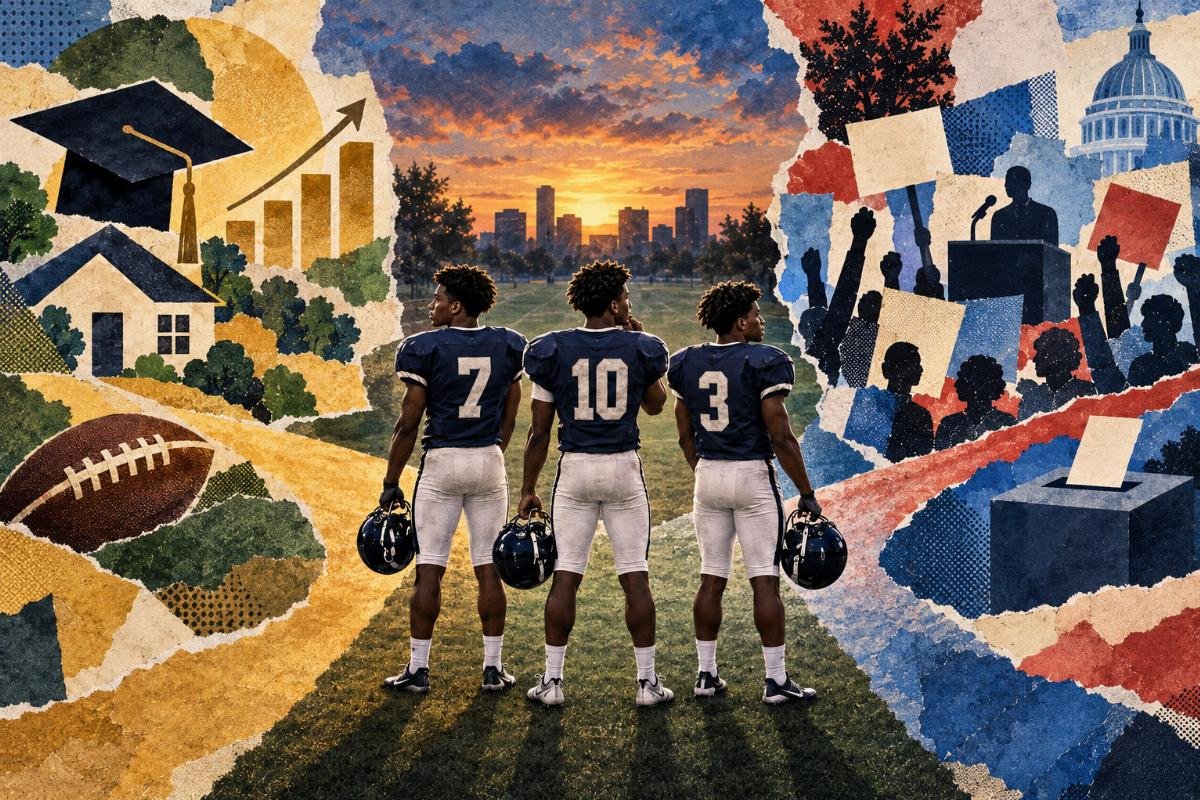
When the NAACP recently urged some of the nation’s top Black high-school football players to withhold commitments from public universities in eight states—and to consider transferring or using their NIL platforms to protest congressional redistricting—it framed the move as a matter of representation. The slogan is stark: “No Representation. No Recruitment. No Revenue.”
But behind that political calculus lies a heavier question: What does it cost a 17-year-old who has spent a decade perfecting his craft to be told his future choices must now carry the weight of a national grievance?
The campaign follows a Supreme Court ruling that struck down Louisiana’s second majority-Black congressional district as an unconstitutional racial gerrymander—a 6-3 decision that left many in civil-rights circles furious. Rather than staying in the courthouse and statehouse, the NAACP’s strategy now reaches into the huddle, the locker room, and the living rooms of families who have watched their sons grind through drills, camps, and film sessions to reach the doorstep of Alabama, Georgia, LSU, Texas, or another powerhouse program.
For those young athletes, the rewards are suddenly aligned against a political ask. Universities want them. NIL money may be waiting. The NFL might be down the road. Yet the very moment their talent has granted them leverage—control over their own path forward—they are being encouraged to view that path through the lens of victimhood and grievance.
A Heavy Load for Teenagers
Critics from across the ideological spectrum have raised alarms. Black Studies professor Elwood Watson called the move “grossly irresponsible and unfair,” warning that young athletes risk becoming “athletic guinea pigs or pawns.” Educator Rann Miller pointed out the asymmetry: What sacrifices are the adults making who are urging these teenagers to put their scholarships, NIL deals, and careers on the line?
Sports psychology offers a more clinical warning: mental fatigue. This isn’t simple tiredness. Research described in a 2026 BMC Psychology meta-analysis of 19 studies found that mental fatigue is linked to poorer reaction time, impaired technical execution, and worse decision-making—with the strongest effects on decision-making, where the measured decline reached roughly two-thirds of a standard deviation.
Think about what the NAACP is asking. A high-school junior or senior is at a developmental stage where the brain’s capacity for long-term planning is still maturing. Studies following decision-making from adolescence into adulthood show that younger people place greater weight on immediate rewards. The ask isn’t just “skip a game”—it’s to weigh immediate social approval and political solidarity against educational, financial, and professional opportunities that may not fully materialize for years, all while coaches are simultaneously trying to get him to read a defense and execute the next play.
The psychological ideal for elite performance is what psychologist Mihaly Csikszentmihalyi called “flow”—complete absorption, where action and awareness merge and irrelevant thoughts are excluded. Grievance politics, by its very nature, pulls attention away from the immediate task and towards an external, unresolved conflict. The athlete’s body may be ready, but his brain is being asked to process far too much.
The Marshmallow Has Gotten More Expensive
I was a student of Stanford psychologist Philip Zimbardo, and his work on time perspective—built on Walter Mischel’s famous marshmallow experiment—has always stuck with me. In that study, a child faced an immediate reward (one marshmallow now) or a delayed one (two later). Fourteen years down the line, the kids who had resisted the immediate treat averaged 250 points higher on the SAT, got into less trouble, and were described as more self-confident and determined. Zimbardo’s lesson: they were future-focused rather than present-focused.
Put the NAACP’s call against that. The immediate reward is obvious—take a stand, feel solidarity, earn the applause of the cause. The delayed reward may be worth millions over a lifetime: the right university, the right coach, the education, the NIL value, possibly a career in the NFL. The marshmallow has simply become considerably more expensive.
Elon Musk has famously described the cultural phenomenon as the “woke mind virus,” warning against replacing individual skill and integrity with race and group identity—and calling the constant injection of race into issues “divisive and corrosive to society.” Former college coach Tommy Tuberville framed it in football terms: when a quarterback effectively takes himself out of the common mission, “that tends to tear down your team” and strips away the “moral loyalty.” Tuberville’s pregame routine—standing for the flag, then kneeling in prayer afterward—symbolized a team built on shared identity and discipline.
But reverse that process: introduce distraction, immediate political reward, victimization, and racial division—and then expect it all to disappear when the ball is snapped. History suggests it doesn’t.
The Kaepernick Precedent
Colin Kaepernick gave us a clear case study. On August 26, 2016, he sat during the national anthem before a preseason game, explaining he wouldn’t honor a flag for a country that “oppresses black people and people of color.” He later switched to kneeling, igniting a national debate about race, policing, and patriotism that rippled far beyond the field.
At the time, the 49ers were expected to struggle—Las Vegas set their preseason win total at just 5½ games. They finished 2-14, a 64% shortfall from that already low bar. Kaepernick started 11 games and went 1-10, though his individual numbers—16 touchdowns, 4 interceptions, a 90.7 passer rating—were hardly disastrous.
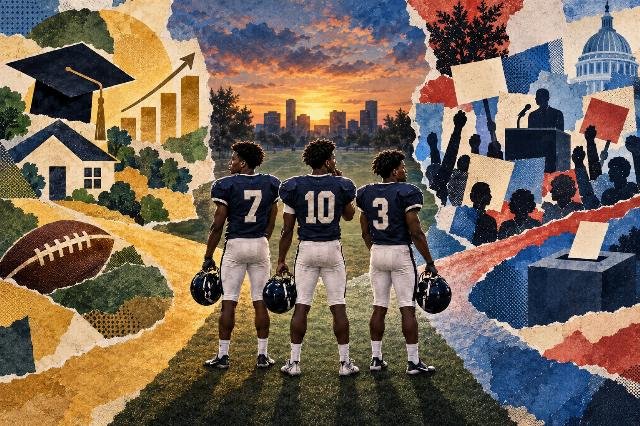
But look at the defense. In 2015, the season before the protest, San Francisco surrendered 387 points. In 2016, they finished 32nd in yards and points allowed, giving up 480—93 more points, a 24% increase. Kaepernick doesn’t play defense, but his teammates were part of the same locker room, the same media circus, the same choices about whether to kneel, disagree, or stay silent. Grievance doesn’t only affect the athlete who voices it; it spreads through the shared environment.
I coined a term at the time for what I was observing: Self-Inflicted Degradation of Performance Syndrome, or SIDOPS—the idea that grievance and distraction degrade individual performance and can ripple through a team. My 2017–18 work compared protesting teams against Vegas expectations, exploring whether a victim-based mindset and social contagion might show up in athletic performance—years before the 2026 meta-analysis confirmed measurable deficits in reaction time, technical execution, and decision-making under mental fatigue.
The “Hands Up, Don’t Shoot” chant that followed the Michael Brown shooting in Ferguson offers another warning about grievance outliving facts. Eric Holder’s Justice Department later found no credible witness who could establish that Brown was shot while clearly surrendering; witnesses who supported that account were contradicted by physical evidence, changed their stories, or recanted. The slogan survived the facts anyway—just as grievance can survive the event that created it.
Ten years later, Kaepernick maintains the NFL is “actively blackballing” him, and he says he no longer watches pro football: “I watch college football.” That’s a man who once quarterbacked a Super Bowl team and earned a contract potentially worth more than $100 million—now describing himself, a decade out of the league, as a victim of the very institution that made him a star.
What the Scoreboard Says
Now the NAACP is asking young Black athletes to bring a similar grievance into decisions that could determine their own futures. Kaepernick’s career doesn’t prove a causal link—but it’s a warning of what may follow when a gifted athlete organizes his future around grievance.
No one disputes that redistricting disputes deserve vigorous political engagement. But the NAACP’s chosen battlefield—the recruitment of teenagers—raises a profound ethical question. Are we willing to ask 17-year-olds to sacrifice their dreams, their scholarships, and their up-and-coming careers to send a message to adults in eight state capitals? And if not, what does it say about the cause that needs them to bear that cost?
Before asking another gifted young athlete to make that trade, it’s worth looking at the scoreboard—and remembering what happened to the last quarterback who took a knee.
Source: www.americanthinker.com — https://www.americanthinker.com/articles/2026/09/when-grievance-enters-the-huddle/