
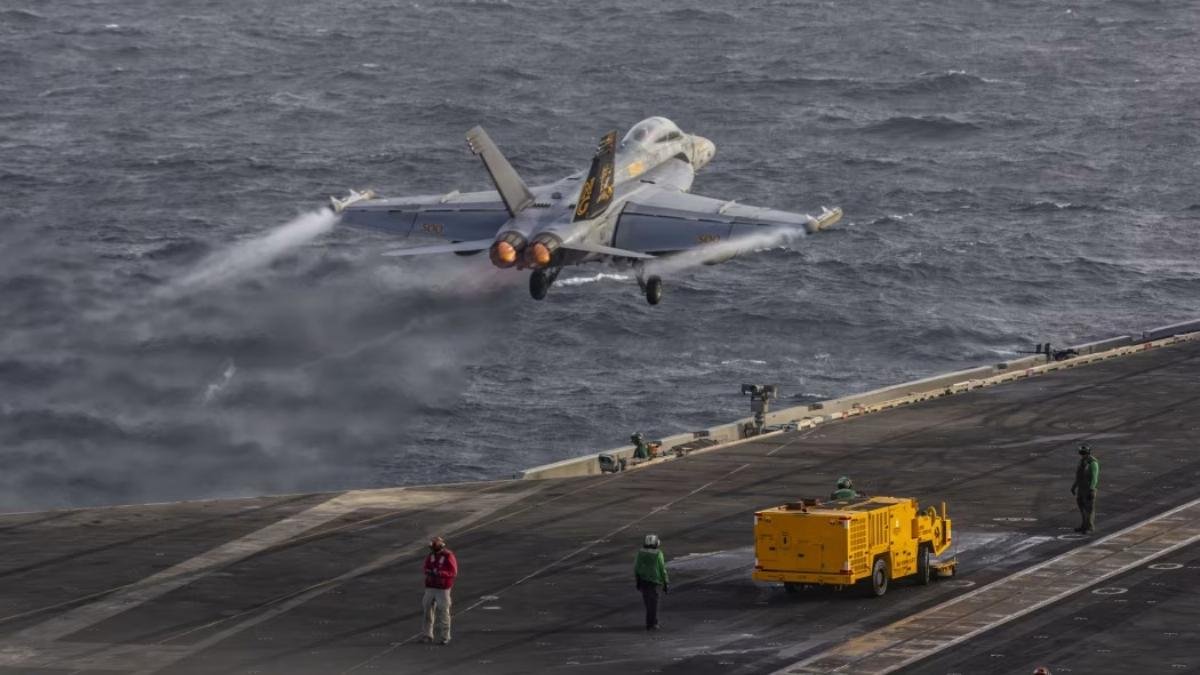
President Trump told reporters this week that he is weighing “decisive action” against Iran and plans to raise the matter with Arab Gulf allies when they gather in New York next week for the UN General Assembly. “Do I want to annihilate them or do I not?” he said, referring to the Iranian regime.
That quote — and the question of whether the American public still has the appetite for the fight — sits at the center of a new American Thinker op-ed by Kenneth R. Timmerman, who argues that the war is being won and that the only realistic path to an Iranian victory runs through Congress.
A poll that Timmerman reads differently
The president’s comments, Timmerman writes, are partly a response to rising public unease. A Fox News poll released Thursday found that 71 percent of registered voters believe the country lacks a strategy to end the war. Timmerman notes the partisan breakdown: 43 percent of Republicans and 83 percent of independents joined Democrats in that view.
He doesn’t buy the premise. “I don’t know how the pollsters chose their sample,” he writes, “but if you ask me, what it really shows is that 71% of Americans aren’t paying attention. Or that they are economically illiterate. Or that they have zero knowledge of history.”
Timmerman settles on inattention as the most charitable explanation, and he credits a line from his friend Morgan Murphy, who said on Newsmax that Americans are “pretty simple” — they want to fill up an F-150 for less than $150 and buy pumpkin spice lattes for the people they love. To Timmerman, high prices are the daily reminder of the war, and they have drowned out any serious analysis of what is actually happening on the ground.
The case that Iran is losing
From there, Timmerman lays out what he calls the measurable reality. By “every measurable metric,” he writes, the United States is winning and the Iranian regime is losing. The fact that Tehran can still fire missiles — or get its Houthi proxies in Yemen to do so — does not mean it is winning. “It just means they are alive,” he writes.
Central to his argument is the Strait of Hormuz, which he describes as Tehran’s supposed trump card — and an increasingly irrelevant one. Roughly ten million barrels of oil a day are moving through the Strait, he says, thanks to U.S. Navy escorts, more than half the prewar volume. Add the seven million barrels a day the Saudis and Emiratis have diverted to the Red Sea, and the net shortfall is only about three million barrels daily — two million of which is Iranian oil kept off the market by the U.S. blockade.
The squeeze extends beyond oil. Timmerman writes that thousands of Iranian trucks are backed up at the Pakistani border after Islamabad joined the blockade, making resupply of everyday goods nearly impossible. He credits Treasury Secretary Scott Bessent with persuading Tajikistan and Kazakhstan to join the economic blockade, cutting the regime’s rail link to China.
The result, in his telling, is a government that can no longer pay salaries — including, he says, those of the Revolutionary Guards and the bassijis, who are being compensated with promissory notes. Fearing imminent U.S. strikes, the regime paraded new IRGC recruits through Tehran this week as part of what it called the Janfaday-e Iran, or “Sacrifice for Iran,” initiative. Timmerman watched the video and came away unimpressed, describing the marchers as a distinctly unwarlike group who looked as if they had been dragged from their homes at gunpoint and didn’t know how to march.
Trump’s options — and Tehran’s only path
Timmerman frames the current moment as one in which the president holds the options. Trump could let the economic pressure keep building until, as Timmerman believes it will, the regime collapses and its top leaders flee to Russia on private jets. CENTCOM, meanwhile, could keep applying what he calls the three-for-two rule: sink three Iranian ships for every two American vessels targeted.
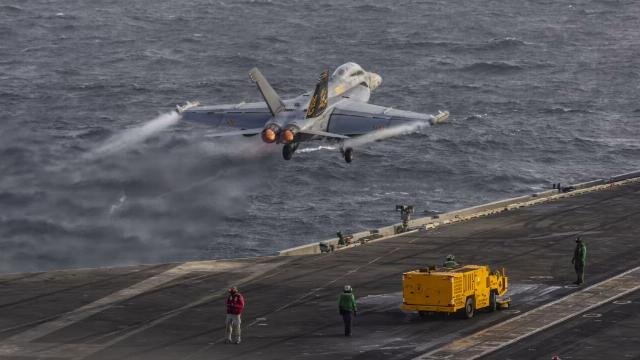
Alternately, the president could authorize what Timmerman describes as devastating decapitation strikes against the regime and the Revolutionary Guards, creating an opening for locals to seize armories and government buildings.
But there is one scenario in which Iran wins, and Timmerman is blunt about it: if enough Republicans join Democrats in voting to cut off funding. He writes that Tehran had been counting on Democrats and their media allies to make the war so unpopular that Trump would order a withdrawal before the November midterms. That hasn’t happened, he argues — the president, in his view, has shown a spine, and now Republicans need to show one too.
A forty-seven-year ledger
The op-ed reaches back through what Timmerman presents as a four-decade record of Iranian state-sponsored violence: the 1979 seizure of the U.S. embassy in Tehran and the 444-day hostage crisis; the 1983 bombing of the U.S. embassy in Beirut and the killing of 241 Marines that October; the hostage-taking in Lebanon during the 1980s that led President Reagan to trade arms for hostages in the Iran-Contra affair; cooperation with al Qaeda in Khartoum in the early 1990s and attacks that culminated on September 11, 2001; and the explosively formed penetrators sent into Iraq that killed more than 800 U.S. servicemembers.
Trump, he notes, campaigned on ending the endless wars in the Middle East — but that doesn’t happen by magic. “This is the war that ends them,” Timmerman writes.
His closing appeal is directed squarely at his own party: Republicans, he writes, need to grow a spine and explain to their constituents what this war is actually about.
Kenneth R. Timmerman, a 2006 Nobel Peace Prize nominee, is the author of The Iran House and thirteen other works of nonfiction.
Source: www.americanthinker.com — https://www.americanthinker.com/articles/2026/09/this-is-the-war-that-ends-the-endless-wars/