
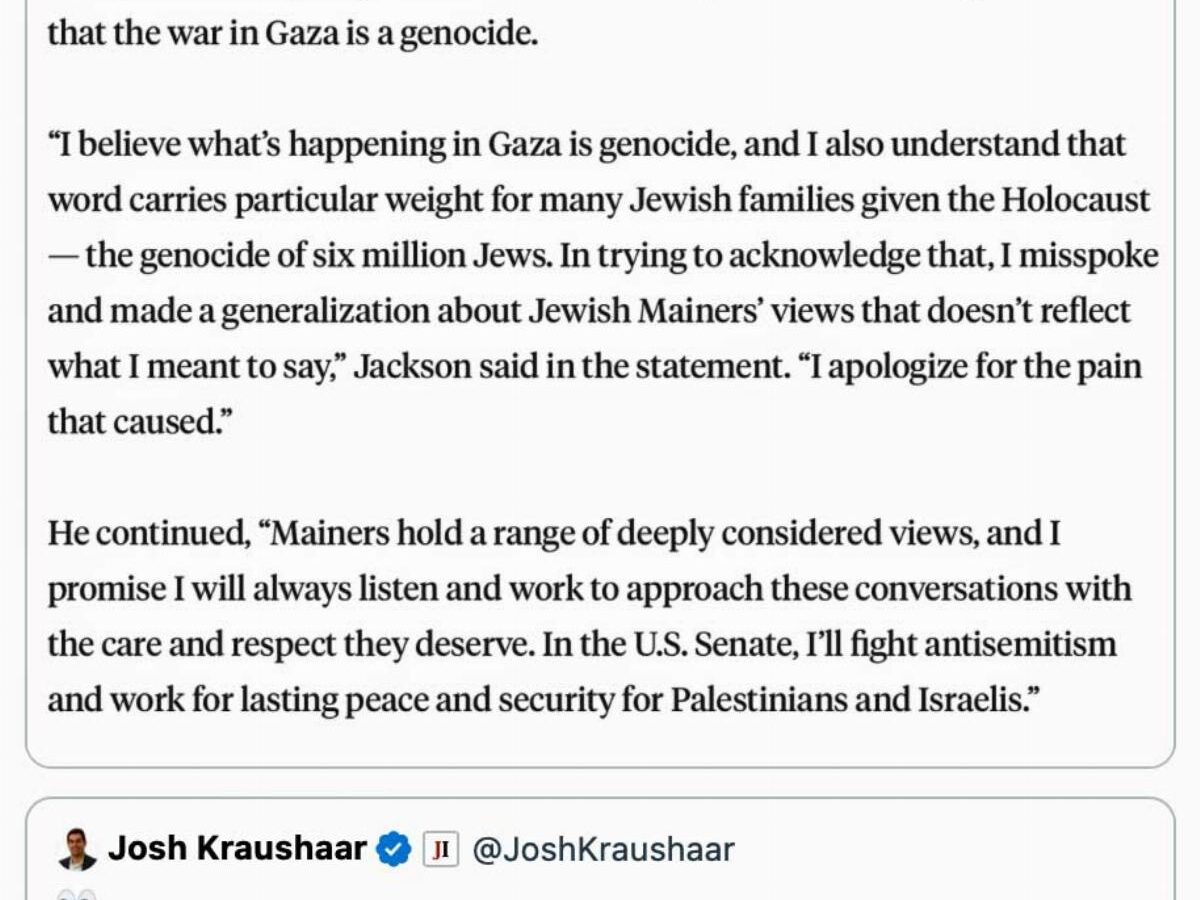
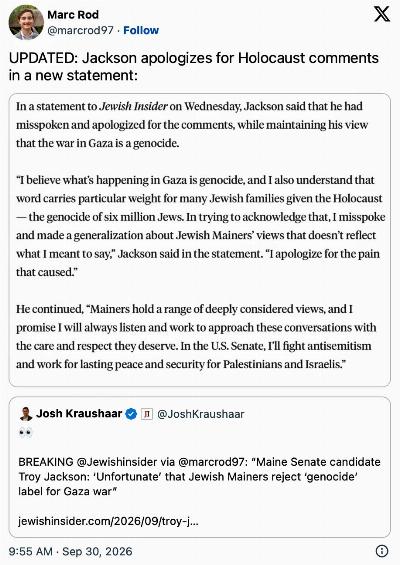
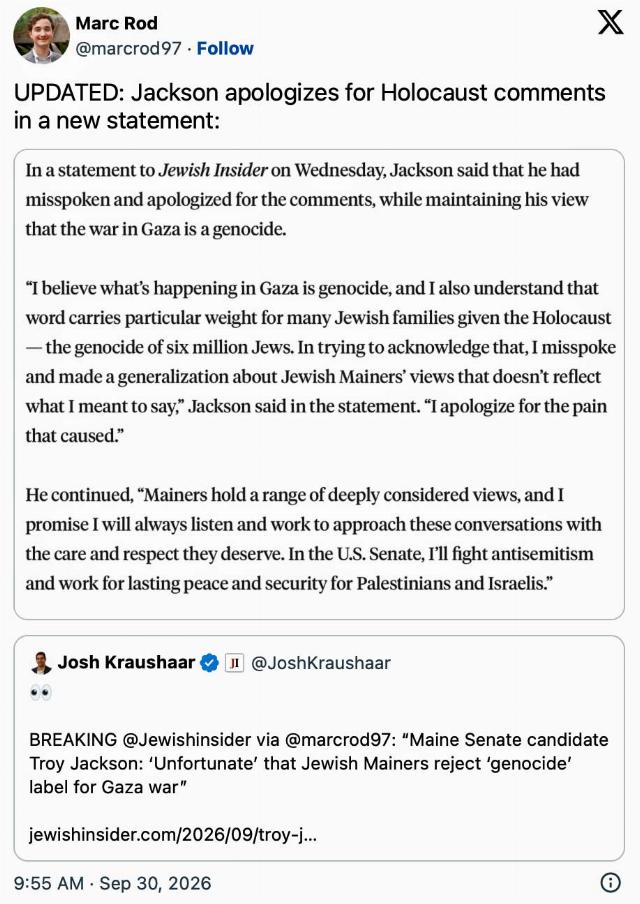
Maine’s Democratic Senate nominee, Troy Jackson, has handed his opponents a fresh line of attack after telling a local television interviewer that it is “unfortunate” Jewish Mainers decline to describe the war in Gaza as a “genocide” — a comment now being framed by critics on the right as a casual dismissal of Jewish historical memory.
Writing for American Thinker, columnist Mike McDaniel argues that Jackson’s remark amounts to a rhetorical shrug at the Holocaust itself, suggesting the candidate would prefer Jewish voters simply “quit being so touchy, suck it up, and do their duty to vote for Democrats no matter what.” The column, published October 4, treats the Senate race in Maine as a test case for a broader Democratic assumption about the loyalty of the Jewish electorate.
What Jackson actually said
The interview aired Tuesday on News Center Maine, Portland’s NBC affiliate. Jackson, a logger from northern Maine and a former president of the state Senate, has referred to the Gaza war as a genocide repeatedly on the campaign trail and says he opposes American military aid to Israel.
In the exchange now circulating widely, Jackson said: “It’s unfortunate that there are people here in Maine that don’t like to use that term only because, you know, they’re Jewish, and what that means to them with the Holocaust.”
McDaniel characterizes that as a “non-apology apology,” reading it as an implication that Jewish sensitivity to the word — rooted in the destruction of European Jewry — is an obstacle Jackson wishes would go away. The column links the remark to the October 7, 2023, attacks on Israel, calling that assault the worst slaughter of Jews since the Holocaust, and to what he describes as ongoing threats from Islamist groups vowing to finish what Hitler began.
Platner’s shadow and the Maine stakes
The column spends considerable space on how Jackson got the nomination. He replaced Graham Platner, whom Democrats abandoned after months of defending him. McDaniel recounts the reasons for that abandonment in lurid detail: a large Nazi tattoo on Platner’s chest that he claimed not to recognize, a record of abusive behavior toward women, and a boast about what he would do to a burglar in his home.
Jackson, by contrast, has the résumé the party has been seeking — a logger and onetime state Senate president, in the same small-business outdoorsman mold Democrats have tried to manufacture elsewhere. He also lost a gubernatorial primary earlier in the year.
On the fundamentals, McDaniel concedes the race is close. Real Clear Politics polling averages put Jackson ahead of Republican incumbent Sen. Susan Collins by only 0.1%, with Collins steadily gaining. In McDaniel’s framing, the specific ideology of Maine’s senior senator — whom he does not describe as a reliable conservative — matters less than the sheer number of Republican seats in the House and Senate. The Senate majority is the prize, and Maine is central to Democratic hopes of reclaiming it.
The ‘genocide’ argument
Most of the column is devoted to contesting the label Jackson has applied to the war. Under the 1948 Genocide Convention, McDaniel notes, the term covers acts committed with intent to destroy a national, ethnic, racial, or religious group, in whole or in part — that is, intent, not simply killing, not even the killing of large numbers of civilians.
He argues Israel has never demonstrated genocidal intent and that, more than any nation in history, it goes out of its way to avoid civilian casualties — a contrast he draws with its Islamist enemies who, he says, call daily for genocide against Jews.
On population, McDaniel writes that Gaza stood at roughly 2.1 million before the war and by 2025 had dropped by about 6%, a figure he says includes natural deaths as well as those killed, missing, or displaced, and reflects large-scale evacuations. He adds that even that number is almost certainly inflated because it originates with Hamas, which he calls a proven liar. Throughout the war, he writes, Israel has delivered millions of pounds of food, fuel, and medical supplies into Gaza — much of it stolen by Hamas — and continues to provide medical treatment for Gazans, treatment he says is partly denied because Hamas uses hospitals to hide fighters and store munitions.
He concludes there is no plan to erase Gaza’s population, still close to 2 million: no forced sterilization, no ethnic cleansing campaign, no effort to eliminate their identity or culture. He compares the Gaza claim to assertions of a “trans genocide” in the United States — much discussed, he writes, but short on hostile intent and bodies.
A broader political read
The column’s closing argument is less about Jackson specifically than about the Democratic coalition. McDaniel calls him a doctrinaire Democrat who, like his party, takes traditional voting blocs such as Jewish and Black voters for granted — presumed to vote Democratic because they always have.
His suggestion is that this assumption is fraying. October 7, in his telling, has given some American Jews a different idea of what is good for them, and he names neither Jackson nor his party as that idea.
For voters in Maine, the immediate question is narrower. Jackson’s Gaza position has been a consistent feature of his campaign, not a slip, and the phrasing he used about Jewish Mainers — captured on local television and now recycled across conservative media — gives Collins and her allies a ready-made line of attack in a race polling within a fraction of a percentage point. Whether a remark about the Holocaust moves a Senate contest decided by a handful of votes is the question both campaigns will spend the coming weeks answering.
Source: www.americanthinker.com — https://www.americanthinker.com/blog/2026/10/troy-jackson-bids-jews-forget-their-silly-holocaust-fixation/
Source: www.americanthinker.com
Related coverage
- American Thinker: Sydney Sweeney’s Novig Ad Outrage Is Selective, Not Principled
- Entrepreneurs Need Freedom, Not Government Handouts, to Build Prosperity
- El-Sayed’s 9/11-Adjacent Conference Appearance Sparks Fresh Islamism Debate in Michigan Race
- Omar Raid Fuels Conservative Claims of a Two-Tiered Justice System