
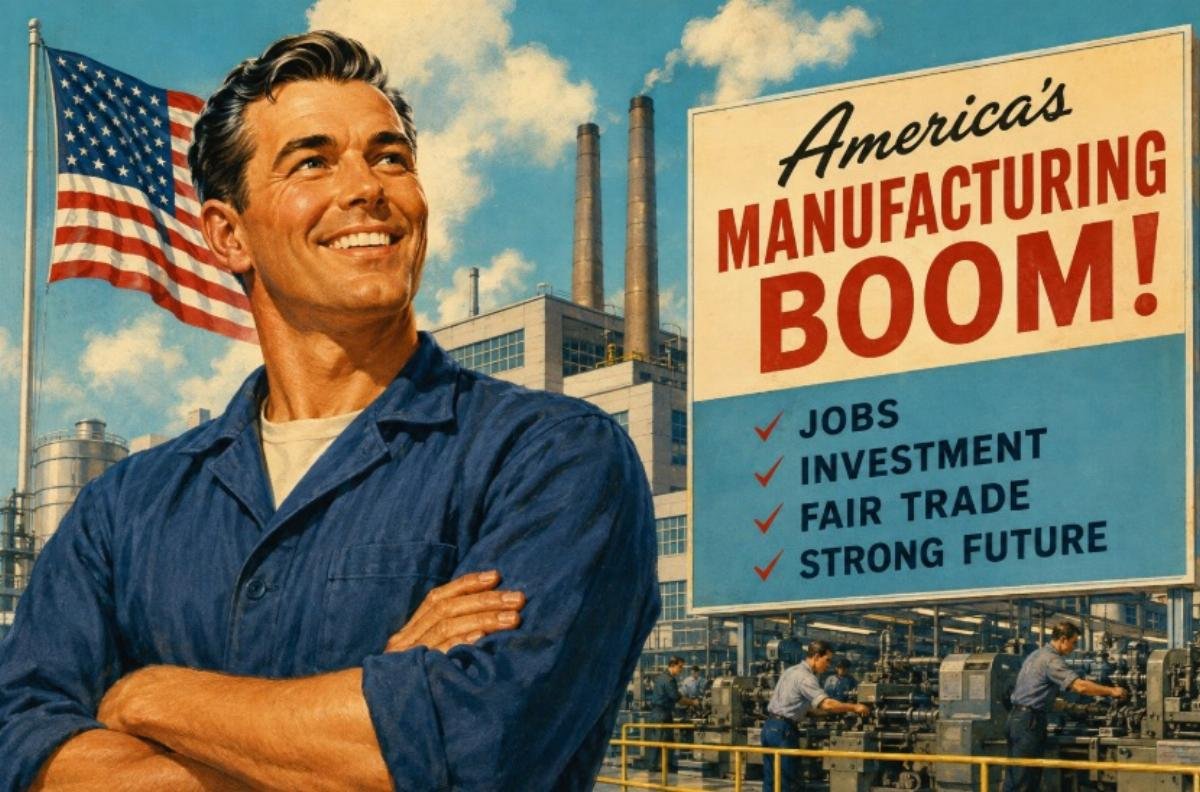
If you listen to the mainstream media, the U.S. economy is teetering on the edge. Gas prices spiked this summer, and that’s the headline that keeps getting pushed. But according to a new column in American Thinker, there’s a much bigger story being ignored: a manufacturing boom that’s been building for months.
Writer Silvio Canto Jr. points to the ISM Manufacturing Index, the most-watched gauge of productive activity, which just surged to a fresh four-year high. The reading now stands at 55, well above the 50 mark that signals expansion, and it has been rising for seven consecutive months. That’s not a blip or a seasonal quirk; that’s a sustained trend.
Manufacturing employment is also up, hitting a new four-year record high. And these aren’t the kind of jobs that feel like side hustles. Canto describes them as high-paying, family-sustaining roles that strengthen the whole society — not part-time gig work or precarious “hustle” economy positions.
The construction numbers that jump out
Perhaps the most striking figure in the column relates to construction jobs tied directly to factories and trade. Under President Donald Trump, these jobs are being added at ten times the pace inherited from former President Joe Biden. In the first quarter of 2025 — when Trump took office — the U.S. added just 9,300 such construction jobs. Now, in the third quarter of 2026, America has added 93,000 such positions and counting. That’s a tenfold increase, and Canto calls it “amazing progress.”
The obvious question is why. Canto’s answer is straightforward: solid policy choices, starting with trade. The Trump administration has insisted on fair and reciprocal trade, moving away from an era in which the U.S. tolerated what he calls “abusive and predatory” trade tactics, particularly from China.
But the column doesn’t stop at the usual criticism of the Chinese Communist Party. It also takes aim at Western allies who, in Canto’s view, have been economically abusive in their own way. Specifically, he cites Western Europe’s heavy subsidization of exports through VAT taxation systems. That Value Added Tax effectively made European goods far more affordable for American consumers than U.S. goods shipped across the Atlantic. Such non-tariff trade barriers, he argues, have now been “smartly exposed and repelled” by the new American approach.
That approach — one might call it signing new trade agreements that work both ways — is encouraging investment in the U.S. rather than letting other governments subsidize their exports at America’s expense. When the rules are fair, Canto writes, U.S. producers are competing much better. He also credits political stability and a more realistic regulatory approach for helping shift the balance.
Why the media isn’t talking about it
The column’s central complaint is that the media are working to hide this good news because the midterms are coming up. Canto doesn’t mince words on that point. If the economy is actually improving in measurable ways, that’s an inconvenient story for those who want to run against the administration’s record.
It’s worth noting that the ISM Manufacturing Index is not a partisan invention. It’s a widely respected, industry-standard measure. A reading of 55, sustained over seven months, is the kind of data point that economists of any stripe would normally celebrate. The same goes for record-high manufacturing employment and a surge in factory-related construction. These are concrete, verifiable numbers, not talking points.
The argument that “more money is coming in than leaving” is a simple way to describe a favorable trade balance trend, and Canto suggests that’s exactly what’s happening now that the rules have changed.
What to make of the boom narrative
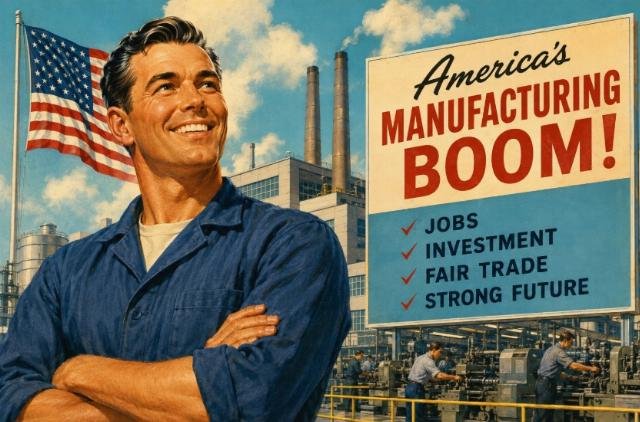
Of course, any economic story has nuance. Gas prices are indeed up, and that hurts consumers. Inflation has been a persistent concern for years. But the American Thinker column makes a pointed case: the picture is not uniformly gloomy, and the parts that are improving are being systematically underreported.
By highlighting the manufacturing sector specifically, Canto is zeroing in on an area where policy choices can have visible, direct effects. Trade agreements, tariff structures, regulatory decisions — these are things an administration controls. And the column’s thesis is that the current administration’s choices are producing measurable results.
The tenfold increase in factory-related construction jobs is the kind of statistic that captures attention. It suggests not just incremental improvement but a structural shift — companies building real physical plants, which implies long-term commitment rather than short-term financial maneuvering.
Whether that continues is an open question. Economic cycles are unpredictable, and no single quarter guarantees the next. But for now, Canto’s conclusion is simple and slightly defiant: “This is good news for the US economy, and maybe we need to hear more about it.”
The piece ends with a plug for his blog and a pitch for donations to American Thinker, but the core argument stands on the data. Whether you attribute the boom to trade policy, deregulation, or something else entirely, the numbers say something is happening. And judging by the column’s title — “Something booming out there” — maybe the media should take a closer look.
Source: www.americanthinker.com — https://www.americanthinker.com/blog/2026/08/something-booming-out-there/