
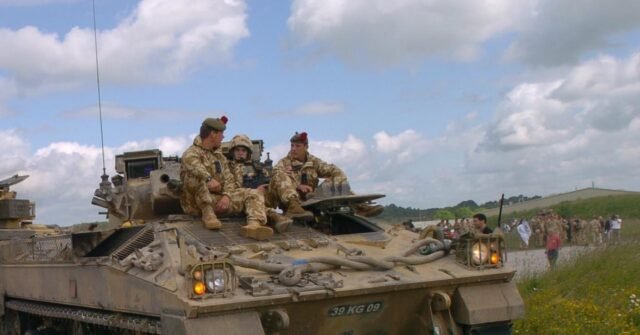
The British Army has been forced to cancel a series of “non-essential” training exercises as the service grapples with a budget crunch, according to a new report from the BBC, which cited an anonymous source within the UK’s defense establishment. The canceled sessions, described as “nice-to-have training,” include planned live-fire drills at ranges in Wiltshire and Wales, where platoons would have practiced large-scale attacks. One such exercise was said to have involved the Royal Tank Regiment operating alongside Apache attack helicopters.
The decision is said to have been driven by financial constraints rather than a strategic choice by Army leadership, the defense source told the BBC. Military officials have stressed that other training, particularly counter-drone tactics honed through observations of the war in Ukraine, will continue to be prioritized. However, the cancellation of live-fire exercises underscores the trade-offs the UK military is making as it tries to balance readiness against a fixed budget.
While the British government has increased defense funding in recent years, much of the new money has been channeled into weapons development programs rather than troop readiness activities. That allocation is now facing scrutiny as the Army pulls back on training that military planners would normally consider essential to maintaining combat effectiveness.
Army Defends Prioritization, Cites £2bn Investment
An Army spokesman pushed back on the notion that training has been broadly halted, saying: “Our training continues and we are prioritising activity that contributes most directly to readiness, deployability and operational effectiveness. We are also investing £2bn to transform training for the British Army over the next 15 years.”
The spokesman’s comments suggest the service is attempting to frame the canceled exercises as part of a broader modernization effort rather than a simple cost-cutting measure. Still, the revelation is an awkward one for the government, which has sought to project an image of military strength amid ongoing global instability.
The news also lands at a politically sensitive moment for Prime Minister Andy Burnham, who took office recently and has already faced questions about how he intends to fund the UK’s defense commitments. At his first Prime Minister’s Questions session on Wednesday, Burnham was pressed by Conservative Party leader Kemi Badenoch on whether he would identify any areas of spending to cut. He declined to single out specific programs for reductions.
Welfare vs. Defense: A £322bn Question
At the heart of the debate is the vast disparity between what the UK spends on welfare and what it allocates to the military. In the 2025/26 budget, the UK government is projected to spend £322.6 billion ($436.4bn) on its welfare system—roughly a quarter of all government spending and an estimated 10.6 percent of GDP. By contrast, defense spending for the same period is set at £62.0 billion ($84bn).
Although Britain’s defense budget has grown since 2016, when it stood at £48.0 billion in current prices, the country still lags behind many peers when measured as a share of national output. NATO allies including Lithuania, Estonia, Latvia, Poland, Greece, Denmark, Sweden, the United States, Norway, Türkiye, Germany, Finland, and the Netherlands all spend a larger percentage of their GDP on defense than the UK.
The government has pledged to raise defense spending to £79.1 billion by the end of the decade, but critics argue that waiting until then is not good enough, particularly when immediate training needs are being cut.
Political Fallout
The Conservative opposition was quick to seize on the report, framing it as a choice between military readiness and social welfare. Helen Whately, the Conservative Shadow Secretary of State for Work and Pensions, said: “Faced with a choice between spending on military training and spending on benefits… Labour chooses more benefits.”
Burnham has so far resisted calls to cut welfare spending to free up additional funds for defense, a position that puts him at odds with those who argue that the UK’s security obligations require immediate financial sacrifices. The prime minister’s refusal to commit to any spending reductions during PMQs has only intensified the pressure, as opposition MPs and some defense experts question whether the government’s long-term spending plans are realistic in the face of current shortfalls.
The situation is further complicated by the fact that the Army’s training cancellations are ostensibly not the preference of military leaders. The anonymous defense source’s comment that the move was due to budget constraints rather than a desire by the Army brass suggests friction between military requirements and the resources provided by civilian leadership.
As the UK heads into the autumn, the intersection of defense funding, welfare spending, and the government’s fiscal strategy is likely to remain a contentious political battleground. Whether Burnham can defuse the criticism or will be forced to revisit his position on welfare cuts remains to be seen. For now, the image of tanks and Apache helicopters being grounded for lack of funds is a potent symbol of the challenges facing Britain’s armed forces.
Source: www.breitbart.com — https://www.breitbart.com/europe/2026/09/04/uk-military-forced-to-cancel-training-exercises-to-save-cash/