
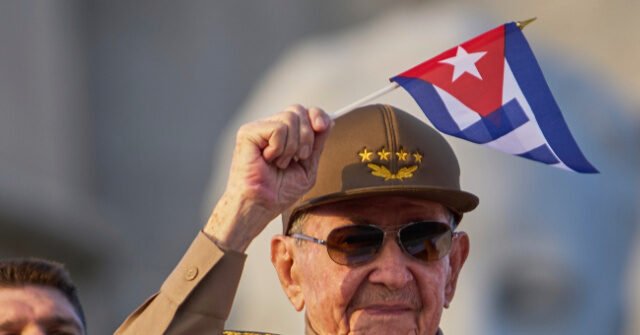
Venezuela’s ruling United Socialist Party (PSUV) issued a statement Wednesday condemning an arrest warrant from a Florida judge against Cuba’s 95-year-old former leader Raúl Castro, according to reporting by Breitbart News. The party’s official response, published on its website and social media, argues the warrant has no legal basis, runs afoul of international law, and is aimed at undermining Cuban sovereignty.
Castro faces conspiracy to commit murder charges tied to the 1996 shootdown of two aircraft belonging to Brothers to the Rescue, a humanitarian group that flew rescue missions over international waters to pick up Cubans stranded at sea during the Balsero crisis of the 1990s. Florida Attorney General James Uthmeier disclosed the warrant this week. The four Americans killed in the episode were Carlos Costa, Armando Alejandre, Mario de la Peña, and Pablo Morales. At the time, Raúl Castro led Cuba’s Revolutionary Armed Forces under his brother Fidel.
The PSUV’s Argument
In its statement, the Venezuelan party framed the warrant as part of a broader campaign of economic pressure on Havana, describing what it called the intensification of the blockade and a policy of material strangulation. The PSUV urged coordinated action across Latin America and the Caribbean to end the siege of Cuba, closing with a call to respect Cuban sovereignty and the right of its people to independence and self-determination.
Notably, the statement carries no signature from any prominent PSUV figure. The party is led by Delcy Rodríguez, whom the source describes as Venezuela’s interim president.
Raúl Castro formally retired in 2018, roughly a decade after taking over from his late brother Fidel. The indictment against him was originally filed earlier this year before the warrant’s public disclosure.
Silence From the Top
The party’s collective statement stands in contrast to the absence of individual public support from its most senior figures. Neither Rodríguez, nor Interior Minister Diosdado Cabello — who serves as PSUV secretary-general — nor any other high-ranking member of the ruling movement had personally and publicly backed Castro over the warrant at the time of the report.
That silence follows other recent signals from Rodríguez that appear to diverge from the decades-old rhetoric of the Bolivarian Revolution. During her September address to the United Nations General Assembly, she did not voice support for the Castro government — a conspicuous departure from what the outlet describes as a quasi-traditional message Venezuelan socialist officials have delivered at the U.N. in the past — while calling for an end to the U.S. embargo on Cuba.
Rodríguez has also declined to comment publicly on torture charges unveiled this month against her former boss, Nicolás Maduro, according to Breitbart.
A Post-Maduro Realignment
Rodríguez began cooperating with the United States and the Trump administration after Maduro was arrested in January in a U.S. law enforcement operation in Caracas, the outlet reported. That collaboration has apparently strained relations with the PSUV’s hardline socialist base and allied far-left organizations, given that the party spent years branding the United States an enemy of Venezuela.
The accommodation cuts against nearly three decades of anti-imperialist messaging from the country’s socialist rulers and the ideological framework of the Bolivarian Revolution established by the late Hugo Chávez and carried on by Maduro.
The PSUV has long been a close ally and financial benefactor of the Cuban government, and Wednesday’s statement reiterated that alignment in institutional terms even as individual leaders held back.
Rodríguez’s family history is itself bound up with the movement’s militant past. Her father, Jorge Antonio Rodríguez, was a Venezuelan Marxist involved in the 1970s kidnapping of American businessman William F. Niehous. She once described the imposition of socialism in Venezuela as an act of personal revenge for her father’s death.
The warrant against Raúl Castro places a long-simmering dispute over the Brothers to the Rescue shootdown back at the center of U.S. relations with Havana and Caracas. On February 24, 1996, Cuban forces shot down the group’s civilian planes over international waters; the source states there is no evidence the aircraft posed a threat to Cuba. The four deaths have remained a touchstone for Cuban-American communities in Florida for three decades.
For the PSUV, the test now is whether a party statement without a signatory can hold together a coalition whose most visible leader is cooperating with Washington while its base still defines itself against it. So far, no senior figure has been willing to attach a name to the defense of Castro.
Source: www.breitbart.com — https://www.breitbart.com/latin-america/2026/10/22/venezuelan-socialists-condemn-u-s-arrest-warrant-against-cuban-dictator-raul-castro/