
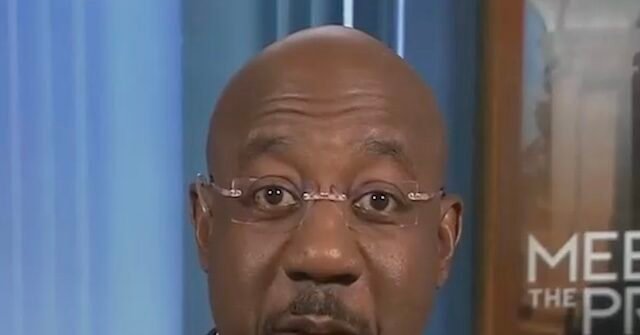
Sen. Raphael Warnock (D-GA) sharply criticized the SAVE Act during an appearance Wednesday on MS NOW’s “Deadline,” calling the Republican-backed election legislation “a poll tax on married women.”
Warnock argued that while the bill is marketed as a simple voter ID measure, its real-world effects would fall hardest on women who changed their names upon marriage and on voters who lack easy access to foundational documents.
‘Not What This Is About’
According to Breitbart, Warnock began by acknowledging that many Americans have heard of the SAVE Act but may not understand its provisions. He then sought to draw a distinction between his support for verifying voter identity and what he described as the bill’s true purpose.
“Republicans want you to believe that this is a voter ID bill,” Warnock said. “Let me be really clear. I think that you should have to demonstrate that you are who you say you are before you vote. And I support the criminal prosecution of non-citizens who vote illegally in our elections.”
But the Georgia Democrat argued that the legislation is not aimed at election security. “They’re not trying to save our democracy. They’re not trying to save our elections. They’re trying to save Donald Trump’s power,” he said.
A ‘Particularly Onerous’ Burden
Warnock focused much of his criticism on how the SAVE Act would affect married women, describing a bureaucratic tangle that could deter eligible voters from registering.
“And it is particularly onerous for married women,” he said. “This is a poll tax on married women. It basically says that when you get ready to register, you’ve got to bring a birth certificate. A lot of my constituents can’t find their birth certificates.”
He added that the difficulty of obtaining a birth certificate is not evenly distributed across the population. “If you are a person of color born during a certain time in this country’s history, believe it or not, getting a birth certificate is not as easy as you think,” Warnock said.
The senator also noted that many of his constituents lack passports, which would be an alternative form of documentation under the bill. For married women specifically, he described a further complication: reconciling the name on a birth certificate with the name on a marriage certificate.
“If you are a married woman, you’ve got to somehow reconcile, you know, your name on your birth certificate, which may be one thing, versus your name on your marriage certificate, which you may not know where it is,” he said. “Depending on your situation, you might not want to know where it is.”
The Broader Debate
The SAVE Act — short for Safeguard American Voter Eligibility — has become a flashpoint in the ongoing national argument over election administration. Supporters frame it as a commonsense measure to ensure that only U.S. citizens vote in federal elections, a goal that polling suggests enjoys broad public support. Critics, including Warnock, contend that the bill’s documentation requirements would create unnecessary hurdles for millions of eligible voters, particularly those in lower-income and minority communities.
Warnock’s characterization of the bill as a “poll tax” invokes a specific and charged history in American politics. Poll taxes were used for decades, particularly in the Jim Crow South, to disenfranchise Black voters by requiring payment before casting a ballot. The 24th Amendment abolished poll taxes in federal elections in 1964, and the Supreme Court struck down remaining state-level poll taxes in 1966. Applying that term to a modern documentation requirement is a serious accusation, and it reflects how deeply the two parties disagree over what constitutes a reasonable election safeguard versus a barrier to the ballot.
The senator’s remarks also reflect a broader Democratic messaging strategy that frames Republican election legislation as a tool for consolidating political power rather than protecting the integrity of the vote. By name-checking Trump directly, Warnock placed the SAVE Act within that larger narrative — one that Republicans reject, arguing instead that their proposals are designed to restore public confidence in elections.
For his part, Warnock was careful to stake out a position that complicates the standard partisan caricature. He did not oppose voter identification in principle, nor did he object to prosecuting non-citizens who vote illegally. His objection was to the specific mechanics of the SAVE Act — the documentary requirements, the name-reconciliation process, and what he described as the practical difficulty many Americans face in producing the necessary paperwork.
That distinction may matter as the debate moves forward. If the fight over the SAVE Act is ultimately about how strict documentation requirements should be, Warnock’s argument positions Democrats as supportive of verification but opposed to what they see as overly burdensome implementation. Republicans, meanwhile, are likely to continue arguing that the requirements are neither unreasonable nor new, and that ensuring citizen-only voting is worth the administrative effort.
Warnock’s appearance on MS NOW’s “Deadline” is the latest in a series of public comments he has made on voting rights, an issue that has been central to his political identity since his election to the Senate. His remarks Wednesday are likely to amplify Democratic opposition to the bill as it continues to draw national attention.
Source: www.breitbart.com — https://www.breitbart.com/clips/2026/09/23/sen-warnock-the-save-act-is-a-poll-tax-on-married-women/