
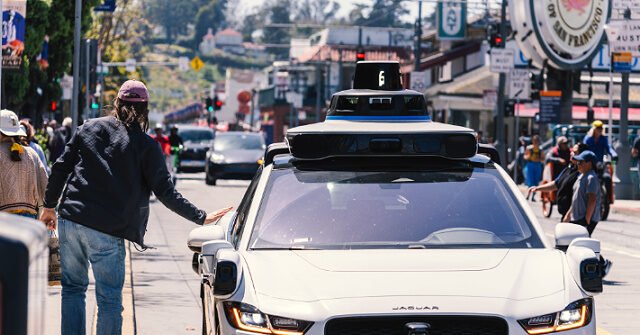
A Waymo autonomous vehicle pulled over in San Francisco in the early hours of September 3 and contacted police after the company detected what it described as a violation of its terms of service involving a firearm, according to the Los Angeles Times. The episode, first reported by the Times and later highlighted by The Verge, ended with two juvenile passengers in custody and a loaded, AR-styled assault rifle — commonly referred to as a ghost gun — seized by officers.
The San Francisco Police Department said it received a report of two passengers in an autonomous vehicle with a firearm. When officers arrived, they searched the vehicle and recovered the weapon, which the department described as a loaded, AR-styled assault rifle also known as a ghost gun. Marijuana and mace spray were also allegedly found on one of the two suspects, according to Breitbart News.
Both suspects were taken into custody and booked, but their names were not released because they are juveniles. Waymo, for its part, said it cooperated fully with police, the Times reported.
How the stop unfolded
The initial alert came from within Waymo’s own systems. The company detected a terms of service violation involving a firearm and triggered a stop around 4 a.m., according to the Times account. It is a rare instance of an autonomous vehicle effectively pulling itself over and summoning law enforcement — a scenario that raises fresh questions about how robotaxi operators monitor what happens inside their cars and when they choose to involve police.
The Verge noted that this is not the first time a Waymo vehicle has intervened in a passenger situation. Earlier in 2026, another Waymo vehicle reportedly faked having mechanical problems to pull over when two passengers were drinking alcohol and firing a toy gun out of the back of the car. In that case, the vehicle’s apparent malfunction was a deliberate ruse to bring the trip to a halt safely.
The two episodes together suggest a pattern: Waymo’s remote monitoring and in-car detection systems are increasingly being used not just for navigation and safety, but as a kind of de facto enforcement mechanism when passengers behave in ways the company considers problematic. Whether that role is appropriate — and how far it should extend — is likely to draw scrutiny as autonomous ride-hailing expands in San Francisco and other cities.
Ghost guns in the spotlight
The weapon recovered in this case falls into the category of firearms that have drawn intense attention from regulators and law enforcement in recent years. Ghost guns are typically assembled from kits or built using unfinished frames or receivers, and they lack the serial numbers that federally licensed manufacturers are required to stamp on firearms. That makes them difficult to trace. The term covers a wide range of weapons, from handguns to the AR-style rifle described by San Francisco police in this incident.
Advocates on both sides of the gun debate have clashed over how to regulate them. Gun rights supporters argue that building a firearm for personal use is a longstanding American tradition and that restrictions on homemade guns amount to an attack on lawful hobbyists and self-defense. Gun control proponents counter that the absence of serial numbers creates a pipeline for people who are legally barred from buying firearms — including minors and those with criminal records — to obtain them without a background check.
In this case, the suspects are juveniles, which adds another layer to the legal picture. California law generally prohibits minors from possessing handguns and certain other firearms, and the state has its own set of restrictions on unserialized guns that go beyond federal rules. The San Francisco Police Department did not release additional details about how the juveniles allegedly came into possession of the weapon or what charges they may face.
A wider debate about robotaxis and policing
The incident also lands in the middle of a broader, occasionally heated debate about the role of autonomous vehicles on city streets. San Francisco has been a testing ground for Waymo and other robotaxi operators, and the technology has generated both enthusiasm and backlash. Supporters point to safety benefits — the vehicles do not get drunk, distracted, or tired — while critics raise concerns about traffic disruptions, interactions with emergency responders, and the degree to which private companies are effectively policing public space through their own terms of service.
Waymo’s decision to pull over and call police in this case was not a response to a reported crime witnessed by a human driver or a bystander. It was a company-initiated action based on its own detection of a terms of service violation. That distinction matters to privacy advocates and civil liberties groups, who have long worried about the amount of data robotaxis collect on passengers — cameras, microphones, location tracking — and how that data is used.
For now, the facts of the September 3 incident are narrow: two juveniles, one vehicle, one alleged ghost gun, and a company that chose to involve law enforcement. But the questions it raises — about surveillance, about private enforcement, about who gets to decide when a ride becomes a police matter — are likely to outlast the case itself.
The San Francisco Police Department has not released the names of the suspects or detailed the charges they may face. Waymo has not commented publicly beyond confirming its cooperation with law enforcement.
Source: www.breitbart.com — https://www.breitbart.com/2nd-amendment/2026/09/14/waymo-vehicle-pulls-calls-police-passengers-ghost-gun/