
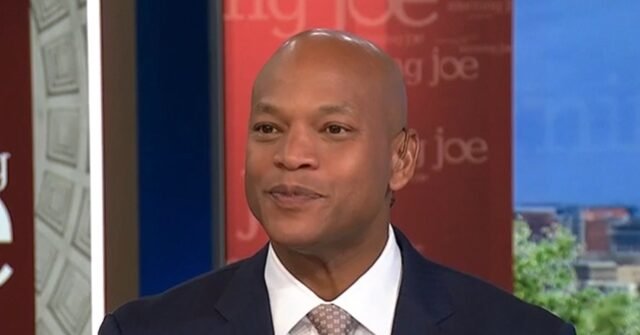
Maryland Gov. Wes Moore said this week that his chief concern about artificial intelligence is not competition from China but the prospect of a technology that escapes human control, arguing the United States needs a dual framework of cooperation and competition with other nations as AI develops.
Moore made the comments Tuesday during an appearance on MSNBC’s “Morning Joe,” according to a clip flagged by Breitbart News. The Democratic governor was discussing the role states and governors can play in shaping AI policy at a moment when much of the national debate has centered on a U.S.–China race for technological supremacy.
A Different Kind of Fear
Moore pushed back directly on the framing that drives much of that debate — the argument that slowing down or regulating AI would cede ground to Beijing.
“I hear this debate about, well, we don’t want to slow down because it’s a fear of China,” Moore said. “Let’s be clear, my fear is not China. My fear is a technology that no human being can control.”
He described the challenge as finding a “delicate balance of cooperation and competition” rather than treating the issue as a zero-sum contest. The warning echoes a recurring theme among policymakers and technologists who argue that the most serious risks from advanced AI — from loss of human oversight to misuse by bad actors — are not contained by national borders and cannot be solved by any single country acting alone.
Governors as a Testing Ground
Moore, who has positioned Maryland as an early mover on AI policy, argued that governors are uniquely situated to work through these questions. He framed his own approach by analogy to his relationships with fellow governors: fiercely competitive in some arenas, collaborative in others.
“As a governor, I’m very competitive with my other governors, but I do understand there are places where we are actually more — where the focus is cooperation and not competition,” he said. “The United States needs to have the same type of framework when it comes to China and other nations.”
According to Moore, that framework should recognize shared interests in making sure AI is developed in ways that benefit people while also keeping “guardrails” in place. He did not detail what specific guardrails he has in mind or what form cooperation with China might take.
A Split in the Democratic Party’s AI Messaging
The remarks put Moore at odds with a strain of thinking in both parties that treats AI leadership as a national security race in which any pause risks handing an advantage to a strategic rival. That argument has been a central rhetorical weapon for opponents of stricter AI regulation, and it has also shaped proposals on export controls and domestic investment.
Moore’s framing does not reject competition outright — he explicitly described a balance between competition and cooperation — but the emphasis lands differently. By naming an uncontrollable technology rather than a foreign adversary as his primary fear, he shifts the case for safeguards away from geopolitics and toward the technology’s own risks.
His comments come as governors across the country have moved ahead of federal lawmakers on AI. States have introduced and passed measures touching on deepfakes, algorithmic transparency, government procurement of AI tools, and child safety online. The patchwork approach has drawn criticism from industry groups that prefer a single national standard, but it has also given governors like Moore a platform to shape the terms of the debate.
What Comes Next
Whether Moore’s call for a cooperation-and-competition framework gains traction in Washington is an open question. Congress has cycled through numerous AI proposals without passing comprehensive legislation, and the Trump administration’s approach has leaned heavily on accelerating American development while restricting Chinese access to advanced chips and related technology.
Still, Moore’s comments offer a window into how at least one prominent Democratic governor is talking about AI as the issue matures beyond the initial scramble for position. Rather than promising to outrun China, he is arguing for a posture that treats the technology itself — and the question of who, if anyone, can control it — as the central problem to solve.
Source: www.breitbart.com — https://www.breitbart.com/clips/2026/09/22/wes-moore-on-ai-my-fear-is-not-china/