
Federal authorities have indicted a Mexican national they describe as the engineering mastermind behind an elaborate network of cross-border tunnels used by one of Mexico’s most powerful drug cartels.
Luis Manuel Hernandez Victoria, 60, stands accused of designing and constructing sophisticated underground passages for Cartel Jalisco New Generation (CJNG), a criminal organization the U.S. government designated as a foreign terrorist organization. According to the U.S. Attorney’s Office for the Southern District of California, a grand jury returned the indictment following an investigation that spanned several months.
Hernandez Victoria is currently being held in Mexican custody after his arrest in Jalisco in mid-October. U.S. prosecutors are working to extradite him to California, where he will face federal charges that could result in a life sentence if convicted.
Discovery of Nearly 2,000-Foot Tunnel System
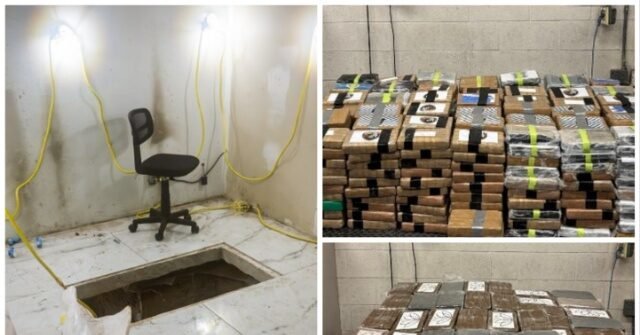
The case centers on a tunnel discovered by authorities in San Diego in May 2026. Federal investigators linked Hernandez Victoria to the sophisticated underground structure, which authorities say enabled CJNG to smuggle more than one ton of cocaine into the United States.
According to Breitbart Texas, the tunnel stretched almost 2,000 feet from Tijuana on the Mexican side to a warehouse in San Diego. The engineering feat included reinforced walls for structural integrity, electrical systems for lighting and ventilation, and a railway system designed to efficiently transport narcotics across the international border.
The tunnel terminated at a Buy 4 Less warehouse in San Diego, which investigators believe served as a front operation for the cartel’s smuggling activities.
Months of Surveillance Before the Bust
Court documents reveal that Homeland Security Investigations (HSI) Tunnel Task Force agents conducted extensive surveillance on the warehouse from December 2025 through May 2026. The investigation was prompted by suspicious activity that didn’t align with typical retail business operations.
According to authorities, agents observed a new group of approximately seven or eight individuals who began appearing at the location. These supposed “employees” engaged in behavior that raised red flags for investigators.
Hernandez Victoria himself reportedly arrived at the business around January 2026. Surveillance teams documented what they described as unusual patterns of activity at the warehouse. The alleged workers were observed repeatedly moving large quantities of suitcases from the store into vehicles or carrying them on foot across the border into Mexico.
Investigators believed the suitcases were empty during these trips and chose not to intercept them at the time, likely to build a more comprehensive case against the operation’s organizers.
Six Others Face Charges in Tunnel Operation
Hernandez Victoria is not the only defendant in the case. Federal authorities charged six other men in connection with the tunnel’s construction and operation.
Those facing charges include Gregorio Epifanio Hernandez Lopez and Jose Jimenez, both of San Diego, as well as Brandon Escalante Sandoval and Antonio Cortez, both of Mexico. The identities of the remaining two defendants charged in the case were not disclosed in available court documents.
Despite the multiple defendants, prosecutors have identified Hernandez Victoria specifically as the mastermind who designed and oversaw the construction of the tunnel infrastructure.
CJNG’s Terrorist Designation
Cartel Jalisco New Generation is one of seven Mexican drug trafficking organizations that the U.S. government has designated as foreign terrorist organizations. This classification subjects the cartel and its members to enhanced legal penalties and allows prosecutors to pursue terrorism-related charges in addition to drug trafficking offenses.
The terrorist designation reflects CJNG’s extreme violence, sophisticated operations, and willingness to attack government officials and civilian targets in Mexico. The cartel has expanded rapidly in recent years, challenging older organizations like the Sinaloa Cartel for dominance in the drug trade.
High-Tech Underground Infrastructure
The tunnel discovered in May 2026 represents a significant investment in smuggling infrastructure. The nearly 2,000-foot length required extensive excavation, while the reinforced walls suggest engineering expertise aimed at preventing collapses that could trap workers or lose valuable cargo.
The inclusion of electrical systems indicates the tunnel was designed for sustained, long-term use rather than as a temporary smuggling route. Lighting would allow workers to operate safely underground, while ventilation systems would be necessary to prevent suffocation in the enclosed space.
The railway system represents perhaps the most sophisticated element of the construction. Such a system would allow cartel members to quickly move large quantities of drugs through the tunnel without the physical strain of carrying heavy loads across the nearly 2,000-foot distance.
Awaiting Extradition
Hernandez Victoria’s current detention in Mexico sets the stage for what could be a lengthy extradition process. The U.S. and Mexico maintain an extradition treaty, but the process can take months or even years, particularly in high-profile cases involving organized crime.
Once extradited to California, Hernandez Victoria will appear before a federal judge for initial hearings. The charges he faces carry severe penalties, with prosecutors noting that a conviction could result in a life sentence in a U.S. federal prison.
The case highlights the ongoing cat-and-mouse game between drug cartels and law enforcement along the U.S.-Mexico border. While authorities periodically discover and shut down cross-border tunnels, the substantial profits from drug trafficking continue to incentivize cartels to invest in these expensive and elaborate smuggling routes.
The Homeland Security Investigations Tunnel Task Force, which led the investigation, specializes in detecting and dismantling these underground passages. The months-long surveillance operation that led to the tunnel’s discovery and Hernandez Victoria’s eventual arrest demonstrates the patient, methodical approach federal agents employ when building cases against cartel infrastructure.
Source: www.breitbart.com — https://www.breitbart.com/border/2026/10/31/u-s-indicts-alleged-mexican-cartel-tunnel-engineer/