
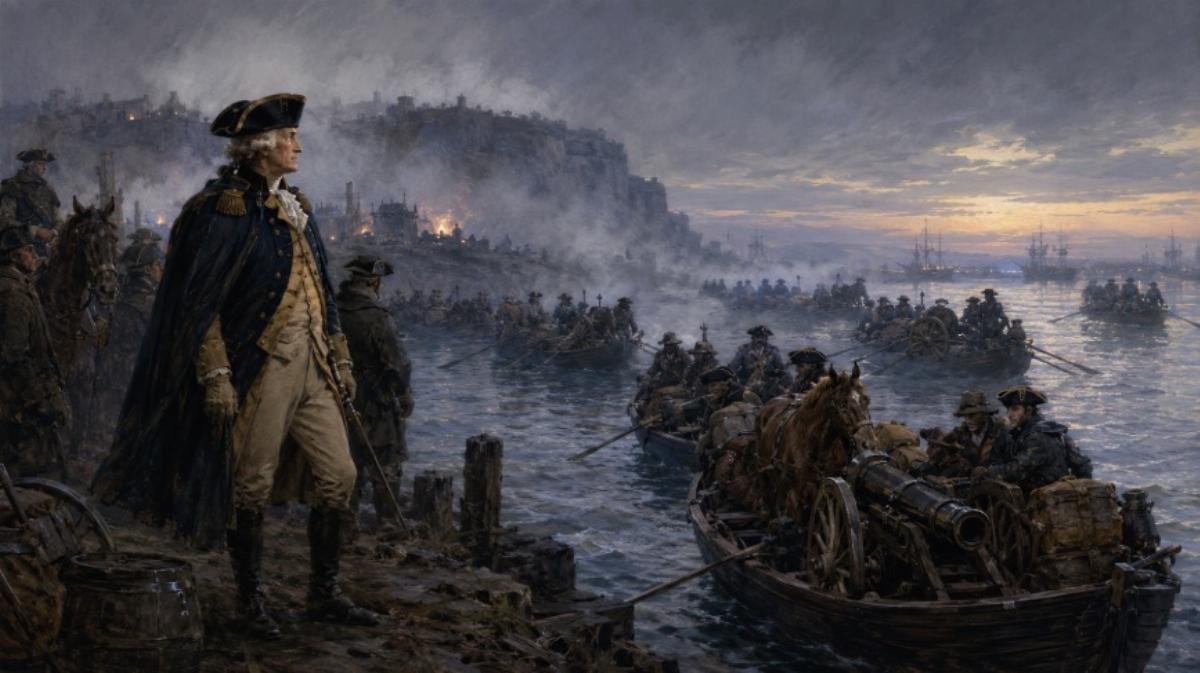
Two hundred fifty years ago tonight, George Washington’s Continental Army faced what looked like certain destruction. Just weeks after signing the Declaration of Independence, the Americans had been beaten, surrounded, and pinned against the East River by a British force of overwhelming strength. Yet by morning, roughly 9,000 soldiers—along with artillery, horses, ammunition, and supplies—had vanished across the water to Manhattan, escaping what should have been the Revolution’s early grave.
As Craig Seibert writes in a new American Thinker essay marking the anniversary, the escape from Brooklyn remains one of the most remarkable events in American military history. It was a defeat, unquestionably. But it was also a triumph of leadership, discipline, seamanship—and, in Seibert’s telling, something more.
A Trap With No Exit
The crisis began on August 27, 1776, when British forces under General William Howe landed in overwhelming numbers and outflanked Washington’s defenses on Long Island. The Americans were driven back to their fortifications at Brooklyn Heights, with the East River at their backs. The British controlled every land approach, and their powerful fleet could potentially enter the river and seal off the only remaining escape route.
Washington faced an agonizing choice. Holding Brooklyn indefinitely was impossible, but abandoning it meant mounting a hazardous nighttime river crossing under the nose of the British Navy. Staying could mean the destruction or capture of the entire Continental Army. He chose the risky move: preserve the army at all costs.
Wind, Calm, and Fog
What followed, Seibert argues, involved circumstances Washington could not command. Strong winds kept British warships from moving up the East River and cutting off the retreat. Then, as the evacuation got underway, the wind died down—calm conditions that allowed small boats to make repeated crossings. Weather that had hindered the British fleet now favored Washington’s makeshift armada.
Among the soldiers were the Marbleheaders of Massachusetts, veteran sailors and fishermen under Colonel John Glover. These men understood boats, currents, and tides in ways that proved indispensable. Fully loaded, their boats’ gunwales sat just inches above the river’s surface. They ferried soldiers, horses, cannon, and supplies across the water all night long.
The operation demanded extraordinary discipline. Men moved silently, avoided lights, muffled wagon wheels. A single sound could alert the British and expose the entire retreat. This was not a rout; it was a carefully organized military withdrawal where any mistake could be fatal.
Dawn Breaks, Fog Appears
As dawn approached, the evacuation remained unfinished. Daylight would expose the boats and the Americans still on Brooklyn Heights to British artillery. Washington needed more time—but he could not create more darkness.
Then came the most famous providential circumstance of the escape: a dense fog settled over Brooklyn, thickest on the American side of the river while visibility remained better toward Manhattan. The Americans could keep moving while the British could not see what was happening. When British troops finally entered the abandoned fortifications, fires still burned in the camp, creating the impression that the army remained. By the time the fog lifted, Washington’s forces were beyond reach.
Seibert notes that each event—the wind, the calm, the fog—could be explained naturally on its own. What is remarkable is their combination and precise timing.
Providence and Preparation
Washington himself interpreted such events through the lens of Divine Providence. In 1776, writing about the earlier British evacuation of Boston, he referred to an “Interposition of Providence” and expressed confidence that such events occurred for purposes beyond immediate human understanding.
But Providence, as Seibert emphasizes, did not eliminate human effort. Washington planned, acted, took risks, and accepted responsibility. The Marbleheaders were ready because their maritime skills had prepared them for exactly this work. Henry Knox, Washington’s chief of artillery, had already demonstrated remarkable logistical ability in hauling Fort Ticonderoga’s heavy guns to Boston earlier that year. He understood that armies need more than soldiers—they need artillery, ammunition, transportation, and supplies. The Brooklyn evacuation preserved much of that equipment, allowing the army to emerge as a functioning fighting force.
Defeat vs. Disaster
The distinction between defeat and disaster is central to the story’s enduring lesson. Brooklyn was a military defeat, but it did not destroy the American Revolution. Washington’s army survived to fight at Harlem Heights, White Plains, Trenton, Princeton, Saratoga, Monmouth, and ultimately Yorktown. The escape transformed what could have ended the American cause into a temporary setback.
“The last boats leaving Brooklyn Heights carried more than soldiers and supplies,” Seibert writes. “They carried the possibility of American independence.”
A Contemporary Echo
Seibert’s essay is not merely historical reflection. He draws a direct line to the present, closing with an exhortation to “keep at the fight today as we seek to see our Republic restored in this Third American Revolution.” The piece, published on the anniversary itself, frames the Brooklyn story as a model of how faith and action coexist—neither passive reliance on divine intervention nor self-sufficient confidence in human capability alone.
For Seibert, the lesson is that Providence works through preparation, courage, and wise decision-making. The soldiers rowed the boats. Glover’s Marbleheaders provided the seamanship. Washington made the critical call. Knox preserved the army’s military capability. Yet none of them controlled the wind or created the fog.
“They acted faithfully within the circumstances given to them,” he writes.
Two hundred fifty years later, the image endures: a defeated army disappearing across the East River under cover of darkness and fog, its commander among the last to leave. It was not a victory on the battlefield. It was something ultimately more important for the American cause—survival, and the chance to fight another day.
Source: www.americanthinker.com — https://www.americanthinker.com/articles/2026/08/the-battle-of-brooklyn-250-and-god-s-providential-aid/