
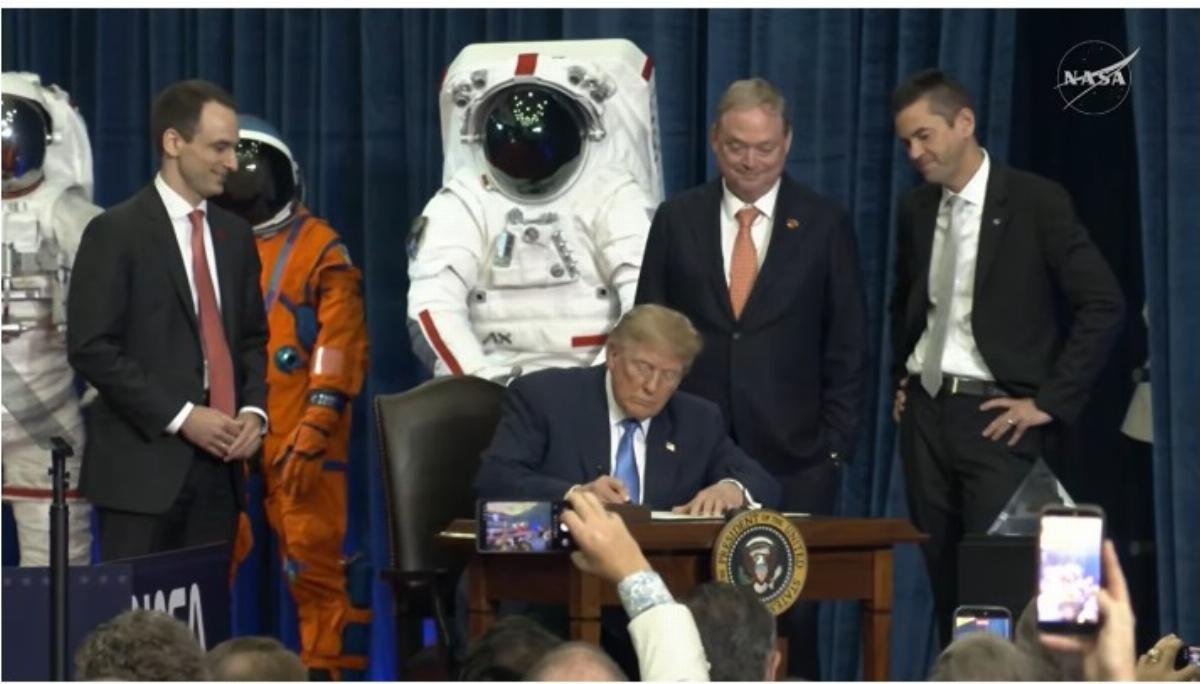
When President Trump announced the formation of the first-ever U.S. Space Academy, the moment may have slipped by quietly. But according to former aerospace CEO and author Matthew G. Andersson, writing in American Thinker, this is not just another military academy—it is the seed of an industrial revolution.
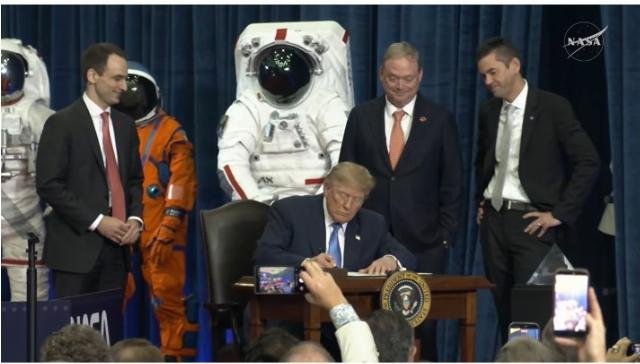
The executive order, signed by Trump and reported on August 29, 2026, establishes a space academy that, unlike traditional institutions like West Point, carries a public-private charter. That charter, Andersson argues, marks a profound shift in how the United States approaches space: instead of keeping space operations strictly within a military and defense framework, the order explicitly brings the civilian and commercial economy into planning, investment, training, and education for future space operations.
A Departure from the Past
Historically, the private sector played a critical but secondary role in U.S. space efforts. Private contractors, consultants, and technical advisors formed the “back-end” supply chain to NASA—deeply involved in missions, but not as formal partners in the way the new academy is chartered, Andersson notes. What the executive order does, he contends, is elevate the private sector to an explicit, front-end partner in the entire operational enterprise.
Andersson highlights the language of the order’s purpose and policy section, pointing out that the very first word is “space”—not “space force” or “space combat.” That word choice signals an intention to treat the entire domain of space as a strategic objective. The order uses words like “entrepreneur,” “innovation,” “workforce,” and “leader.” Andersson calls it subtly groundbreaking: “This is no ordinary government decree—it is a business plan.”
The order’s text states, in part, that “space is a critical domain for American national security, economic growth, scientific discovery, and technological innovation,” and that American superiority depends on “the strength, skill, and character of those who explore, secure, and build the industries critical to it.” It calls for preparing “the next generation of astronauts, scientists, engineers, operators, entrepreneurs, civil servants, and warfighters” and for recruiting “America’s best and brightest from across the Nation.”
Beyond a Moon Shot
Andersson draws a comparison to President John F. Kennedy’s famous moon speech, which was largely a response to the Soviet Sputnik program. But he argues that the space academy goes far beyond a limited project like the Apollo program. Where Kennedy’s vision was a targeted national commitment, the executive order represents a “national declaration of ‘total commitment'” of U.S. ingenuity, directed at an industrial-scale transformation.
He contrasts this with past presidential initiatives—Wilson’s New Freedom, Roosevelt’s New Deal, LBJ’s Great Society, Clinton’s NAFTA, Obama’s Obamacare and Green New Deal, and Biden’s Build Back Better. In Andersson’s view, those were government spending programs or offshoring efforts that did nothing to grow the economy; their effect was to grow the government. The space academy’s purpose-and-policy paragraph, by contrast, contains “the seeds of an industrial revolution, not just another grand social spending program.”
Public-Private Integration as a National Security Strategy
The academy’s public-private charter also carries implications for foreign policy and national security. Andersson warns that space operations can easily fall back into 20th-century Cold War habits, especially as China pursues its own space ambitions and Russia retains a long-standing competence in spaceflight technology. He argues that “no amount of irregular warfare or diplomatic hostility” against either country will be ultimately productive if the goal is a functional space economy.
The increasing presence of the commercial private sector, as articulated in the executive order, may help soften those Cold War instincts, Andersson suggests. It exposes the true scale of resources required for actual outer space colonization—and the unavoidable logic of great power cooperation. The risk, he notes, is that space becomes a strictly contested battle zone instead of a “new 3rd-dimensional stage of economic growth.” That risk can be managed, he argues, if the private commercial sector maintains equal weight in space operations.
Next Steps and Potential Follow-Ons
Much detailed work lies ahead, Andersson acknowledges. He suggests that a dedicated U.S. space law and policy authority may be a logical component of the new space academy—and a logical follow-on executive order, if critical space property, regulations, and rights are to be established and protected in private and international law.
As President Trump put it in launching the academy, “A nation cannot be first on Earth if we’re going to be second in space.”
Andersson is a former aerospace CEO, a jet command pilot, and a graduate of Embry-Riddle Aeronautical University. He has testified before the U.S. Senate on new aircraft in the National Airspace System and has been featured in the National Academies of Science on space flight policy. He is the author of The New Airline Code on public-private aerospace integration, used at Northwestern University, McGill University’s Institute of Air & Space Law, and DePaul University’s International Aviation Law Institute.
Whether the Space Academy will truly become a launching pad for an industrial revolution—or be remembered as another ambitious government program—remains to be seen. But the executive order’s explicit integration of the private sector into what was once a strictly military domain is, at minimum, a notable shift in how the United States is approaching its future in space.
Source: www.americanthinker.com — https://www.americanthinker.com/blog/2026/08/the-u-s-space-academy-is-an-industrial-revolution/