
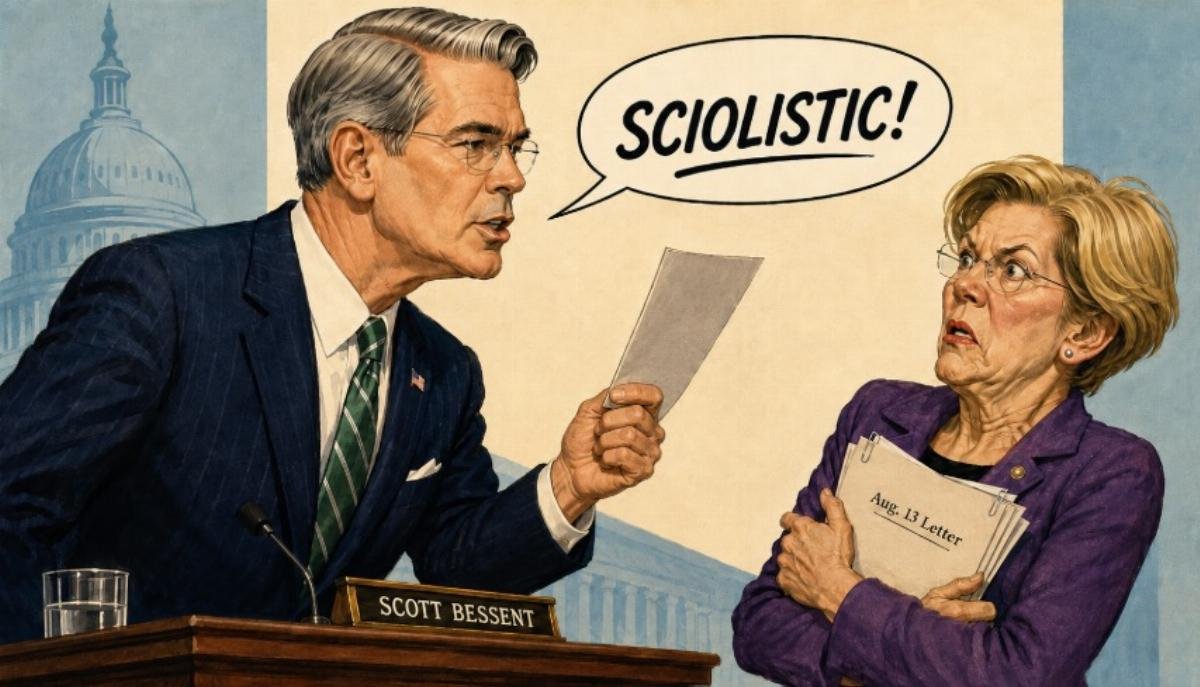
In the often staid world of Treasury Department correspondence, Secretary Scott Bessent’s recent letter to Senator Elizabeth Warren stands out—not for its diplomacy, but for its surgical dismantling of the senator’s financial credibility. The August 27 missive, responding to Warren’s August 13 critique of Treasury’s actions in the Japanese yen market, does not merely correct the senator; it eviscerates her claims to financial expertise, a reputation that has been central to her political identity.
For decades, Warren has positioned herself as a champion of consumers, a scourge of Wall Street, and a leading voice on banking and finance. Her purported expertise helped her secure a Harvard Law professorship, where she became the school’s highest-paid professor, and later propelled her to the U.S. Senate. But as Bessent’s letter makes clear, when it comes to the mechanics of international finance, Warren’s grasp may be far less firm than her public persona suggests.
Warren’s flawed yen critique
The conflict began on August 13, when Warren took issue with the Trump administration’s efforts to stabilize the Japanese yen, objecting that the move amounted to a taxpayer-funded bailout of a foreign currency. In her letter, she reportedly claimed that the money was a loan, that such interventions were nearly unprecedented, and that the administration was acting without the backing of Western banks.
Bessent’s response was blunt. He pointed out that Treasury had simply exchanged existing Exchange Stabilization Fund foreign-currency assets for yen—there was no new appropriation, no credit extended, and no loan for Japan to repay. “Japan owes Treasury nothing,” he wrote. “There is therefore no risk that Japan will fail to repay a debt that does not exist.” He also noted that similar actions have occurred under previous administrations, including Bill Clinton’s.

But Bessent’s critique went beyond the specifics of the yen transaction. He accused Warren of demonstrating “scriolistic” knowledge—a term he introduced to Americans, meaning displaying superficial or pretended understanding. (The correct spelling is “sciolistic,” as Bessent later used.) “Your opening paragraph is wrong about where the money came from, what the transaction was, and whether there was even a borrower,” he wrote.
A pattern of overstated claims
Bessent’s letter arrives amid a broader reassessment of Warren’s record on financial issues. Her career has been built on a series of high-profile claims, some of which have not held up to scrutiny. Perhaps most famously, she rose to national prominence on the strength of studies asserting that medical bills drove roughly 62% of U.S. bankruptcies. Subsequent, more careful analyses found the true numbers to be far lower—ranging from 4% to 17%, and at most 29%, depending on methodology.
Then there was the matter of her claimed Native American heritage, which she leveraged early in her academic career. A DNA test revealed that her connection was minimal at best—at most 1/1024 of her DNA tied to tribal peoples. As one commentator noted, her “Indian” identity turned out to be as fabricated as, some would argue, her financial expertise.
The CFPB’s costly legacy
Warren’s most significant policy achievement, the Consumer Financial Protection Bureau (CFPB), has also come under renewed criticism. The agency, which Warren conceived and championed, was designed to police mortgages, credit cards, and student loans. But according to the White House Council of Economic Advisors, between 2011 and 2024, the CFPB cost consumers between $237 billion and $369 billion in fiscal costs, higher borrowing costs, and reduced loan origination. The paperwork burden alone—29 million hours per year—requires an estimated $2.5 billion annually to cover extra workers.
Bessent’s letter, while focused on the yen transaction, implicitly underscores a broader point: Warren’s record on financial matters may be more about branding than expertise. Her response to Bessent, rather than engaging with his substantive points, was a series of taunts on social media, including a claim about a $20 billion bailout of Argentine hedge fund investors and a vague call for “actual answers to our questions.”
Bessent was not impressed. “I am not holding my breath,” he wrote, suggesting that Warren’s next letter might demonstrate she has learned “the difference between a currency purchase and a swap or a loan.”
A history of doubletalk
For some, Bessent’s letter is a long overdue public comeuppance. Andrea Widburg, a former student of Warren’s at the University of Texas School of Law, recalled her professor as someone who spoke in “oracular pronouncements” that were difficult to translate into logical English, a style she described as “intellectual-sounding doubletalk” that masked a lack of substance.
Widburg, writing for American Thinker, noted that Warren’s real talent lay not in financial analysis but in self-promotion—selling herself as a financial genius to advance her political career. Bessent’s letter, she said, has now “laid bare” Warren’s “foolish leftist banality.”
Whether that assessment is fair or overly harsh is a matter of opinion. But what is undeniable is that a sitting Treasury secretary felt compelled to publicly and harshly correct a senior senator’s basic misunderstandings of international finance—and that correction has resonated across the political spectrum.
Source: www.americanthinker.com — https://www.americanthinker.com/blog/2026/08/scott-bessent-shows-fauxcahontas-warren-s-financial-acumen-is-as-fake-as-her-indian-heritage/