
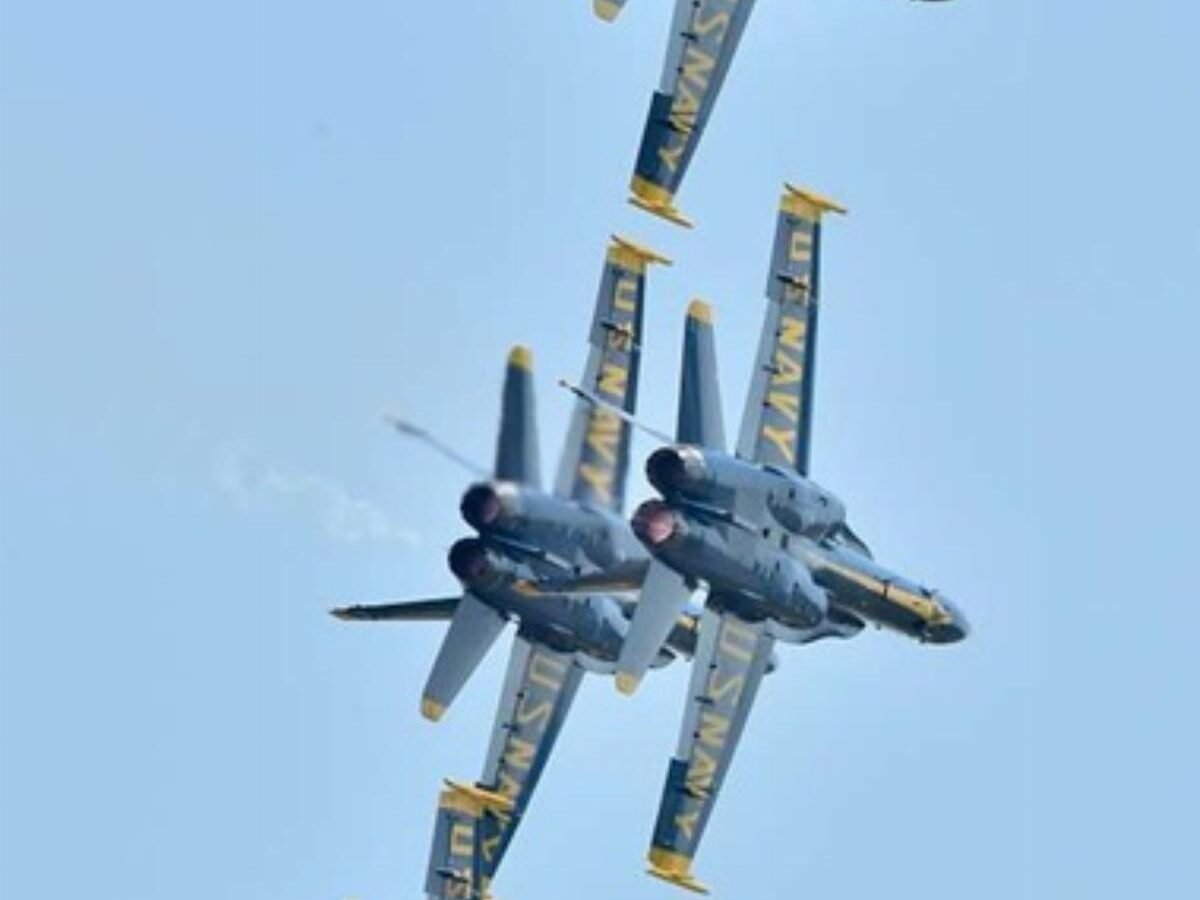
The Navy’s decision to end a 43-year relationship with The Sewing Box, the longtime maker of Blue Angels Distinctive uniforms, has sparked criticism. But a closer look at federal contracting rules and the new agreement suggests the move may be more about modernization than mistreatment, according to a new analysis.
Announced on May 14, 2026, the new contract went to Aquila International LLC. Critics have pointed to the price tag — $1,691,506.40 over five years — versus the nearly $700,000 paid to The Sewing Box since 2008, suggesting the Navy is overpaying. The Sewing Box is Black-owned, adding to the outcry.
But Julius Sanks, a retired federal program manager with decades of experience in competitive proposals, argues those comparisons are misleading. In an analysis published by American Thinker, Sanks writes that the Navy didn’t act suddenly, and the new deal isn’t the budget-buster it appears to be.
Apples and oranges in contracting
Sanks explains that the dollars cited by critics are apples and oranges. The Sewing Box, doing business as Jellie B The Sewing Box LLC, worked on 14 purchase orders between 2014 and 2026, according to USAspending. Purchase orders are used for simple acquisitions, usually for off-the-shelf items, while contracts are for more complex work.
Many of The Sewing Box’s orders had very short periods of performance — some just one day — and involved delivering already-in-stock ceremonial flight suits. Starting in 2017, orders had a one-year period of performance for fitting and delivery.
The new Aquila contract is fundamentally different. It’s a five-year indefinite delivery/indefinite quantity (IDIQ) agreement, valued at up to $1,691,506.40, for as many as 1,700 uniforms — roughly 340 per year. That works out to $995 per uniform, just $12.44 more than The Sewing Box’s final quote, Sanks noted.
More importantly, the Aquila work comes with stricter requirements. The solicitation includes two tables specifying spectral reflectance for wavelengths between 600 and 860 nanometers, and demands custom-fitting for each team member. The contractor also must travel to Naval Air Station El Centro, California.
Under the firm fixed-price (FFP) structure, the contractor bears all financial risk, Sanks notes. The Navy is not obligated to buy all 1,700 uniforms.
“Considering the expanded scope, this looks like a pretty good deal,” Sanks wrote. “The journalists’ claims that this is a higher cost for the same work are unfounded.”
A shift to competition
Perhaps the biggest change is that the Navy moved from sole-source awards to a full and open competition. The Sewing Box had received sole-source justifications in the past, which claimed the firm owned the suit design. Sanks doubts that claim, noting that when the government pays for a product, it generally owns the result.
In January 2026, the Navy announced an industry day for February 13, 2026, releasing a draft solicitation and inviting comments. Bidders had to demonstrate their qualifications. The Navy also confirmed during the Q&A period that this was “a new and distinct requirement,” distinct from previous, smaller-scale work.
That language matters, Sanks says. It signals the Navy wanted a higher-quality uniform and opened the door to new vendors.
Why the change?
Sanks speculates on reasons for the shift: perhaps the sole-source justification was denied, or the Navy simply decided to open the job to others based on new needs. The federal acquisition system is designed to encourage competition, he notes, and sole-source awards limit that.
In a full and open competition, any company can submit a proposal. Evaluators score each proposal against set criteria, without comparing them side by side, and the sequence is randomly determined. The winner is chosen based on combined scores.
Sanks acknowledges the process is tough on everyone. “The feds spend months building the solicitation. Good proposals are hard to write. Contractors often spend a year or more on their own nickel preparing for the big ones,” he writes.
He also notes that contractors sometimes protest awards, and pricing is subject to Defense Contracting Audit Agency review, keeping the system accountable.
What about The Sewing Box?
Did The Sewing Box submit a proposal? From the owner’s interview, it seems they did not, Sanks said. Her disappointment is understandable, but in a competitive environment, the government must avoid any appearance of favoritism — and incumbents aren’t guaranteed the next job.
Sanks uses a term for complacent incumbents: “incumbentitis.” After years of sole-source work, he says, it’s not surprising the owner missed the new solicitation. But he sympathizes.
“Nowhere is it written that an incumbent is guaranteed the next job,” he wrote.
Sanks concludes with well wishes to all three parties involved:
“Good luck to The Sewing Box, Aquila, and the Blue Angels.”
Source: www.americanthinker.com — https://www.americanthinker.com/articles/2026/09/did-the-blue-angels-get-a-good-deal/