
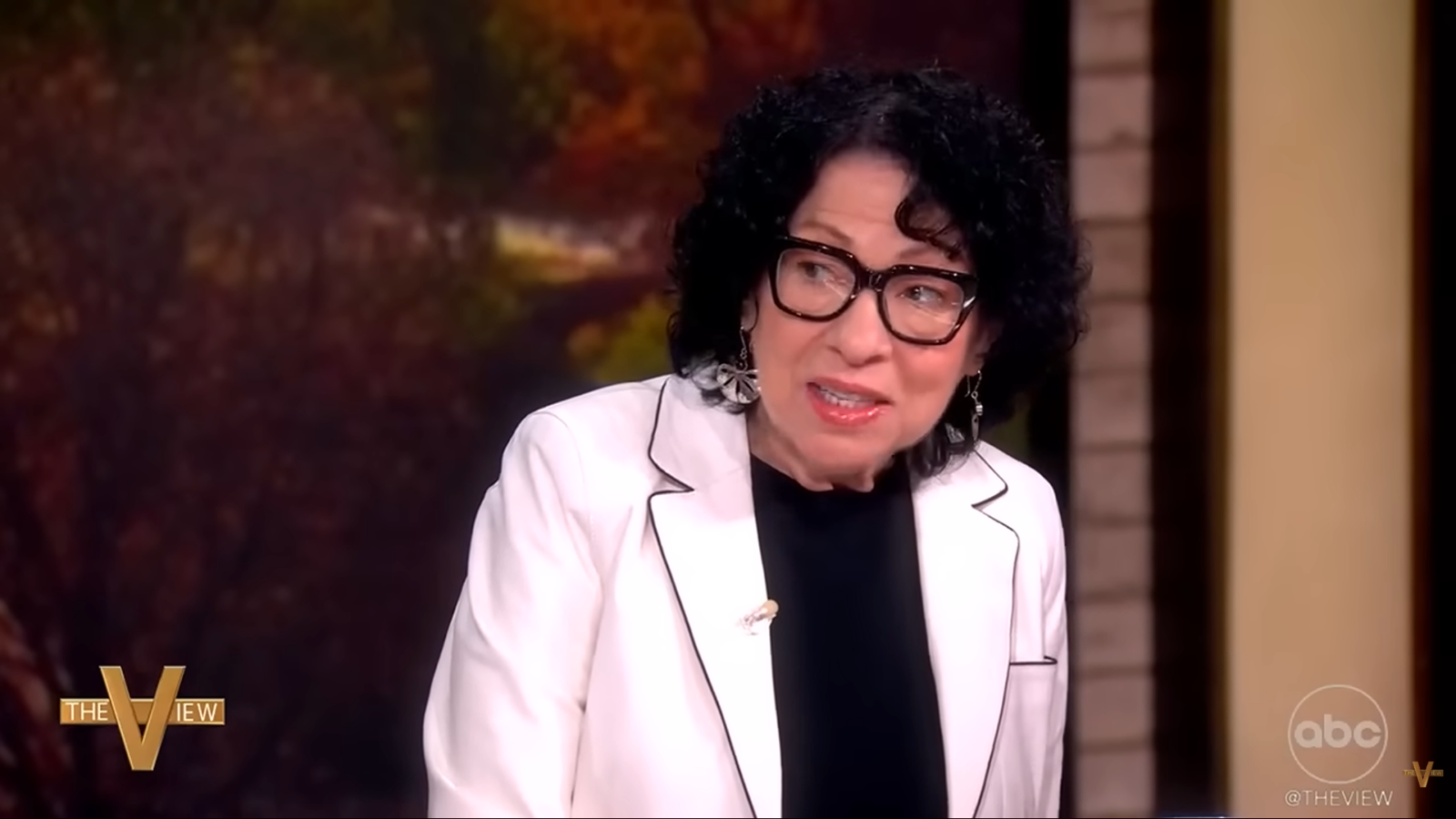
Supreme Court Justice Sonia Sotomayor publicly accused several of her conservative colleagues of deciding cases based on the outcomes they prefer rather than the law as written, according to an account of her appearance Wednesday at a University of Oklahoma-Tulsa event.
Speaking with moderators about the three tiers of the federal judiciary, Sotomayor described the role of a district judge as one focused on doing justice for the parties in front of them. At the circuit level, she said, the task shifts to ensuring there was no error of law. When she turned to the Supreme Court, however, she reportedly suggested that many of the justices she serves with are no longer anchored to what the law says.
“When you’re on the Supreme Court, you’re thinking about what the law should be,” Sotomayor said, per local media accounts cited by The Federalist. “If you’re reading our opinions, many of my colleagues are not worried about what the law was. What they’re thinking about is what the law should be.”
The comment echoed a years-old tension on the bench: whether justices are bound by original meaning and text or whether they may interpret the Constitution in light of contemporary values. Sotomayor, appointed by President Barack Obama in 2009, has long been associated with a more pragmatic approach to judging, while the court’s conservative majority has increasingly emphasized originalism and textualism.
A Claim That Colleagues Lack Basic Civics Knowledge
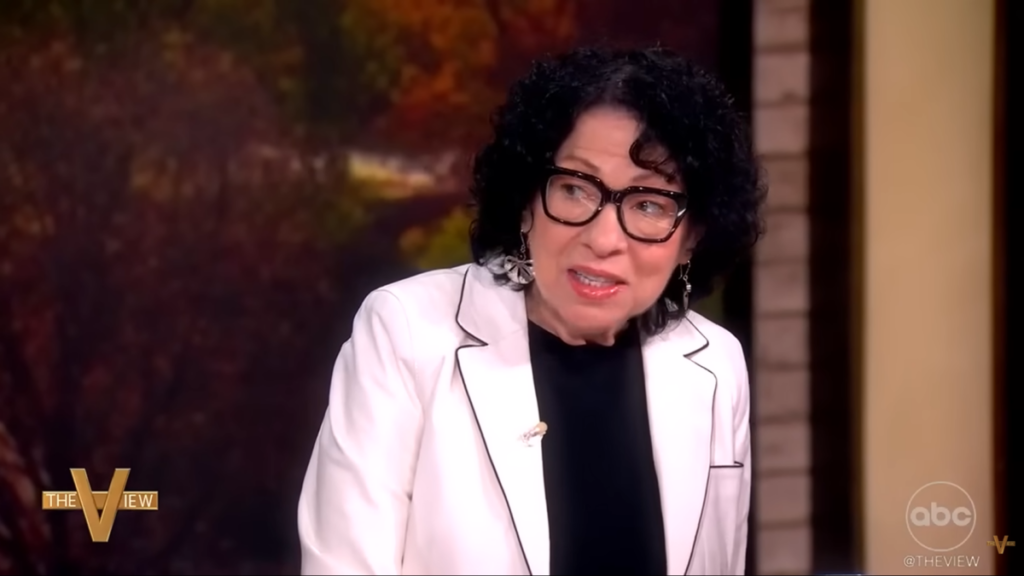
Sotomayor also reportedly said that some of her fellow justices do not grasp how the American system of government operates, a remark she tied to a broader worry about declining civic education. According to the account, she warned that many citizens do not understand the First Amendment or the assumptions underlying the constitutional structure — and then extended that critique to the bench itself.
“My greatest fear is that people don’t understand our system of government. They don’t understand what the First Amendment means. They don’t understand what our system of government presumes,” she said. “Some of my colleagues don’t either by the way, and I’m not joking about that.”
Sotomayor pointed to the unitary executive theory as an example of what she views as a misreading of the Constitution. That theory holds that the president possesses inherent authority under Article II to control the executive branch. She reportedly argued that the framers instead created a system of checks and balances, and that the unitary executive theory upends that design.
“That’s not what was created,” she said, according to the account. “We created a government with checks and balances, and the unitary executive theory is overturning that balance.”

The dispute over presidential removal power was front and center in the Supreme Court’s Trump v. Slaughter decision this year, in which the court upheld 6-3 President Trump’s firing of Rebecca Slaughter from the Federal Trade Commission. The ruling overturned longstanding precedent that had allowed Congress to impose certain limits on a president’s ability to remove members of so-called independent agencies. Sotomayor dissented.
Sotomayor’s Own Record Draws Scrutiny
The Federalist argued that Sotomayor’s critique of her colleagues is difficult to square with her own jurisprudence. The outlet pointed to her support for the 2015 Obergefell v. Hodges decision, which recognized a constitutional right to same-sex marriage, and her dissent in the 2022 Dobbs v. Jackson Women’s Health Organization ruling that overturned Roe v. Wade. In both cases, The Federalist contended, Sotomayor favored outcomes aligned with her ideological preferences rather than a narrow reading of the Constitution’s text or history.
Whatever the merits of that characterization, the interview marks the latest instance in which Sotomayor has used a public appearance to criticize the court’s conservative wing — a practice that has drawn return fire from supporters of the conservative justices and, on at least one occasion, prompted the justice herself to apologize.
Earlier this year, Sotomayor took aim at Justice Brett Kavanaugh over an interim docket opinion he wrote that cleared the way for the government’s immigration enforcement policies. While criticizing his writing, she said, “This is from a man whose parents were professionals. And probably doesn’t really know any person who works by the hour.” She later issued a statement apologizing to Kavanaugh for what she called “hurtful” and “inappropriate” comments.
A Broader Pattern on the Left
Sotomayor is not the only liberal justice to publicly clash with the court’s conservative majority. Justice Ketanji Brown Jackson, appointed by President Joe Biden in 2022, has drawn attention for sharp language both on and off the bench.
At an event last year, Jackson described the Supreme Court’s recent rulings as an “existential threat to the rule of law.” She also criticized her colleagues’ handling of interim docket cases during a speech at Yale Law School earlier this year.
Her written opinions have taken a similar tone. In an interim docket case involving the Trump administration last year, she accused the conservative justices of abandoning proper jurisprudence to favor the government. She wrote that the approach amounted to “Calvinball jurisprudence with a twist,” adding that “Calvinball has only one rule: There are no fixed rules. We seem to have two: that one, and this Administration always wins.”
More recently, Jackson accused her colleagues of playing politics in a case involving race-based redistricting. That prompted a rebuke from Justice Samuel Alito, who said her “rhetoric … lacks restraint.”
The back-and-forth underscores a court that is frequently divided not just on outcomes but on how justices describe one another’s motives. Sotomayor’s Wednesday remarks, as reported, will likely add to that debate.
Source: thefederalist.com — https://thefederalist.com/2026/09/18/in-public-attacks-on-scotus-sotomayor-sinks-to-a-new-low/