
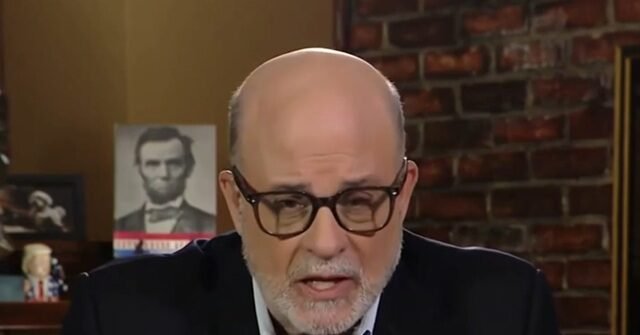
Fox News host Mark Levin used his weekend program to push back hard against mounting public anxiety over artificial intelligence and the data centers powering it, telling viewers that the concerns have been inflated by politicians, activists, and a compliant media.
During Saturday’s broadcast of “Life, Liberty & Levin,” the host opened with a direct appeal to his audience: “Relax, America! Relax. It’s going to be fine.” Breitbart reported on the remarks.
Levin ran through a list of specific claims he said were unfounded. Artificial intelligence is not contaminating water supplies, he said, and it is not responsible for rising energy costs. “No, Democrats drive up energy costs,” he said. He also predicted the technology would produce a net gain of millions of jobs across blue-collar and white-collar sectors alike, and noted that noise abatement measures are already part of data center operations.
Beyond the specific rebuttals, Levin argued that existing legal frameworks are sufficient to handle any real problems. Zoning and tax questions remain in the hands of local and state governments, he said, while antitrust, criminal, and civil laws apply to AI just as they do to any other industry.
A Book He Wrote, and a Pattern He Sees
Levin tied the current debate to arguments he made decades ago in his book “Liberty and Tyranny,” which he said described the same dynamic in the context of environmental policy. His thesis: with help from a sympathetic press, the “statist” uses junk science and fearmongering to manufacture public health and environmental scares, because a frightened public will accept aggressive government action it would otherwise reject.
“The more dire the threat, the more liberty people are usually willing to surrender,” Levin said. “You remember COVID?”
He laid out what he described as a recurring sequence: an event or a new study identifies a frightening risk, cherry-picked experts issue urgent predictions, media outlets amplify them without independent scrutiny, public officials compete to show they are responding, and new laws or regulations follow. He listed alar, artificial sweeteners, bird flu, swine flu, dioxins, E. coli, listeria, Ebola, MTBE, and formaldehyde as examples of what he characterized as phony scares.
The DDT Story, Retold
The bulk of Levin’s segment was devoted to DDT, which he called “probably the greatest healthcare farce ever.”
He recounted the history of the pesticide’s use against insect-borne disease, citing figures from San Jose State University professor Jay Gordon Edwards, a longtime opponent of banning DDT, writing in 2004. According to Levin’s retelling, DDT’s role in combating malaria was unprecedented: by 1959, the United States, Europe, parts of the Soviet Union, Chile, and several Caribbean islands were nearly malaria-free.
Levin also cited journalist Malcolm Gladwell’s account of eradication campaigns in Italy, Taiwan, the Caribbean, the Balkans, parts of North Africa, the South Pacific, Australia, and India. In India, he said, malaria had infected an estimated 75 million people and killed 800,000 annually before fatalities dropped to zero by the early 1960s.
He pointed to a 1970 National Academy of Sciences statement that DDT had prevented 500 million human deaths from malaria in a little more than two decades.
Then came Rachel Carson’s 1962 book “Silent Spring,” which Levin said spread hysteria about the chemical’s effects on wildlife and children. He quoted Carson’s claim that 12 percent of deaths among children aged one to 14 were caused by cancer, and argued the statistic was meaningless without context, since childhood cancer deaths were rising as a share of the total because infectious disease deaths were falling so sharply.
Levin noted that Carson never mentioned in the book that DDT had saved tens of millions of lives — a fact he said was widely known by 1962. He described President John Kennedy forming an advisory committee, Congress holding hearings, and the Environmental Defense Fund and the Sierra Club bringing litigation to pressure the government. The EPA, established in 1970, banned DDT in 1972, and global use fell sharply after the United States and the World Health Organization withdrew financial support.
The World Health Organization reversed course in 2006 and backed DDT for malaria control, Levin noted. By then, he said, tens of millions of children in the developing world had died as a result of the ban. He also cited Gladwell’s account of test subjects during World War II lathering themselves with DDT in the Pacific theater, where his own grandfather and great uncle served.
Where the Segment Was Headed
Levin was building toward a broader argument he said he would develop further with reference to the MacIver Institute, a conservative Wisconsin think tank, before the clip ended. The through-line was consistent: he contends that the same machinery that once turned DDT into a global villain is now being aimed at AI and the data centers that support it.
“Artificial intelligence and data centers — they’re not going to kill you. They’re not going to destroy you,” he said.
The segment lands amid a widening national argument over data center construction, electricity demand, water consumption, and the pace of AI deployment — a debate that has increasingly split along partisan lines as state and local governments weigh zoning, tax incentives, and utility planning. Levin’s framing casts the opposition as an elite-driven panic rather than a set of concrete policy disputes.
Whether that framing gains traction is an open question. What Levin made clear is that he intends to keep making the case, using the history of past scares as his template.
Source: www.breitbart.com — https://www.breitbart.com/clips/2026/09/20/theyre-trying-to-scare-you-mark-levin-dismisses-ai-data-center-scare/