
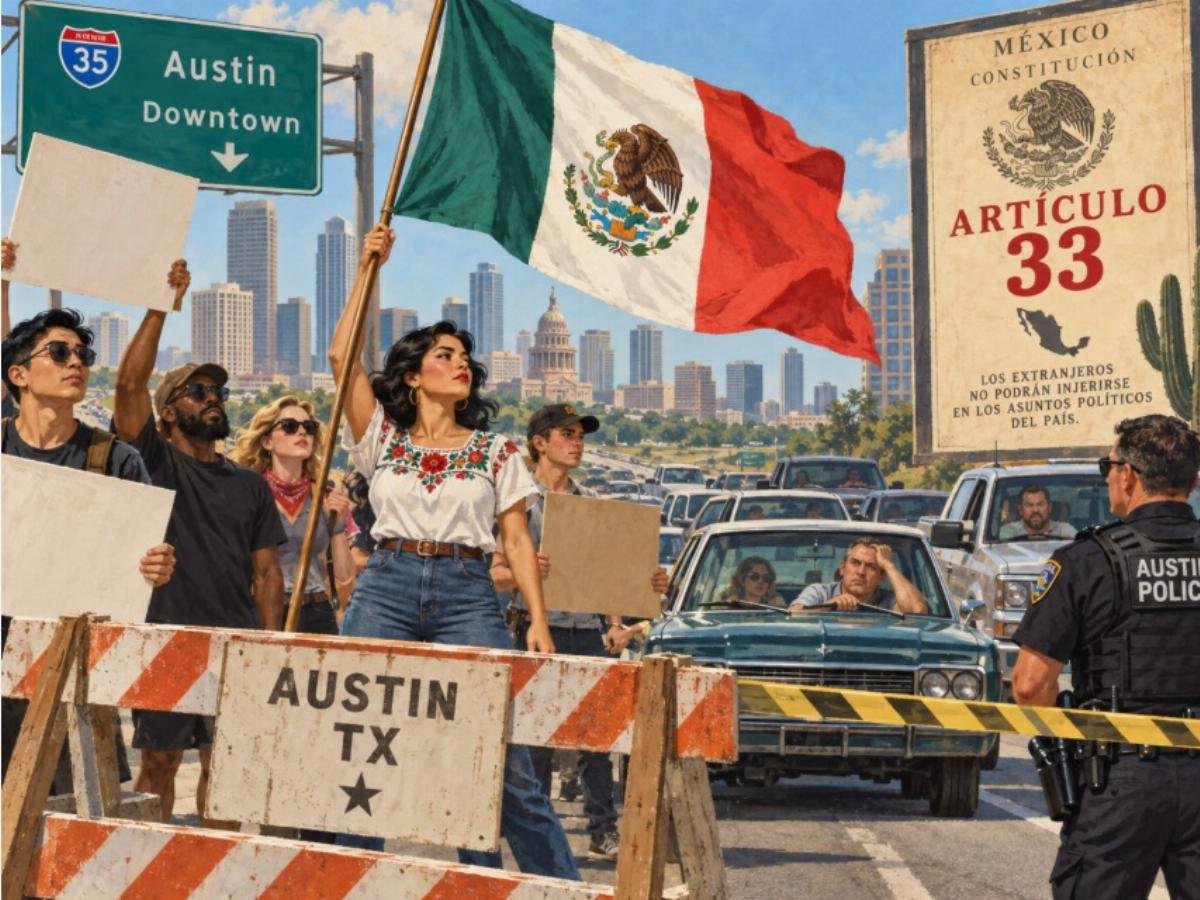
Austin, Texas, was brought to a standstill this week by anti-ICE demonstrators, and among the images that traveled fastest was a now-familiar one: protesters waving Mexico’s flag on American streets. For Silvio Canto, Jr., writing in American Thinker, that flag is more than a symbol — it’s an irony with a paper trail going back to Mexico’s own constitution.
Canto opens his column with a personal aside. Some years ago he lived and worked in Mexico for a U.S. company, an experience he describes warmly. He remembers a running joke among the foreign community there: whenever an expatriate made a critical remark about Mexican politics, Mexican colleagues would laugh and warn, half-seriously, that the government might apply “el 33” to them. Everyone would laugh it off. But the joke had a legal anchor.
What Article 33 Actually Says
That anchor is Article 33 of the Mexican Constitution, a provision Canto takes care to lay out. In English, he writes, the text reads: “The president of the republic will have the power to expel from national territory any foreigner, according to the law and after a hearing. Foreigners may not in any way participate in the political affairs of the country.”
Canto characterizes Article 33 as a relic of “hyper-nationalism” in Mexican history — a clause most Mexicans, he says, have no idea exists. It grew, he argues, out of a historical fear that foreigners might take over the country, a fear he traces to the U.S.-Mexican War of the 1840s and the French intervention of the 1860s, pointing readers toward the 1862 Battle of Puebla as background. (The battle, in which Mexican forces defeated French troops, later became the occasion for Cinco de Mayo.)
Whatever its origins, the rule itself is blunt: foreigners in Mexico are prohibited from participating in the country’s political affairs in any way. Canto’s second sentence makes the implication explicit — Mexico, he notes, would not tolerate outsiders marching in its streets under a foreign banner to weigh in on its domestic politics.
From Mexico City to Austin
Canto’s point is the contrast he says he sees every time foreign flags appear at U.S. protests — most recently in what he describes as this week’s anti-ICE demonstrations in Austin. He cites an X post and video from Nick Sortor to illustrate the scene, describing rioters waving foreign flags while blocking major roadways following an ICE-involved shooting. Sortor’s post claims demonstrators stole police tape and barricades to shut down roads, trapping several hundred motorists on a ramp, and calls for Texas state troopers to intervene because, in his words, the Austin Police Department “sure as hell won’t.”
Canto doesn’t relitigate the details of the shooting itself. Instead, he trains his argument on tactics. Protesting under a foreign flag, he writes, echoing Ronald Reagan’s famous debate line, is a recurring act that backfires — one that is unlikely to persuade anyone who might still be persuadable that the demonstrators’ cause is just. His alternative advice is pointed: the protesters would have been better off staying quiet and waiting for the facts of the shooting to emerge before taking to the streets.
That restraint, he suggests, isn’t what this crowd wants. Canto accuses participants of seeking what he calls their “free lunch” for showing up, along with the fleeting attention of newspeople he says are eager to cast ICE in a bad light.
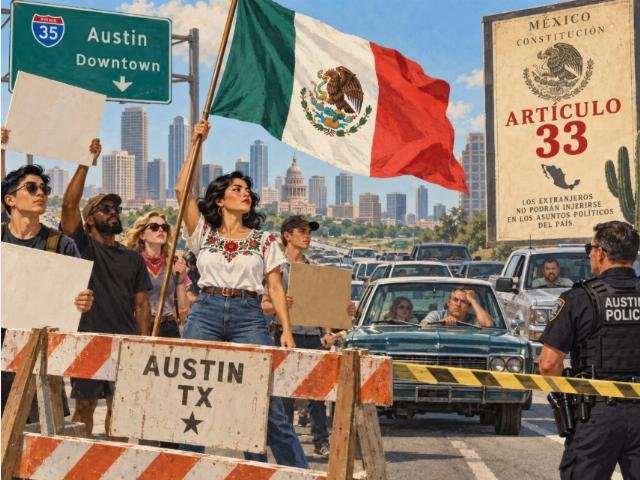
His closing prescription is deliberately cheeky: send them home and have them read Article 33 of their own constitution — a document, he notes elsewhere in the piece, that he first encountered as a joke told over office banter in Mexico, and that he now thinks of whenever he watches foreign flags ripple across an American protest.
An Argument About Symmetry, Not Just Symbolism
Strip away the sarcasm and Canto’s column makes a narrower case than a broad indictment of immigration politics. His core claim is one of asymmetry: that Mexico’s constitution explicitly bars foreigners from political participation, and that foreigners in Mexico would face legal consequences for doing what protesters in Austin did this week. He does not argue that U.S. law should mirror Article 33 — he makes no such legislative proposal — but rather that the demonstrators’ choice of banner is self-defeating, handing critics an easy image and doing nothing to advance the cause they claim to support.
It’s a rhetorical move common to commentary from both sides of the immigration debate: seize on a single visual from a chaotic scene and treat it as the scene’s meaning. Readers inclined to agree with Canto will find in Article 33 a tidy illustration of what they see as a double standard. Readers inclined to disagree may object that a rowdy protest is not a diplomatic delegation, that Mexican citizens marching under their home flag are not “foreigners participating in Mexican politics,” and that Article 33’s own history — a tool for expelling outsiders — is precisely the sort of provision a U.S. audience might not rush to emulate. Canto anticipates little of that pushback, and his piece doesn’t attempt to.
What the column does supply is context most American readers likely lack: a concrete citation to a constitutional clause almost nobody in the United States has heard of, deployed to make a point about how a protest looks to the other side. Whether that point lands depends on whether one accepts Canto’s premise — that the flag, not the shutdown, is what persuadable observers will remember. His bet, clearly, is that it is. Article 33, in his telling, is less a policy model than a rhetorical mirror: Mexico has a rule against exactly this, so why don’t the people waving its flag see the contradiction?
For Canto, the answer seems to be that they never bothered to read it. His column’s final sentence is less an argument than a homework assignment.
Source: www.americanthinker.com — https://www.americanthinker.com/blog/2026/09/don-t-protest-with-a-foreign-flag-in-mexico/