
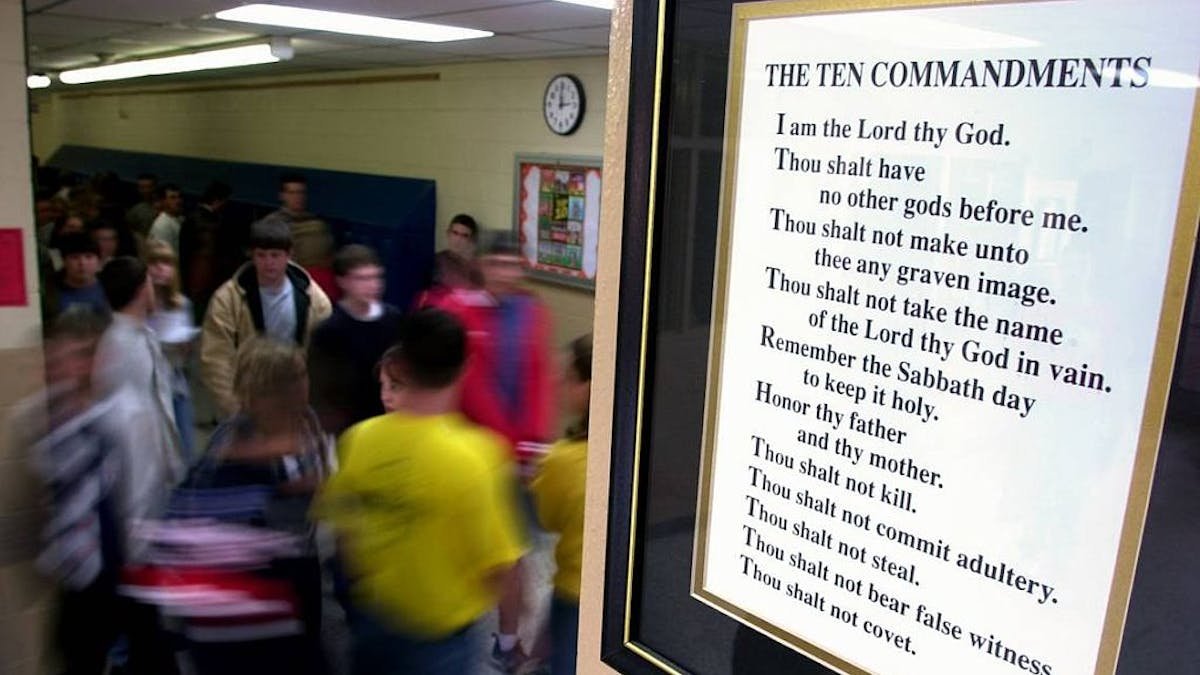
The ACLU’s decades-old legal strategy of invoking a “wall of separation between church and state” is facing its most significant challenge yet, following a federal appeals court decision that upheld a Texas law requiring the Ten Commandments in public school classrooms. The Fifth Circuit’s ruling in April has prompted the ACLU to file a brief this week asking the Supreme Court to overturn it, but legal analysts say the case could finally bury the controversial Lemon test once and for all.
The dispute centers on Louisiana’s 2023 law mandating the Ten Commandments be displayed in every public-school classroom, a measure that Texas and other states quickly copied. The ACLU and similar activist groups have sued, arguing such displays violate the Establishment Clause of the First Amendment. Lower courts have previously struck down similar displays as “plainly unconstitutional,” but the Fifth Circuit’s recent decision marks a departure.
Jefferson’s Wall: A Misunderstood Metaphor
Proponents of the displays argue that the “wall of separation” often cited by the ACLU is a misreading of history. Thomas Jefferson, who popularized the phrase in an 1802 letter, also allowed religious services in the U.S. Capitol and proposed a national seal depicting God parting the Red Sea. “Jefferson’s wall was never meant to keep God out of government. It was meant to keep government out of church governance,” according to the ruling’s supporters.
For most of American history, Ten Commandments displays on public property were uncontroversial. That changed in 1971 with the Supreme Court’s decision in Lemon v. Kurtzman, which created a three-part test to determine if a law violates the Establishment Clause. The test required that a law have a secular purpose, not advance or inhibit religion, and avoid excessive entanglement with religion. Over the years, courts used this test to remove nativity scenes, challenge “Under God” in the Pledge of Allegiance, and ban graduation prayers.

The Slow Death of Lemon
The Supreme Court has been chipping away at the Lemon test for two decades. In 1993, Justice Scalia famously called it a “ghoul in a late-night horror movie” that stalked the Court’s religious freedom jurisprudence. By 2005, Chief Justice Rehnquist said the test was “not useful” when the Court allowed a Ten Commandments monument to remain at the Texas Capitol. Justice Alito rejected it again in 2019 in a case involving a memorial cross on public land in Maryland.
The turning point came in 2022 when the Supreme Court sided with a Washington state football coach who was fired for kneeling in prayer on the field after games. The lower court had used the Lemon test to uphold the firing, but the Supreme Court reversed, effectively burying the test. “This Court has been tearing up bad religious liberty law, one case at a time,” the Fifth Circuit noted in its ruling.

Fifth Circuit’s Landmark Decision
In Nathan v. Alamo Heights Independent School District, Judge Stuart Kyle Duncan wrote that the Supreme Court “jettisoned Lemon some years ago” and that Texas’s classroom posters bear “none of the hallmarks of a founding-era establishment of religion.” The ruling is the first from a federal appeals court to explicitly embrace the post-Lemon framework, arguing that actual religious establishments — those that taxed citizens to fund an official church or punished dissenters — are fundamentally different from a poster on a wall.
The ACLU’s petition to the Supreme Court seeks to overturn this ruling. The Court now has two options: deny the petition, which would leave the Fifth Circuit’s opinion as binding law in Texas, Louisiana, and Mississippi, or accept the case and affirm the ruling, settling the matter for all 50 states and formally declaring Lemon dead everywhere.
Observers say the outcome could have broad implications, potentially affecting similar laws in other states and reshaping how courts evaluate religious displays in public settings. “No state has to hang the Ten Commandments in its classrooms. But it’s long past time for the Supreme Court to make one thing permanently clear: no state is forbidden from doing it either,” wrote Andrea Picciotti-Bayer, director of the Conscience Project, in a recent analysis.
The Supreme Court has not yet announced whether it will hear the case. If it does, a ruling could come as early as next term, potentially setting a final precedent on the constitutionality of such displays.
Source: www.dailywire.com — https://www.dailywire.com/news/tearing-down-the-myth-why-the-aclus-wall-of-separation-is-dead