
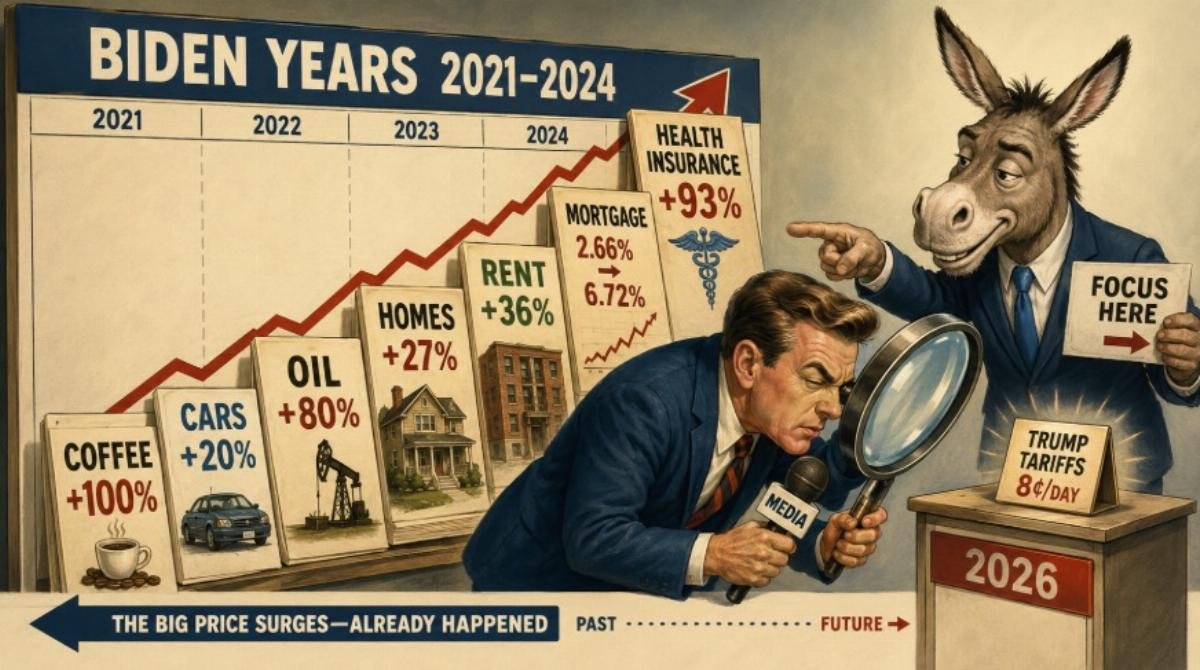
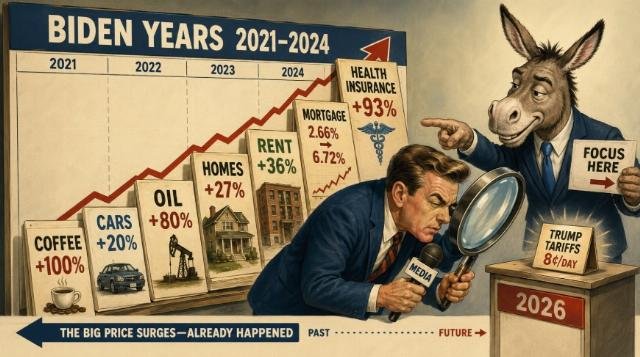
In the ongoing political battle over the economy, few phrases are as loaded as “affordability crisis.” Democrats and much of the media have used it to hammer the Trump administration, pointing to tariffs and rising costs as evidence that his policies are hurting American families. But a recent opinion piece at American Thinker turns that narrative on its head, arguing that the real affordability crisis occurred during the Biden years—and that the current administration is actually fixing it.
The piece, authored by Jack Hellner, challenges the media’s framing by digging into specific data points across housing, cars, energy, insurance, and even coffee. His central claim: while the media now highlights every price increase under Trump, it largely ignored the far more dramatic spikes that happened under Biden.
Breaking Down the Tariff Math
One of the most frequently cited examples of Trump’s economic policies is his 50% tariff on $20 billion worth of Canadian products. The media has warned that this will make American goods unaffordable. Hellner, however, runs the numbers for a typical consumer.
Assuming the entire $10 billion tariff is passed directly to consumers and spread evenly across the U.S. population of 343 million people, that works out to just $29.15 per year, or $2.43 per month. That’s roughly eight cents a day. “Maybe people could give up a half cup of Starbucks coffee each month to compensate,” he quips.
By contrast, he points to the wholesale price of Colombian coffee, which was $1.70 per pound when Trump left office in January 2021. By the time Biden left office, that price had doubled to $3.41—a 100.6% increase. It has since fallen to $3.25 as of June 2026, eighteen months into Trump’s term. “Still, the media didn’t talk about unaffordability during Biden’s years and endlessly blame Trump now,” Hellner writes.
Housing and Mortgage Costs
The housing market is another area where the cost burden shifted dramatically, according to the article. Hellner argues that Biden’s decision to immediately refuse to enforce border laws led to millions of undocumented immigrants entering the country, which he says put upward pressure on home and rent prices, especially at the lower end of the housing stock.
But the bigger driver, he claims, was inflation. Under Biden, inflation soared from 1.4% in 2020 to 8% in 2022, forcing the Federal Reserve to raise interest rates. The article provides a striking comparison: a $300,000 30-year mortgage at 2.66% carries a monthly payment of $1,210.47. At 6.72%, that same mortgage costs $1,939.82 per month—an increase of $729.35 per month, or $8,752.15 in extra interest payments each year.
“The media supported Democrats as they shut down the government at the end of 2025 because subsidies on Obamacare for high-income people would go away. They falsely said that the rates for the poor would also soar, but they are still near zero. They stopped reporting on the story when the truth was known,” Hellner writes, drawing a parallel between media coverage of healthcare and housing.
Auto Prices and Energy Costs
On cars, the article notes that when Trump won the election, people were warned to rush out and buy vehicles because tariffs would substantially raise prices. But the media, Hellner says, never gave similar warnings about the costs of Biden’s policies aimed at ending gas-powered cars, including mandates forcing manufacturers to produce expensive electric vehicles that many consumers didn’t want.
He also points to crude oil prices, which took off as soon as Biden won the election and were up by 80% within a year of his taking office. “Yet we didn’t see the media blame his policies for the inflation and unaffordability these high prices caused,” he writes.
The Healthcare Squeeze
Healthcare is another area where Hellner argues the media has misled the public. He cites Obamacare, which was sold on the promise that premiums would go down. Instead, he says, they have skyrocketed.
According to his data, in December 2009, average single premiums were $402 per month. By June 2026, they had risen to $777 per month—a 93% increase, compared with a cumulative inflation rate of 53%. Family premiums went from $1,115 to $2,249 per month—a 101% increase. “Obamacare destroyed competition and made big insurance companies a lot richer while making the public poorer,” Hellner asserts.
Stock Market Defies Predictions
Finally, the article addresses predictions that Trump’s tariffs would crash the stock market. The experts, most of the media, and other Democrats warned of a downturn following the April 2, 2025 tariff announcement. But according to Hellner, the opposite happened.
“The truth is that stock prices and corporate profits are way up, not down,” he writes. “People and public pension funds who didn’t listen to the experts and other Democrats have greatly improved their financial situation and affordability, especially for the future.” He credits capitalism for this outcome and suggests that “poor and middle-class children” should consider investing in what he calls “Trump accounts.”
A Partisan Divide Over the Numbers
Of course, critics will argue that Hellner’s analysis cherry-picks data and ignores the human impact of tariffs, which can disproportionately affect lower-income households even if the per-person cost seems small. The media’s focus on affordability, they would say, reflects genuine concerns about the cost of living, not a partisan conspiracy.
But Hellner’s broader point is starkly partisan: “In summary, Democrats and most of the media lie. They care about power, not affordability.”
Whether that conclusion holds up is a matter of perspective. What’s clear is that the debate over who owns the affordability crisis is just as intense as the crisis itself.
Source: www.americanthinker.com — https://www.americanthinker.com/blog/2026/08/putting-the-affordability-crisis-in-perspective/